The 3 Types of Dental Implants: A Patient’s Guide

Dental implants are classified into three anatomical types: endosteal, subperiosteal, and zygomatic. Each type is defined by where it anchors in or around the jaw, and that placement determines everything from surgical complexity to who qualifies. Knowing what are the 3 types of dental implants before your first consultation puts you in a far stronger position to ask the right questions. Implantveneerguide covers all three types in clinical detail, grounded in peer-reviewed evidence, so you can walk into a dentist’s office informed rather than overwhelmed by unfamiliar terminology.
What are the 3 types of dental implants?
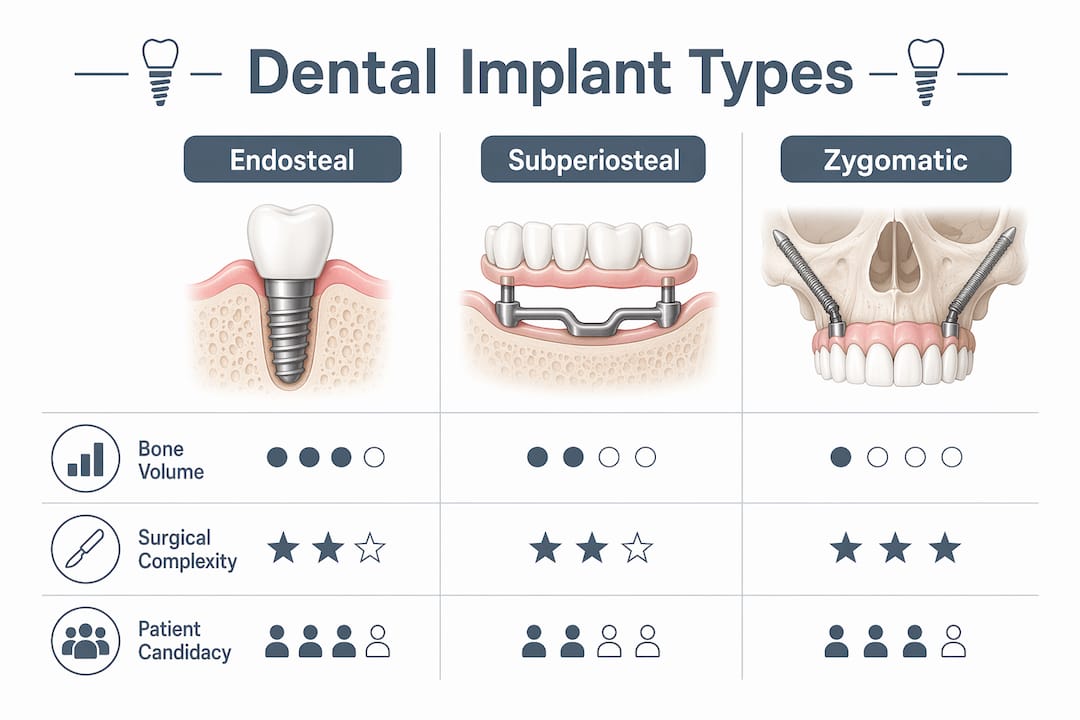
The three main types are endosteal, subperiosteal, and zygomatic implants. They differ by anatomical placement: endosteal implants go into the jawbone, subperiosteal implants sit on top of the bone beneath the gum, and zygomatic implants anchor into the cheekbone. That single distinction, where the implant is placed, drives every other clinical decision.
Placement determines the surgical approach, the healing timeline, and the patient profile that qualifies. A patient with strong, dense jawbone is a candidate for endosteal implants. A patient with minimal bone height may need subperiosteal. A patient with severe upper jaw bone loss may require zygomatic implants to avoid extensive bone grafting. No single type works for everyone, which is exactly why the classification matters.
Understanding these categories also helps you evaluate treatment plans more critically. When a clinician recommends a specific type, you will know what anatomical reasoning sits behind that recommendation.
What are endosteal implants and who are they best for?
Endosteal implants are the most common dental implant type. They are placed directly into the jawbone, typically as titanium or zirconia screws ranging from 3.0 to 6.0 mm in diameter, and they function as artificial tooth roots. Once placed, the bone grows around them through a process called osseointegration, which takes 3–6 months and creates direct bone-to-implant contact without any fibrous tissue in between.
That direct contact is what gives endosteal implants their strength. Standard implants restore close to 100% of natural chewing force, compared to roughly 90% for bridges and only 25–30% for dentures. The functional difference is significant for patients who want to eat without restriction.
Who qualifies for endosteal implants?
The ideal candidate has sufficient bone density and volume in the jaw to support the implant during and after osseointegration. Good overall health, non-smoking status, and controlled blood sugar levels also improve outcomes. Patients with bone health concerns such as osteoporosis require a more thorough candidacy evaluation before proceeding.
Key advantages of endosteal implants include:
- High long-term survival rate. Dental implants exceed a 95% survival rate at 10 years, outperforming bridges and dentures that typically need replacement every 5–10 years.
- Bone preservation. Implants mimic natural tooth roots and prevent bone resorption that accelerates with bridges and dentures.
- Natural function. Patients regain full biting and chewing capacity without removing the restoration.
- Aesthetic results. The crown sits at gum level, replicating the appearance of a natural tooth.
Pro Tip: If your bone volume is insufficient for standard endosteal implants, ask your clinician about bone grafting. A graft rebuilds the site over several months and can make you a viable candidate when you otherwise would not qualify.
What are subperiosteal implants and when are they used?
Subperiosteal implants rest on top of the jawbone, beneath the gum tissue, rather than inside the bone. A custom metal framework is fabricated to fit the patient’s specific bone contour, and posts protrude through the gum to support the prosthetic teeth. This design bypasses the need for adequate bone depth entirely.
The primary indication is limited bone height. Patients who cannot receive endosteal implants due to severe bone loss, and who either cannot or choose not to undergo bone grafting, are the core candidates. Subperiosteal implants were more widely used before bone grafting techniques became reliable and accessible. Today, they occupy a narrower clinical niche, but they remain a legitimate option for specific anatomical situations.
Honest pros and cons of subperiosteal implants:
- Pro: No bone grafting required, which reduces treatment time and surgical complexity.
- Pro: Suitable for patients with minimal remaining bone height in the lower or upper jaw.
- Con: Less long-term stability data compared to endosteal implants.
- Con: The framework sits on bone rather than integrating with it, which can affect load distribution over time.
- Con: Fabrication requires precise imaging and custom manufacturing, which adds cost and planning time.
Pro Tip: Before accepting a subperiosteal recommendation, ask your clinician whether a bone graft combined with endosteal implants is feasible. For many patients, the longer treatment timeline of a graft leads to a more durable long-term result.
What are zygomatic implants and who benefits from them?
Zygomatic implants are anchored into the zygomatic bone, commonly called the cheekbone, rather than the jawbone. They are significantly longer than standard implants, with body lengths ranging from 30 to 52.5 mm, and they are used exclusively for patients with severe upper jaw bone loss where traditional implants are not feasible.
The cheekbone is dense and stable even when the upper jaw has resorbed significantly. By anchoring there, zygomatic implants allow patients with extreme maxillary bone deficiency to receive a full upper arch restoration without undergoing major bone grafting procedures. That distinction matters clinically because large-volume grafts carry higher surgical risk and add months to the treatment timeline.
Who needs zygomatic implants?
Zygomatic implants are not a first-line option. They serve a specific patient profile:
- Patients with severe upper jaw resorption who do not have enough bone for standard endosteal implants.
- Patients who have been told they are “not candidates” for conventional implants due to bone loss.
- Patients seeking to avoid the extended timeline of bone grafting followed by standard implant placement.
The surgical procedure is more complex than standard implant placement and requires a clinician with specialized training in zygomatic techniques. Recovery involves more swelling and discomfort than a routine endosteal procedure. Potential risks include sinus complications, given the proximity of the zygomatic bone to the maxillary sinus. Patients considering this path should review zygomatic implant indications in detail before committing to a treatment plan.
How do implant materials and arch systems affect your choice?
Beyond the three anatomical types, two additional factors shape every implant treatment plan: material and arch system. Implants are classified by material as either titanium or zirconia, and by arch system as single tooth, bridge, or full arch.
Titanium is the clinical standard. It bonds reliably with bone, has decades of outcome data behind it, and works across all three implant types. Zirconia is metal-free and offers a white color that can be advantageous when gum tissue is thin and the implant body might show through. Both materials undergo osseointegration successfully, but titanium remains the more widely used option.
The arch system determines how many teeth the implant supports:
- Single tooth implant. One implant supports one crown. This is the most straightforward application and the most common.
- Implant-supported bridge. Two or more implants support a bridge spanning multiple missing teeth, without replacing every tooth root individually.
- Full-arch restoration. A complete upper or lower arch is supported by four to six implants. The All-on-4 protocol, for example, uses four strategically angled endosteal implants to support a full arch without bone grafting in many cases.
Mini implants are a fourth subcategory worth knowing. Mini implants under 3 mm in diameter are used primarily for denture stabilization in patients with narrow ridges. They are less invasive and lower cost, but they are not approved for single crown restoration due to diameter and strength constraints.
Pro Tip: Clinicians prioritize arch system and bone quality above implant brand or material when building a treatment plan. If your consultation focuses heavily on brand names rather than your bone anatomy, ask more questions.
The treatment timeline varies considerably depending on which combination of type, material, and arch system your clinician recommends. A single endosteal implant with no grafting takes roughly 3–6 months from placement to final crown. A full-arch zygomatic case can be completed faster in some protocols because bone grafting is avoided entirely.
Key Takeaways
The right dental implant type is determined by bone anatomy, not patient preference, making a thorough candidacy evaluation the single most important step before any implant treatment begins.
| Point | Details |
|---|---|
| Three anatomical types | Endosteal, subperiosteal, and zygomatic implants differ by placement location and bone requirements. |
| Endosteal is the standard | Most patients with adequate bone density qualify for endosteal implants, which restore close to 100% chewing force. |
| Subperiosteal fills a niche | Patients with insufficient bone height who cannot graft may qualify for subperiosteal implants placed on the bone surface. |
| Zygomatic for severe loss | Zygomatic implants anchor in the cheekbone and serve patients with extreme upper jaw resorption who cannot receive standard implants. |
| Materials and arch systems matter | Titanium vs. zirconia and single vs. full-arch decisions layer on top of placement type and affect cost, aesthetics, and timeline. |
What I’ve learned from watching patients choose the wrong implant type
I have reviewed hundreds of patient cases and treatment plans over the years, and the most common mistake I see is patients choosing an implant type based on cost or convenience rather than anatomy. A patient who pushes for endosteal implants because they heard they are “the best” but does not have the bone density to support them is setting up for failure. Implant failure is expensive, painful, and demoralizing.
The second mistake is the opposite: patients who accept a subperiosteal recommendation without asking whether bone grafting could open the door to a more stable endosteal option. Grafting adds time, but the long-term stability difference is real. A 10-year survival rate above 95% for endosteal implants is a compelling argument for taking the longer route when anatomy allows it.
What I find most underappreciated is the zygomatic option. Patients who have been told they are “not candidates” for implants often do not know zygomatic implants exist. For the right patient, they are not a compromise. They are the correct clinical answer. The candidacy evaluation process should always include a conversation about all three types, not just the most common one.
My honest advice: do not let initial cost drive the decision. Bridges and dentures cost less upfront but require replacement and do not preserve bone. The financial math over a decade almost always favors implants. Choose the type your bone anatomy supports, not the type your budget prefers.
— Georgina
Implantveneerguide resources for your implant decision
Choosing between endosteal, subperiosteal, and zygomatic implants is not a decision you should make based on a single article or a single consultation.
Implantveneerguide provides evidence-based tools built specifically for patients at this stage of research. The implant candidacy checker walks you through bone health indicators and health history factors to give you a clearer picture of which implant types you may qualify for. The procedures overview covers full-arch systems, grafting protocols, and single-tooth options in clinical detail. For patients concerned about healing, the recovery timeline guide breaks down what to expect at each phase. Every resource on Implantveneerguide is built without brand sponsorship or advertising, so the information reflects clinical evidence rather than marketing priorities.
FAQ
What are the 3 main types of dental implants?
The three types are endosteal, subperiosteal, and zygomatic implants. They are categorized by anatomical placement: into the jawbone, on the bone surface, or into the cheekbone.
Which dental implant type has the highest success rate?
Endosteal implants have the strongest long-term data, with a survival rate above 95% at 10 years. They are the standard choice for patients with adequate jawbone density.
Can you get dental implants with no bone?
Patients with severe upper jaw bone loss can receive zygomatic implants, which anchor into the cheekbone and bypass the need for a functional jawbone in the upper arch.
How long does osseointegration take?
Osseointegration typically takes 3–6 months, during which the bone grows directly around the implant surface to create a stable, load-bearing foundation.
Are mini implants the same as regular implants?
Mini implants are under 3 mm in diameter and are used primarily for denture stabilization in patients with narrow ridges. They are not approved for single crown restoration due to their smaller size and lower load capacity.