Who Is a Good Candidate for Dental Implants?

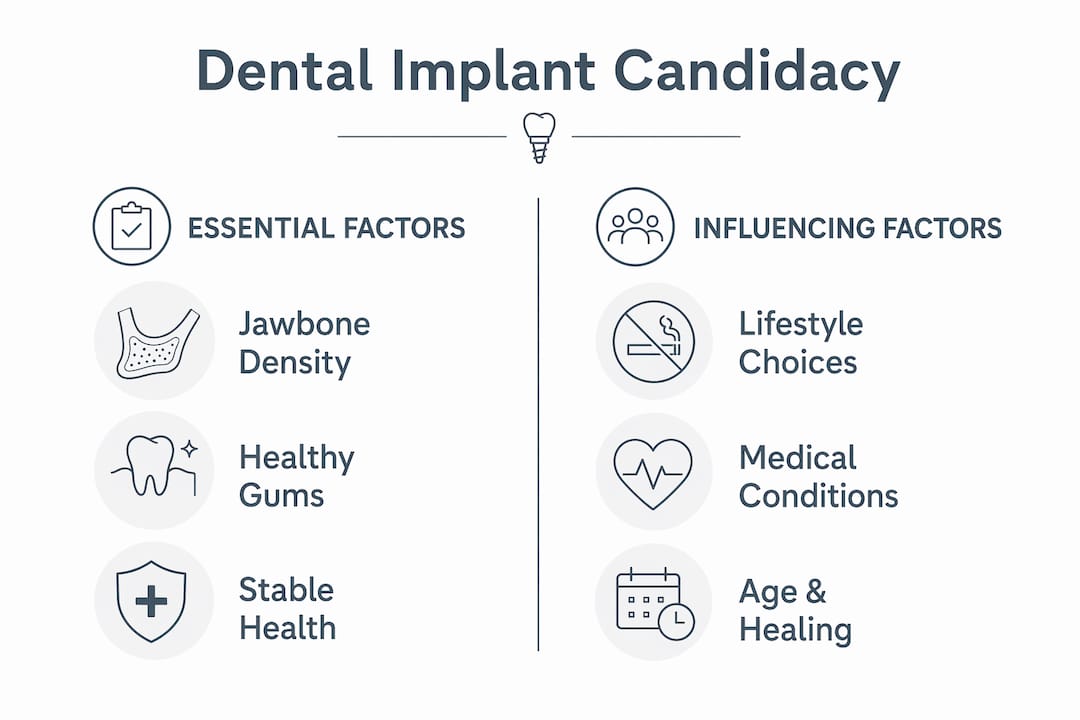
A good candidate for dental implants has sufficient jawbone density, healthy gums, stable overall health, and a commitment to daily oral hygiene. Dental implant candidacy, the clinical term for this assessment, depends on anatomical, medical, and behavioral factors working together. When all three align, implant survival rates exceed 95% over 10 years. That number reflects what is possible when patients are properly screened. This guide breaks down every factor that determines eligibility so you can walk into a consultation knowing exactly where you stand.
Who is a good candidate for dental implants?
The ideal candidate is a non-smoking adult with adequate bone volume, controlled systemic health, and healthy gum tissue. That description covers most adults who have lost one or more teeth, but the details matter. Each factor below can either confirm your eligibility or point to something you need to address first.
Core candidacy criteria at a glance:
- Jawbone volume: At least 10mm vertical height and 5mm horizontal width at the implant site
- Gum health: No active periodontal disease or infection
- Systemic health: Conditions like diabetes must be well controlled before surgery
- Smoking status: Non-smokers or patients willing to quit before and after the procedure
- Age: Skeletal maturity must be complete (typically 18 or older for females, 21 or older for males)
- Oral hygiene commitment: Daily brushing, flossing, and regular dental visits for the life of the implant
Candidacy is not a binary pass or fail. Many patients who do not meet every criterion initially can qualify after targeted treatment. The candidacy quiz on Implantveneerguide walks you through these criteria with evidence-based screening questions.
Pro Tip: Bring a list of all current medications to your consultation. Several drug classes, including high-dose bisphosphonates used for osteoporosis, can complicate implant placement and require special protocols.
What medical and systemic health factors affect candidacy?
Systemic health shapes how well your body heals after implant surgery. The titanium post must fuse with living bone through a process called osseointegration. Any condition that disrupts healing or immune response raises the risk of failure.
Diabetes and blood sugar control
Uncontrolled diabetes raises implant failure risk by approximately 40%. The threshold most clinicians use is an HbA1c level below 7%. Patients with well-managed diabetes who hit that target regularly are generally good candidates. The key is coordination: your dentist and primary care physician need to communicate before surgery is scheduled. Implantveneerguide’s guide on diabetes and implant outcomes explains the clinical reasoning in plain language.
Autoimmune diseases and immunosuppressants
Patients with autoimmune diseases or those taking immunosuppressant medications are not automatically disqualified. They do require closer evaluation and physician coordination. The concern is that suppressed immune function slows healing and increases infection risk at the implant site. A rheumatologist and an oral surgeon working together can often find a safe treatment window. Implantveneerguide’s resource on autoimmune conditions and implants covers the evidence on this in detail.
Bisphosphonate medications
High-dose intravenous bisphosphonate therapy significantly raises the risk of osteonecrosis of the jaw, a serious complication where bone tissue dies. This does not apply to low-dose oral bisphosphonates taken for osteoporosis in most cases, but the distinction matters. Tell your surgeon exactly which medication you take, the dose, and how long you have been on it. Special protocols exist for these patients, but they require advance planning.
Pro Tip: If you take any bone-modifying medication, ask your prescribing physician for a drug holiday assessment at least three months before your implant consultation. This gives your surgical team the information they need to plan safely.
Why jawbone density and oral health are critical for implant success
The implant post anchors into your jawbone. Without enough bone to hold it, the implant cannot integrate and will fail. This is the most common anatomical barrier to candidacy, and it is also one of the most treatable.
Minimum bone requirements
Standard implant placement requires at least 10mm of vertical bone height and 5mm of horizontal bone width at the implant site. These measurements come from CBCT (cone beam computed tomography) imaging, which gives your surgeon a three-dimensional view of your jaw. A standard dental X-ray does not provide enough detail for this assessment. If your bone falls short, that does not end the conversation.
| Bone condition | Typical solution | Expected outcome |
|---|---|---|
| Adequate volume | Direct implant placement | High success rate |
| Mild deficiency | Minor bone graft | Implant placed after healing |
| Significant deficiency | Major bone graft or sinus lift | Implant placed 4–6 months later |
| Severe deficiency | Staged grafting protocol | Candidacy reassessed after grafting |
Bone grafting and sinus lifts
Bone grafting and sinus lift procedures have become routine, reliable treatments. Approximately 85% of patients with initial bone deficiencies become viable implant candidates after these procedures. A sinus lift is used specifically in the upper back jaw, where the sinus cavity often sits too close to the bone surface. Both procedures add healing time, typically 4–6 months, but they open the door for patients who would otherwise be turned away.
Gum health and peri-implantitis risk
Poor gum health increases the risk of peri-implantitis, an infection around the implant that can destroy the surrounding bone and cause implant loss. Active periodontal disease must be treated and resolved before any implant is placed. Patients with a history of periodontitis are not disqualified, but they need more frequent monitoring after placement. Implantveneerguide’s guide on periodontitis and implants outlines the evidence-based monitoring protocols used in these cases.
Pro Tip: Ask your dentist for a full periodontal charting before your implant consultation. Knowing your pocket depths and bone levels in advance saves time and helps your surgeon plan accurately.
How lifestyle choices influence who qualifies for dental implants
Behavior is the one candidacy factor entirely within your control. Two patients with identical bone volume and health records can have very different outcomes based on what they do before and after surgery.

Smoking and implant failure
Smoking is the single most damaging lifestyle factor for implant success. Smokers face two to three times the implant failure rate of non-smokers. Nicotine restricts blood flow to the gums and bone, which directly impairs the healing process that osseointegration depends on. The risk applies to cigarettes, cigars, and smokeless tobacco. Vaping has not been studied as thoroughly, but the available evidence points to similar risks.
Steps smokers must take to improve candidacy:
- Quit smoking at least 2 weeks before implant surgery
- Remain smoke-free for at least 8 weeks after placement
- Commit to permanent cessation for the best long-term outcomes
- Discuss nicotine replacement options with your physician before surgery
Implantveneerguide’s guide on smoking and implant outcomes reviews the clinical evidence and cessation strategies that have the strongest track record.
Daily oral hygiene and follow-up care
Implants are not a set-and-forget solution. Daily brushing, interdental cleaning, and regular professional cleanings are non-negotiable for long-term success. Patients who skip routine dental visits are at significantly higher risk of peri-implantitis. The commitment required is no different from what you would give a natural tooth. If that level of maintenance feels unrealistic, that is worth discussing honestly with your surgeon before proceeding.
Age considerations: who qualifies for implants based on jaw development
Age alone does not disqualify anyone from receiving dental implants. What matters is biological maturity at the lower end and overall health at the upper end.
Why young patients must wait
Skeletal maturity is non-negotiable for safe implant placement. The jaw must stop growing before an implant is placed. If the jaw continues to develop after placement, the implant stays fixed while the surrounding bone shifts, creating misalignment and potential failure. Maturity thresholds differ by sex: females typically reach jaw maturity at 18, males at 21. These are general thresholds, not hard rules. A hand-wrist X-ray or cephalometric analysis can confirm skeletal maturity in borderline cases.
Seniors and implant candidacy
Biological age, not chronological age, determines candidacy for older adults. A healthy 75-year-old with well-managed systemic conditions and adequate bone volume is an excellent candidate. There is no upper age limit in clinical guidelines. The factors that matter are bone density, gum health, and the absence of uncontrolled systemic disease. Implantveneerguide’s guide on age and implants covers outcomes data from patients across the full age spectrum.
How can patients improve their candidacy for dental implants?
Candidacy is dynamic. Many patients who are not eligible today can become eligible through targeted treatment and lifestyle changes. The following steps represent the most common and effective pathways.
- Treat active gum disease first. Periodontal therapy must be completed and the tissue must be stable before any implant surgery is scheduled.
- Pursue bone grafting if volume is insufficient. Your surgeon can harvest bone from another site in your mouth or use processed donor material to rebuild the implant site.
- Optimize blood sugar control. Work with your physician to bring HbA1c below 7% before your surgical date.
- Quit smoking. Cessation before surgery is the single highest-impact behavioral change you can make for implant success.
- Coordinate your medical team. Share your full medication list and health history with both your dentist and your primary care physician so they can plan together.
- Schedule a thorough evaluation. CBCT imaging, periodontal charting, and a full medical history review give your surgeon the complete picture needed to assess your eligibility accurately.
The dental implant consultation checklist on Implantveneerguide helps you prepare for that first appointment so nothing gets missed.
Key takeaways
A good candidate for dental implants has adequate jawbone volume, healthy gums, controlled systemic health, and a firm commitment to oral hygiene and follow-up care.
| Point | Details |
|---|---|
| Bone volume is foundational | Implants require at least 10mm vertical and 5mm horizontal bone; grafting can fix deficiencies. |
| Systemic health must be controlled | Uncontrolled diabetes raises failure risk by ~40%; HbA1c below 7% is the standard threshold. |
| Smoking doubles to triples failure risk | Quitting before and after surgery is the most impactful behavioral change a patient can make. |
| Age thresholds are biological, not numerical | Females need jaw maturity at 18, males at 21; seniors with good health face no upper age limit. |
| Candidacy can be improved | Around 85% of patients with bone deficiencies qualify after grafting or sinus lift procedures. |
What I’ve learned about candidacy that most guides skip
Patients come to me convinced they are not candidates because a previous dentist mentioned bone loss years ago. That single conversation, often brief and undocumented, becomes a belief they carry for a decade. The reality is that bone grafting has changed the calculus entirely. What was a disqualifying finding in 2010 is now a treatable starting point in 2026.
The other thing I see consistently is patients underestimating the behavioral side of candidacy. They focus on the surgery and assume the hard part is over once the implant is placed. The truth is that the first year of maintenance determines whether a 10-year success rate is achievable. Patients who treat their implant like a natural tooth, cleaning around it daily and showing up for every follow-up, do dramatically better than those who do not.
My honest advice: do not self-disqualify based on incomplete information. Get a CBCT scan, get a full periodontal assessment, and have an honest conversation with a surgeon who will tell you what it actually takes to get you to candidacy. Most patients are closer than they think.
— Georgina
Ready to find out if you qualify?
Implantveneerguide has built its candidacy resources around one goal: giving you accurate, unbiased information before you sit in a surgeon’s chair. The evidence-based candidacy checker walks you through your bone health, systemic conditions, lifestyle factors, and age considerations in under five minutes.
If you want to go deeper, the procedures overview covers bone grafting, sinus lifts, and full-arch options with clinical detail that helps you understand what your surgeon is proposing. Every guide on Implantveneerguide is reviewed against peer-reviewed research so you get the same quality of information your dentist uses, without the sales pitch.
FAQ
Who is not a good candidate for dental implants?
Patients with uncontrolled diabetes, active periodontal disease, insufficient jawbone volume, or high-dose IV bisphosphonate use are typically not immediate candidates. Many can qualify after targeted treatment.
Can seniors get dental implants?
Yes. Biological age and overall health determine candidacy, not chronological age. Seniors with controlled systemic conditions and adequate bone volume are often excellent candidates with no upper age limit in clinical guidelines.
Does smoking disqualify you from getting implants?
Smoking does not automatically disqualify you, but it raises failure rates two to three times compared to non-smokers. Surgeons typically require cessation before and after surgery to proceed.
How long does it take to become a candidate after bone grafting?
Bone grafting requires a healing period of approximately 4–6 months before implant placement. Around 85% of patients with initial bone deficiencies qualify for implants after this process.
What is the minimum age for dental implants?
The minimum age is determined by skeletal maturity, not a fixed number. Females typically qualify at 18 and males at 21, though imaging can confirm readiness in borderline cases.