Alternatives to Dental Implants: Your 2026 Options Guide

Alternatives to dental implants are defined as prosthetic or restorative solutions that replace missing teeth without surgically placing a titanium root in the jawbone. The four primary options are fixed dental bridges, removable partial dentures, full dentures, and implant-supported dentures. Each carries a distinct cost range, treatment timeline, and clinical profile. Dental implants hold a documented 10-year survival rate above 95%, yet they are not suitable for every patient. Uncontrolled diabetes, heavy smoking, immune disorders, and insufficient bone volume all limit candidacy. Knowing your options means you can make a decision grounded in your actual clinical situation, not just what sounds best on paper.
1. What are the main alternatives to dental implants?
The four primary alternatives are fixed dental bridges ($2,500–$6,000), removable partial dentures ($1,500–$3,000), full dentures ($1,000–$4,000), and implant-supported dentures ($3,000–$30,000). Each option targets a different clinical scenario. A patient missing one tooth between two healthy teeth faces a completely different decision than someone missing an entire arch. The right choice depends on bone health, adjacent tooth condition, budget, and how quickly you need a result.
2. Fixed dental bridges
A fixed dental bridge is a prosthetic tooth, called a pontic, anchored to crowns placed on the two teeth on either side of the gap. The result is a permanent, non-removable restoration that looks and functions like a natural tooth. Treatment typically completes in 2–4 weeks, compared to the 3–6 months required for a standard implant. That speed advantage matters when you need a functional tooth quickly.
Pros of fixed bridges:
- Fixed in place, no removal required
- Lower upfront cost than implants ($2,500–$6,000)
- Faster treatment timeline (2–4 weeks)
- Natural feel and appearance
- Covered more often by dental insurance than implants
Cons of fixed bridges:
- Adjacent healthy teeth must be reshaped and crowned
- No bone preservation at the missing tooth site
- Lifespan of 10–15 years before likely replacement
- Failure of one crown affects the entire bridge
Bridges work best when the teeth on either side of the gap already need crowns due to decay or large fillings. In that case, a bridge combines two treatments into one without sacrificing healthy tooth structure. You can review a detailed implant vs. bridge framework to weigh both options side by side.
Pro Tip: If your adjacent teeth are healthy and intact, a bridge requires grinding down sound enamel that can never be restored. In that scenario, an implant preserves more of your natural dentition long term.
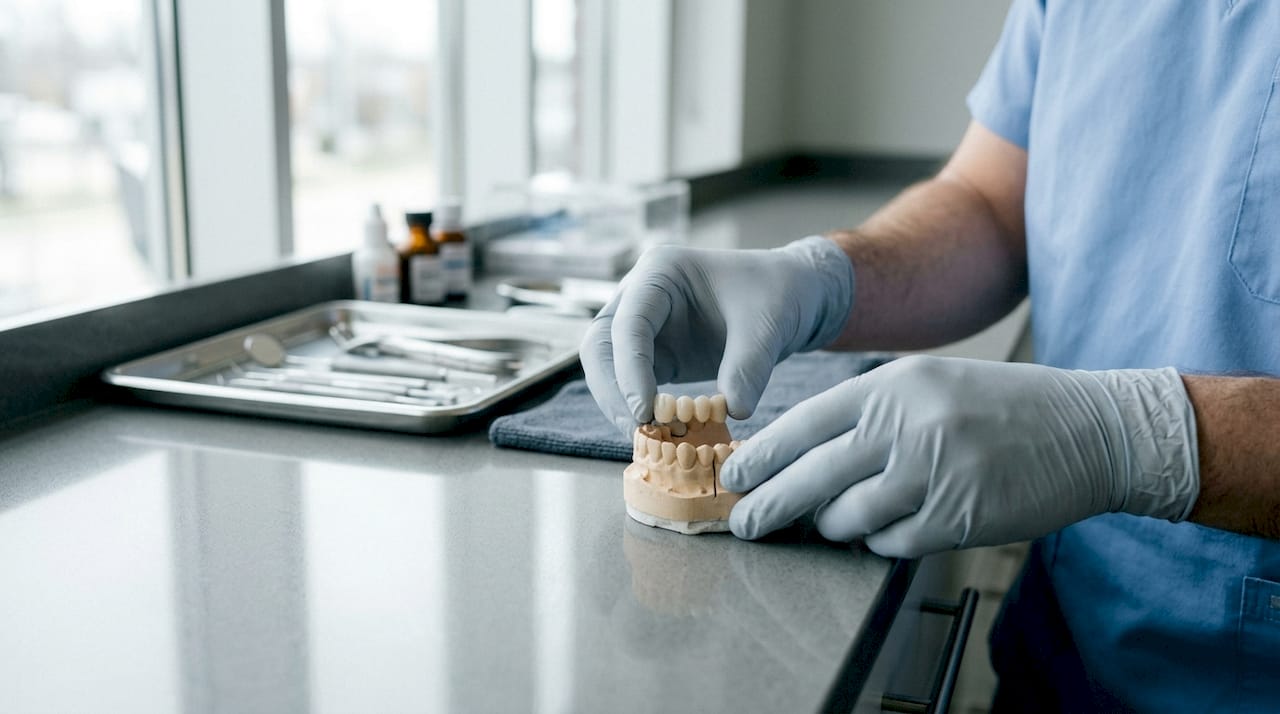
3. Removable partial dentures
A removable partial denture (RPD) replaces several missing teeth in the same arch using a metal or acrylic framework that clips onto remaining natural teeth. RPDs are the most affordable multi-tooth replacement option, with costs ranging from $1,500 to $3,000. They are removable for cleaning, which is both a practical benefit and a lifestyle adjustment. Patients often describe the initial fit as bulky, though most adapt within a few weeks.
Pros of RPDs:
- Low upfront cost
- No surgery required
- Preserves remaining natural teeth
- Adjustable as more teeth are lost
Cons of RPDs:
- Less stable than fixed options during eating
- Require daily removal and thorough cleaning
- Metal clasps can be visible when smiling
- Lifespan of 5–8 years before replacement
The biggest clinical risk with RPDs is hygiene failure. Neglecting daily cleaning allows plaque to accumulate on the anchor teeth, accelerating decay on the very teeth holding the prosthesis in place. That decay can lead to further tooth loss, which defeats the purpose of the restoration.
Pro Tip: Remove your RPD after every meal and brush both the appliance and your natural teeth before reinserting it. This single habit prevents the most common cause of RPD failure.
4. Full dentures
Full dentures replace an entire arch of missing teeth and rest directly on the gum tissue. They are the cheapest alternative to dental implants for patients who have lost all teeth in one or both arches, with costs ranging from $1,000 to $4,000. Modern acrylic materials produce natural-looking results, and same-day “immediate dentures” can be placed right after extractions. The trade-off is stability: full dentures rely on suction and adhesive rather than bone or implants.
Full dentures also accelerate bone resorption. Without a tooth root transmitting chewing forces into the jaw, the bone gradually shrinks. Over 10–20 years, this bone loss changes the shape of your face and makes the denture fit progressively worse. Patients typically need relining or replacement every 5–10 years as the jaw changes shape.
Full dentures remain the right choice for patients with no remaining teeth, limited budget, or medical conditions that rule out surgery. They are a valid starting point, not a permanent failure. Many patients later upgrade to implant-supported dentures once their health or finances allow.
5. Implant-supported dentures and All-on-4
Implant-supported dentures are a hybrid solution. They use 2–4 implants placed in the jaw to anchor a full denture, rather than relying on suction alone. The result is dramatically better stability, improved chewing force, and partial bone preservation compared to conventional full dentures. Implant-supported dentures cost between $3,000 and $30,000 depending on the number of implants and whether one or both arches are treated.
Key benefits over conventional dentures:
- Denture snaps securely onto implants, eliminating slippage
- Chewing efficiency is significantly higher
- Implants slow bone resorption at implant sites
- Removable versions allow easy cleaning
The All-on-4 technique places four implants per arch and attaches a fixed, non-removable prosthesis the same day. This is a permanent full-arch replacement, not a removable denture. All-on-4 costs more than implant-supported removable dentures but delivers a result closer to natural teeth in function and feel. Patients who want the stability of fixed teeth without individual implants for every tooth find All-on-4 the most practical path. You can explore 3D-printed denture technology that is now improving fit and reducing cost for both implant-supported and conventional dentures.
6. Key factors for choosing the right dental implant alternative
Choosing between dental implants alternatives requires an honest assessment of four factors: bone health, adjacent tooth condition, medical history, and timeline.
Common implant contraindications include uncontrolled diabetes, heavy smoking, certain heart conditions, immune disorders, and insufficient jawbone volume. When any of these apply, bridges or dentures become the primary path rather than a fallback. Consulting a prosthodontist and requesting a CBCT scan gives you the bone volume data needed to make an informed decision.
The table below summarizes the key differences across all four options:
| Option | Typical cost | Treatment time | Bone preserved | Lifespan |
|---|---|---|---|---|
| Fixed bridge | $2,500–$6,000 | 2–4 weeks | No | 10–15 years |
| Removable partial denture | $1,500–$3,000 | 2–4 weeks | No | 5–8 years |
| Full denture | $1,000–$4,000 | 2–6 weeks | No | 5–10 years |
| Implant-supported denture | $3,000–$30,000 | 3–6 months | Partial | Implant: indefinite |
The “do nothing” option carries its own cost. Not replacing missing teeth causes progressive bone loss that makes future restorations more complex and expensive. Delaying treatment rarely saves money in the long run. Use the Implantveneerguide treatment timeline planner to map out realistic timeframes for each option based on your situation.
Patients with autoimmune conditions face additional complexity. Implantveneerguide covers the evidence on autoimmune disease and implant candidacy in detail, which directly informs whether a bridge or denture is the safer long-term choice.
Key Takeaways
The best alternative to dental implants is determined by bone health, budget, adjacent tooth condition, and how quickly you need a functional result.
| Point | Details |
|---|---|
| Fixed bridges are fastest | Bridges complete in 2–4 weeks and cost $2,500–$6,000, making them the quickest fixed solution. |
| Dentures suit full-arch loss | Full dentures cost $1,000–$4,000 and work best when all teeth in an arch are missing. |
| Implant-supported dentures offer a middle path | Two to four implants dramatically improve denture stability and slow bone loss. |
| Bone resorption is the hidden cost | All non-implant options allow bone shrinkage over time, complicating future treatment. |
| Contraindications drive the decision | Diabetes, smoking, and low bone volume often make bridges or dentures the only viable option. |
What I’ve learned about choosing alternatives to implants
Patients often arrive at this decision framing alternatives as a compromise. That framing is wrong. Alternatives are not inferior options. They are the correct clinical choice for a large portion of patients, and treating them as a consolation prize leads to poor decisions.
The case I see most often mishandled is the bridge versus implant decision for a single missing tooth flanked by two heavily restored teeth. In that scenario, a bridge is not just acceptable. It is arguably the smarter choice because it addresses three problems at once: the missing tooth, the failing adjacent restorations, and the timeline pressure. Framing it as “settling” misses the clinical logic entirely.
What I find most underappreciated is the bone resorption timeline. Patients accept a denture at 55 and do not realize that by 70, the bone loss will have changed their facial structure and made any future implant placement far more complex. That 15-year window matters. If you are choosing a non-implant solution, you should have an explicit conversation with your dentist about monitoring bone volume and when an upgrade to implant support becomes worth pursuing.
The technology gap between options is also closing fast. Modern implant-supported dentures with precision attachments bear little resemblance to the loose, uncomfortable dentures of 20 years ago. Patients who dismissed dentures based on a parent’s experience are often surprised by what current prosthetics deliver.
My honest advice: do not let cost alone drive the decision toward the cheapest option. Do not let fear of surgery alone drive it toward the most expensive one. Get a CBCT scan, get a second opinion from a prosthodontist, and use the clinical data to choose the option that fits your actual jaw, health, and life.
— Georgina
What Implantveneerguide offers for your next step
Deciding between dental restoration options is easier when you have the right tools and evidence behind you. Implantveneerguide provides a free implant candidacy checker that screens your medical and anatomical factors to clarify whether implants, bridges, or dentures are the most realistic path for you.
The site also includes a cost estimator for US patients covering implants, bridges, and denture options, so you can compare real price ranges before your first consultation. Every guide on Implantveneerguide is built with dental professionals and grounded in peer-reviewed research, with no advertising or sponsored content influencing the recommendations. If you are weighing your options, the dental procedures overview is the clearest starting point for understanding what each treatment actually involves.
FAQ
What is the cheapest alternative to dental implants?
Full dentures are the cheapest alternative, with costs ranging from $1,000 to $4,000 per arch. Removable partial dentures follow at $1,500–$3,000 for patients who still have some natural teeth.
Are there alternatives to dental implants and dentures?
Fixed dental bridges offer a non-implant, non-denture option by anchoring a prosthetic tooth to crowns on adjacent teeth. Bridges are permanent, non-removable, and complete in 2–4 weeks.
What is the best alternative to dental implants?
The best option depends on your clinical situation. Fixed bridges suit patients missing one or two teeth with compromised adjacent teeth; implant-supported dentures suit patients needing full-arch replacement with better stability than conventional dentures.
Do alternatives to dental implants cause bone loss?
Yes. All non-implant options allow progressive bone resorption because no root transmits chewing forces into the jaw. Only implants, including those supporting implant-retained dentures, slow this process at the implant site.
Can I switch from a denture to implants later?
Switching is possible but becomes more complex over time as bone volume decreases. A prosthodontist can assess remaining bone with a CBCT scan and determine whether grafting is needed before implant placement.