Can You Use CareCredit for Veneers? Here’s the Verdict
Yes, CareCredit finances dental veneers, and most U.S. dental offices that offer cosmetic work accept it. The catch: CareCredit’s headline offers are usually 0% promotional periods running 6 to 24 months, and those are deferred-interest plans, not true no-interest loans. Miss the payoff deadline by even one payment cycle, and the card charges interest retroactively on the entire original balance, not just what’s left.
Before you fill out an application, do two things:
- Get a real cost estimate for your specific case (single veneer versus a full 6 to 8 tooth set changes the math dramatically)
- Call your dentist’s office and ask directly whether they accept CareCredit and what promotional terms they’re currently running
Key Takeaways
CareCredit finances veneers effectively only when the promotional term is matched to a realistic payoff plan, since missing the deadline triggers retroactive interest on the full original balance.
| Point | Details |
|---|---|
| Verify acceptance first | Confirm your dentist takes CareCredit and check current promo terms before applying. |
| Know your cost range | Composite veneers average around $1,068 per tooth; porcelain runs $1,000 to $2,500 per tooth. |
| Understand deferred interest | Unpaid balances at promo expiration trigger retroactive interest from the original purchase date. |
| Prequalify before committing | Soft-pull prequalification shows estimated terms without affecting your credit score. |
| Automate your payoff | Set autopay tied to the exact promo end date to avoid costly missed deadlines. |
This article is general information, not a substitute for advice from a qualified doctor. Consult a qualified healthcare professional about your own circumstances before acting on anything here.
Table of Contents
- Typical Veneer Costs in the U.S.: Per Tooth and Full-Set Pricing
- How Does CareCredit Financing Work for Dental Work?
- What Credit Score Do You Need for CareCredit Approval?
- Pros, Cons, and How to Manage the Risk
- Alternatives to CareCredit for Veneer Financing
- Steps to Take Before and During Your Veneer Consult
- Sample Monthly Payments: What Veneers Actually Cost Month to Month
- Why Trust This Article’s Guidance on Veneer Financing
- Ready to Plan Your Veneer Financing?
- The Real Question Isn’t Whether CareCredit Works. It’s Whether You Do the Math First
- Sources
Typical Veneer Costs in the U.S.: Per Tooth and Full-Set Pricing
Veneer pricing swings hard based on material, and that swing is exactly what determines whether a CareCredit promo window gives you enough runway to pay it off.
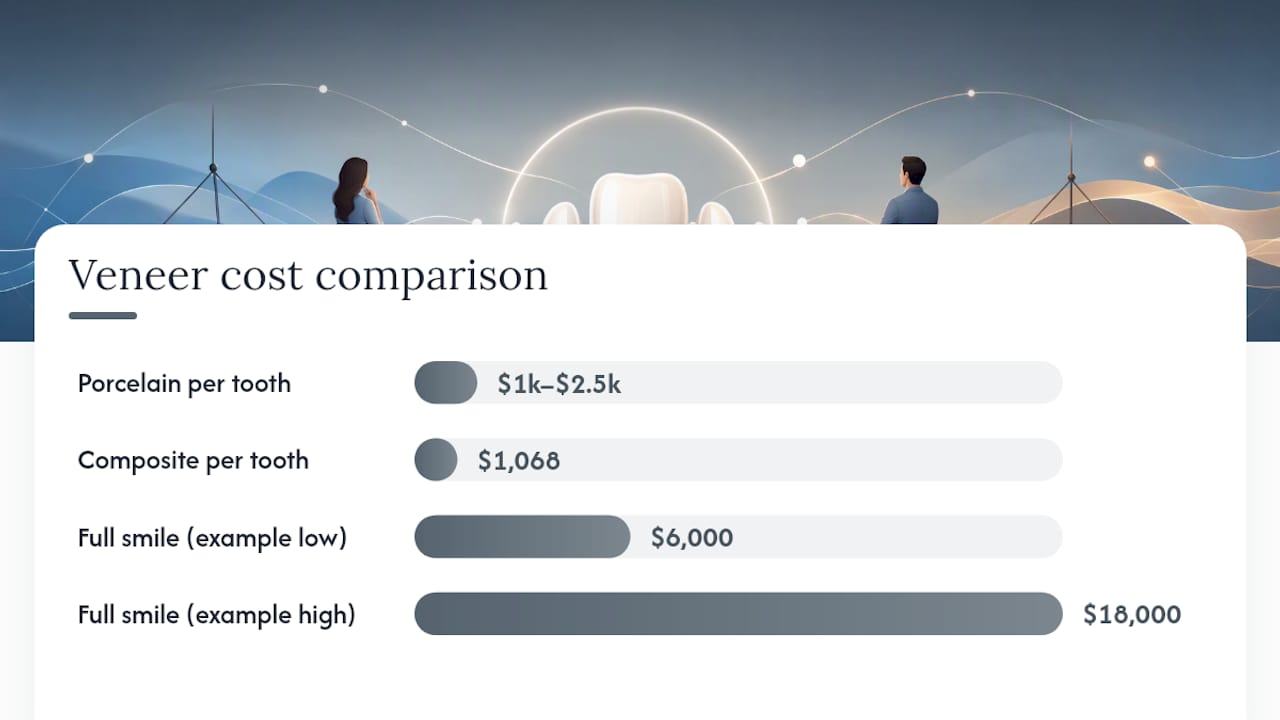
Porcelain veneers, the traditional choice for durability and stain resistance, typically run $1,000 to $2,500 per tooth nationally. Composite veneers, especially the minimally invasive kind that require less enamel removal, average considerably less; learn more about the differences between composite or porcelain veneers. One CareCredit resource puts the average around $1,068 per tooth for a minimally invasive composite option.
Multiply either figure across a full smile makeover (usually 6 to 8 front teeth) and the difference between materials can mean thousands of dollars.
A few things push these numbers around:
- Lab-fabricated versus same-day CAD/CAM veneers. Same-day systems can shift the price and the timeline, sometimes trading a lower lab fee for a higher chairside fee.
- Provider expertise and reputation. A cosmetic specialist in a major metro area often charges more than a general dentist in a smaller market.
- Geography. Coastal cities and high cost-of-living regions routinely run 20% to 40% above rural averages.
Run your own numbers through the cost estimator before you talk financing. Knowing whether you’re looking at a $6,000 case or an $18,000 case changes which CareCredit promo term actually makes sense.
How Does CareCredit Financing Work for Dental Work?
CareCredit isn’t a loan in the traditional sense. It’s a healthcare-dedicated revolving credit card, meaning once you’re approved, you can use it repeatedly for eligible medical and dental expenses without reapplying every time. That’s different from a personal loan, which gives you a fixed amount once and closes.
The financing structure that matters most for veneers is the promotional period. CareCredit’s dentistry page outlines offers that typically run 6, 12, 18, or 24 months at 0% interest for qualified applicants. These are deferred-interest promotions, which is a distinction worth sitting with for a second: interest accrues silently in the background the entire time. If you pay off the full balance before the promo end date, that accrued interest disappears. If you don’t, it gets added to your account, calculated from the original purchase date, not from whenever you started falling behind.
Miss the deadline and the standard APR kicks in retroactively. That rate commonly lands in the mid-to-high 20% range, which turns a manageable dental bill into a genuinely expensive one.
Before assuming your dentist takes CareCredit, verify it. CareCredit’s Acceptance Locator lets you search by provider name or zip code, and most cosmetic-focused practices are in the network already. You can apply through the CareCredit app, online, or in person at the dental office. Practices frequently favor third-party financing like CareCredit over running their own in-house credit programs, so asking the front desk which financing partners they work with is a fast way to confirm your options.
What Credit Score Do You Need for CareCredit Approval?
Approval odds for the best promotional terms improve significantly with fair-to-good credit. Industry guidance commonly points to a credit score around 660 or higher as the threshold where applicants tend to see approval and access to longer 0% windows.
Here’s the sequence that works best if you’re planning ahead:
- Check your credit score first. Free monitoring through your bank or a service like Credit Karma tells you where you stand before you apply.
- Use prequalification, not a full application, to test the waters. Prequalification typically triggers a soft inquiry that doesn’t affect your score, letting you see estimated terms before committing.
- Submit the full application only when you’re ready to move forward. This step involves a hard credit pull, which can temporarily dip your score by a few points.
- If you’re borderline, consider a co-signer or a lower-cost alternative. Some applicants split treatment into stages, financing a few veneers now and the rest after a few months of clean payment history.
Applying at your consultation, rather than after treatment starts, gives your dentist a clear budget to work with while planning your case.
Pros, Cons, and How to Manage the Risk
CareCredit’s biggest advantage is reach. It’s accepted at a wide swath of U.S. dental practices, and its provider network and straightforward application flow make it genuinely easier to use than most alternative financing paths. Credit limits typically are sufficient to cover cases involving multiple veneers, accommodating full smile makeovers.
The downside is the deferred-interest structure itself. It rewards discipline and punishes forgetfulness. A single missed payment near the end of a 12-month promo can trigger interest charges on the full original balance, not the remaining amount. Standard APR after the promo period tends to be higher than typical personal loan or low-interest credit card rates.
- Match your promo length to a realistic payoff plan, not the maximum term offered.
- Set autopay so a forgotten due date never becomes a five-figure mistake.
- Confirm your statement closing date and promo expiration date in writing, since they’re not always the same.
- Build a small buffer into your monthly payment so a delayed paycheck doesn’t push you past the deadline.
Pro Tip: Calculate your monthly payment assuming the promo is one month shorter than advertised. That cushion protects you if a payment posts late or the promo end date lands mid billing cycle.
CareCredit tends to work best when your total case cost is realistic against a specific promo term you can actually hit. It’s a weaker fit if your income is unpredictable or you’re already carrying high credit utilization elsewhere.
Alternatives to CareCredit for Veneer Financing
CareCredit isn’t the only route, and for some financial situations, it isn’t the best one.
- In-house phased billing. Some dental offices let you pay in two or three installments tied to treatment milestones, no credit check involved. Works well for smaller balances paid off in a few months.
- Buy now, pay later apps. Short-term, interest-free splits (think four payments over six weeks) suit smaller cosmetic add-ons rather than full veneer cases.
- Personal loans or low-interest credit cards. Third-party lenders with fixed terms and predictable amortization schedules suit patients who want a longer runway (24+ months) without the deferred-interest trap.
- HSA or FSA funds. If veneers are deemed medically necessary rather than purely cosmetic, some patients can apply pre-tax health savings dollars, though this is the exception rather than the rule for elective cosmetic work.
The general pattern: CareCredit and similar cards like Alphaeon suit 6 to 24 month repayment windows well. In-house billing suits very short timelines. Online installment lenders serve longer terms but often at meaningfully higher APRs than a well-managed CareCredit promo. Compare all of them against your own financing options before signing anything.
Steps to Take Before and During Your Veneer Consult
Getting your financing lined up before you sit in the chair saves time and prevents sticker shock mid-appointment.
- Estimate your total case cost. Use a cost estimator to get a realistic range for your material choice and tooth count.
- Pick a promo length that matches your budget, not the longest one offered. A shorter promo with a payment you can comfortably hit beats a 24-month term you might miss.
- Call the office and ask three questions: Do they accept CareCredit, what promotional terms are currently active, and when do charges typically post to the account.
- Apply or prequalify before your consultation, so you walk in with an approved limit and can discuss treatment scope against real numbers.
- Set autopay or calendar reminders the same day you’re approved, tied to your specific promo end date, not a general reminder to “pay CareCredit.”
Pro Tip: Ask the office to confirm the exact date your CareCredit charge posts. Promos are calculated from the purchase date, and a delayed posting can quietly shrink your payoff window by weeks.
Sample Monthly Payments: What Veneers Actually Cost Month to Month
Numbers make this concrete.

Now the scenario that actually costs people money: say you finance an 8-tooth porcelain set at $14,000 on a 12-month promo, and you miss the payoff by $1,500 when the promo expires. Deferred interest doesn’t just apply to that $1,500. It applies retroactively to the full $14,000 from the original purchase date, at the standard APR, which often lands in the mid-to-high 20% range. That single oversight can add well over $1,000 in interest that a fully paid-off balance would have avoided entirely.
Run your own case through the interactive cost estimator to see how your specific numbers hold up against different promo lengths.
Why Trust This Article’s Guidance on Veneer Financing
Implantveneerguide builds its cost and financing guidance around evidence-based tools rather than marketing copy, and this piece was developed with input from dental professionals and reviewed editorially by Georgina.
Before applying for any financing, it’s worth running your case through resources built specifically for this decision:
- The Veneer vs. Crown Decision Aid if you’re still deciding on treatment type
- The Financial Planning for Implants & Veneers guide for mapping costs against financing timelines
These tools exist to give you real numbers before you commit to a credit application, not after.
Ready to Plan Your Veneer Financing?
If you’re weighing CareCredit against other payment routes, start with the numbers rather than the application. Run your case through the Dental Implant & Veneer Cost Estimator to see a realistic U.S. price range for your specific veneer type and tooth count, then compare that against the promotional terms your dentist’s office actually offers. If you’re still unsure whether veneers or crowns fit your situation better, the Veneer vs. Crown Decision Aid walks through the tradeoffs before you finance anything.
The Real Question Isn’t Whether CareCredit Works. It’s Whether You Do the Math First
The conventional advice on CareCredit stops at “0% interest, apply now,” and that’s where most people get burned. The research here supports a more specific judgment: CareCredit is a genuinely good tool for veneer financing when the promo term is chosen to match a realistic payoff plan, and a genuinely risky one when it’s chosen based on the lowest advertised monthly payment.
Most guides underplay the retroactive interest mechanic. It’s not a fine-print footnote. It’s the entire risk profile of the product. A patient financing an 8-tooth case who treats the 24-month option as “more time to figure it out” is taking on more risk than someone who picks the 12-month option because they’ve already confirmed they can hit that payment.
What should come first, before comparing APRs or reading reviews, is a real cost number for your specific case and material choice. Everything else, the promo length, the monthly payment, the risk of deferred interest, only makes sense once you know what you’re actually financing.
— Georgina
Sources
- Dental Veneers Cost and Procedure Guide — CareCredit
- Dental Veneer Financing 101: Options, Costs & Budgeting Tips — GrowingFamilyBenefits