Financing Options for Dental Implants: How to Choose

For most U.S. patients, the smartest starting point is combining whatever HSA or FSA funds you have with a short-term 0% promotional offer for predictable single-tooth costs, or a fixed-rate personal loan for anything above $10,000. Here is a quick map before you dig into the details:
- HSA/FSA funds first. Pre-tax dollars reduce your effective out-of-pocket cost more than any promotional rate can. Best when you already have funds accumulated.
- Promotional healthcare credit (CareCredit-style) for shorter cases. A 12- or 18-month 0% promo works well for a single implant, only if you can pay the full balance before the promo ends. The retroactive-interest risk is real.
- Fixed-rate personal loan for $10,000+. Predictable monthly payments, no deferred-interest traps, and terms up to 60–84 months for full-arch cases.
- HELOC or home equity loan for $20,000+ cases. Lower rates than unsecured loans, but your home is collateral.
- In-house practice plans or no-hard-check lenders (Sunbit-style) for limited credit. Approval is easier, but read the APR carefully.
Start by using the cost estimator on Implantveneerguide to build a realistic budget, then gather itemized receipts and a medical-necessity note if you plan to use HSA/FSA funds.
Table of Contents
- What financing options for dental implants are actually available?
- Which option fits your situation?
- How do you pick the right plan?
- HSA/FSA, dental insurance, and what actually qualifies
- Step-by-step: from estimate to final payment
- Typical U.S. costs and worked financing examples
- Credit, retroactive interest, and long-term financial risks
- Key Takeaways
- The case for conservative math in implant financing
- Implantveneerguide tools make the planning concrete
- Authoritative sources and further reading
What financing options for dental implants are actually available?
The U.S. market offers more routes than most patients realize. Each covers different procedure components and suits different financial profiles.
HSA and FSA accounts let you pay with pre-tax dollars. Eligible expenses typically include implant surgery, diagnostic imaging (3D CT scans), anesthesia, follow-up appointments, and prescribed medications. The catch with FSAs is the plan-year deadline: funds often expire unless your plan offers a grace period or limited carryover.
Dental insurance and dental savings plans rarely cover implants fully. Traditional insurance caps annual maximums, often at $1,000–$2,000, which barely covers part of a single implant. Dental savings plans (discount plans) reduce the fee schedule at participating offices but do not pay claims directly.
In-house practice payment plans are arranged directly with your dental office. Terms vary widely, from interest-free installments over a few months to longer arrangements with interest. These tend to be more flexible on credit requirements.
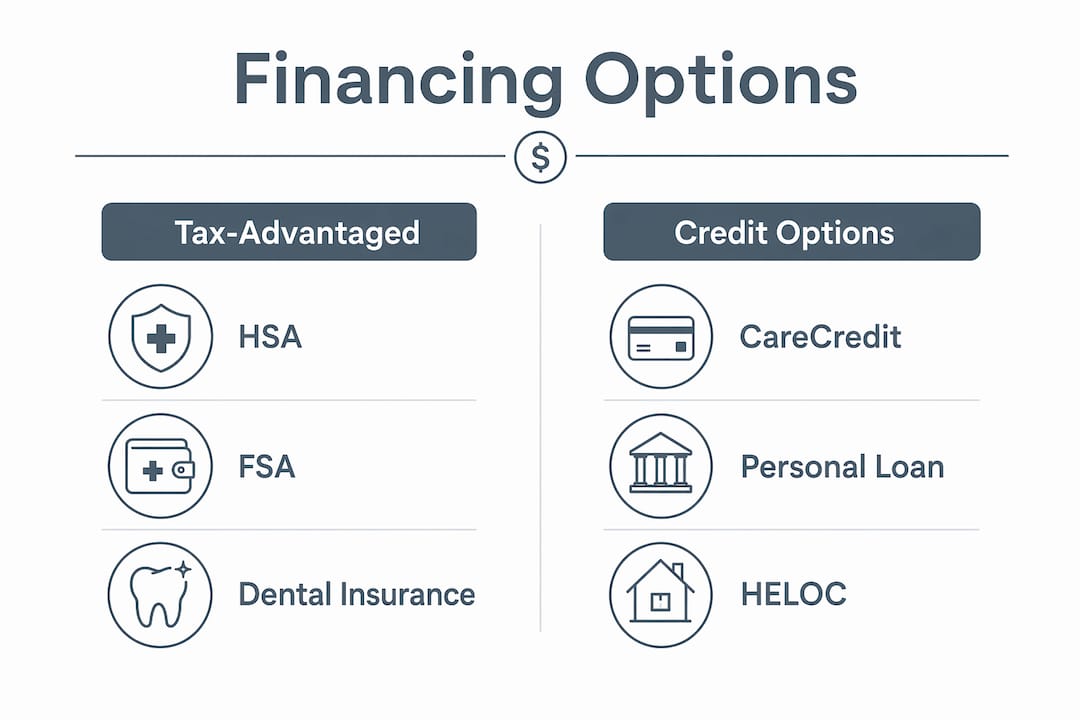
Dedicated healthcare credit cards like CareCredit are accepted at over 285,000 locations and offer promotional financing for purchases of $200 or more. They cover implants, crowns, imaging, anesthesia, and follow-up care within the CareCredit network.

Personal loans from banks or online lenders offer fixed rates and fixed terms. They cover any treatment component and are not restricted to specific provider networks.
HELOC or home equity loans give homeowners access to larger sums at lower rates than unsecured credit, but the loan is secured against the home.
No-hard-check patient lenders like Sunbit position their application process as having no hard credit inquiry, which protects your credit score during the approval process. Terms and amounts still vary.
Staged treatment splits a full-arch case into phases billed separately, letting you finance each phase independently and use HSA/FSA funds across multiple plan years.
Which option fits your situation?
| Financing Route | Typical APR / Promo | Term | Est. Monthly ($5k) | Credit Check | What’s Covered | Key Risk | Credit Impact | Approval Speed |
|---|---|---|---|---|---|---|---|---|
| HSA/FSA | N/A (pre-tax) | Plan year | N/A | None | Surgery, imaging, anesthesia, meds, follow-ups | FSA use-it-or-lose-it deadline | None | Immediate |
| CareCredit promo | 0% promo / — after | 6–24 months | ~$278/mo (18-mo) | Hard pull | Implants, crowns, imaging, anesthesia | Retroactive interest if not paid in full | Reports to bureaus | Same day |
| Personal loan | 7%–20% fixed | 24–84 months | ~$159/mo (36-mo, 9%) | Hard pull | Any treatment component | Origination fee (0%–8%) | Reports to bureaus | 1–5 days |
| HELOC | 7%–10% variable | 10–20 years | Low draw payment | Hard pull | Any | Home as collateral | Reports to bureaus | 2–6 weeks |
| In-house plan | Varies (0%–18%) | 3–24 months | Negotiated | Soft or none | Office-specific | Limited to that practice | May not report | Same day |
| Sunbit | Varies | 3–60 months | Varies | No hard pull | Office-specific | Higher APR possible | May report | Minutes |
| Dental savings plan | N/A (annual fee) | Annual | N/A | None | Discounted fees only | Not insurance | None | Same day |
Single implant ($4,000–$6,000): A CareCredit 18-month promo at $5,000 requires roughly $278 per month to clear the balance. A 36-month personal loan at 9% on the same amount runs about $159 per month with total interest near $720. If you have $2,000 in HSA funds, apply those first and finance only the $3,000 remainder.
Full-arch All-on-4 ($15,000–$35,000): At $25,000, a 60-month personal loan at 10% costs roughly $531 per month and about $6,800 in total interest. A HELOC at 8% on the same amount over 10 years runs about $303 per month. The All-on-4 treatment scope affects which line items qualify for HSA/FSA, so get an itemized estimate before you commit to any financing structure.
How do you pick the right plan?
Work through this checklist before signing anything.
- Get a total itemized estimate. Ask for procedure codes (CDT codes if possible) and separate line items for surgery, implant posts, crowns, imaging, anesthesia, and follow-ups.
- Confirm your HSA/FSA balance and plan-year deadline. Know exactly how much you can deploy pre-tax and when those funds expire.
- Calculate the equal-payment schedule, not the minimum. Divide the promo balance by the number of months in the promo period. That is the payment you need to make, not the advertised minimum.
- Ask whether deferred interest is retroactive. The exact question: “If any balance remains at the end of the promo period, is interest charged from the original purchase date?” For CareCredit-style offers, the answer is yes.
- Check the credit-check type. Hard pulls affect your score; no-hard-check options (Sunbit-style) do not, which matters if you are applying to multiple lenders.
- Ask which receipts the office will provide. Confirm they will issue itemized receipts for each procedure component, not a single lump-sum invoice.
- Compare total cost of financing, not just monthly payment. A lower monthly payment over a longer term often costs more in total interest.
- Ask about penalties for early payoff or missed payments. Some in-house plans have strict late-fee structures.
Pro Tip: Treat the advertised minimum payment on any deferred-interest offer as a warning sign, not a budget target. Calculate the equal monthly payment that zeroes the balance by the last day of the promo period, and set up autopay for that amount.
HSA/FSA, dental insurance, and what actually qualifies
HSA and FSA funds can cover a broader range of implant-related expenses than most patients expect. Eligible categories commonly include implant surgery, 3D CT diagnostic imaging, anesthesia and sedation, follow-up appointments, and prescribed medications related to the procedure. The key requirement is that the treatment is medically necessary, and you need documentation to prove it.
For FSAs specifically, the plan-year timing is the biggest practical risk. Most FSA plans run January through December, with a grace period of up to 2.5 months or a carryover of up to $640 (IRS limits adjust periodically). If your treatment spans two plan years, you can potentially use two years of FSA contributions, but you need to plan the billing schedule with your dental office in advance.
The practical workflow: secure an itemized pre-treatment estimate with CDT codes, confirm with your HSA/FSA administrator which line items qualify, keep every receipt and any clinician notes supporting medical necessity, and submit promptly within your plan’s rules.
On the insurance side, dental insurance for implants typically applies only after waiting periods for major restorative work (often 12 months), and annual maximums of $1,000–$2,000 cover only part of a single implant. Supplemental plans with higher maximums exist but require careful comparison of premiums versus likely benefit.
Documentation is the difference between a reimbursed expense and a denied claim. An itemized receipt listing each procedure separately, paired with a letter of medical necessity from your dentist, is the standard that HSA/FSA administrators and insurers expect. A single-line invoice for “dental treatment” is routinely rejected.
Step-by-step: from estimate to final payment
- Request a detailed itemized estimate at your consultation. List every component: surgery fee, implant post, abutment, crown, imaging, anesthesia, and follow-up visits. Ask for CDT codes.
- Submit for insurance preauthorization if you have dental coverage. Get the written response showing what will and will not be covered and the applicable annual maximum.
- Calculate your uncovered balance after insurance and HSA/FSA funds. This is the amount you need to finance.
- Apply for financing early, before your procedure date. Confirm the exact APR, term, promo period (if any), and whether interest is deferred or a true 0% intro rate.
- Set your payment schedule the day you receive the financing. For any deferred-interest promo, divide the balance by the number of promo months and automate that payment.
- Track payments against the promo expiration date. The Credit CARD Act governs how payments are allocated in the final billing cycles, so confirm your balance is zeroed before the promo end date, not just on the statement date.
- Keep all receipts and lender disclosures in a dedicated folder for HSA/FSA reimbursement and any future audit.
Typical U.S. costs and worked financing examples
Cost ranges below are estimates based on published practice-level guides and should be confirmed with your provider.
| Treatment | Estimated Cost Range | Suggested Financing Amount |
|---|---|---|
| Single implant + crown | $4,000–$6,000 | $2,000–$5,000 after HSA/FSA |
| Multi-tooth (2–3 implants) | $10,000+ | — |
| Full-arch All-on-4 (per jaw) | $15,000–$35,000 | $12,000–$30,000 |
Scenario A — Single implant, $4,500, 18-month 0% promo: Equal monthly payment = $250. If you pay only the advertised minimum and a balance remains at month 18, interest accrues from the original purchase date at the card’s standard APR.
Scenario B — Multi-tooth, $12,000, 36-month personal loan at 9%: Monthly payment ≈ $381. Total interest paid ≈ $1,716. No retroactive-interest risk; fixed schedule.
Scenario C — Full-arch, $30,000, HELOC at 8% over 10 years: Monthly payment ≈ $364. Total interest ≈ $13,680. Lower monthly cost than an unsecured loan, but the home secures the debt. For a detailed breakdown of full-arch component costs, the All-on-Four clinical guide is a useful reference.
Use the Implantveneerguide cost estimator to model your specific case before approaching any lender.
Credit, retroactive interest, and long-term financial risks
The deferred-interest structure is the most misunderstood feature in healthcare financing. CareCredit’s own disclosures confirm that minimum monthly payments may not fully amortize the promotional balance. Pay the minimum every month, carry $1 into month 19 of an 18-month promo, and interest charges from the original purchase date hit your account. On a $5,000 balance at a standard APR near 30%, that retroactive charge can exceed $1,000.
Hard credit pulls from personal loan applications typically lower your score by a few points temporarily and remain on your report for two years. Soft pulls and no-hard-check options like Sunbit avoid that impact entirely, which matters if you are rate-shopping across multiple lenders simultaneously. Applying to several lenders within a short window (typically 14–45 days) usually counts as a single inquiry for scoring purposes under FICO’s rate-shopping rules.
For larger cases, using home equity reduces your interest cost but converts unsecured dental debt into secured debt. Missing payments on a HELOC puts your home at risk. Combining HSA/FSA dollars with any financed amount reduces the principal you pay interest on, which is the most tax-efficient move available to most patients.
Key Takeaways
The single most effective approach to financing dental implants is combining pre-tax HSA/FSA funds with a financing method matched to your loan size and credit profile.
| Point | Details |
|---|---|
| HSA/FSA reduces real cost | Pre-tax dollars lower your effective out-of-pocket more than any promotional rate. |
| Promo minimums are a trap | Calculate the equal monthly payment that zeroes the promo balance; never rely on the advertised minimum. |
| Loan size should drive method | Under $6k: short promo or in-house plan. $6k–$15k: personal loan. $15k+: personal loan or HELOC. |
| Documentation wins claims | Itemized receipts with CDT codes and a medical-necessity letter are required for HSA/FSA reimbursement. |
| Implantveneerguide tools | Use the cost estimator and candidacy checker to size your financing need before applying anywhere. |
The case for conservative math in implant financing
Most financing guides focus on getting you approved. This one focuses on what happens after approval, because that is where patients run into trouble.
The deferred-interest structure is genuinely dangerous for anyone who budgets around the minimum payment. The math is not complicated, but it requires you to run it before you sign, not after you receive a retroactive interest charge. The same logic applies to HELOC decisions: the lower monthly payment looks attractive until you remember the collateral involved.
What tends to get overlooked is how much documentation discipline matters. Patients who keep itemized receipts, request CDT codes upfront, and confirm FSA timing with their administrator recover significantly more in pre-tax reimbursements than those who reconstruct paperwork after the fact. The difference is not a small rounding error on a $20,000 case.
The financial planning guide on Implantveneerguide is built around this same principle: conservative payment math, transparent comparisons, and documentation checklists developed with dental professional collaborators. The goal is not to make implants sound affordable in every situation. It is to give you an accurate picture so you can decide whether the timing and financing structure actually work for your budget.
Implantveneerguide tools make the planning concrete
Before you apply for any financing, you need two numbers: what your treatment will likely cost, and whether you are a strong candidate for the procedure you are considering. Guessing on either one leads to either over-borrowing or choosing a financing structure that does not fit the actual scope.
The Implantveneerguide candidacy checker walks you through the clinical factors that affect both your eligibility and your likely treatment complexity, which directly affects cost. The cost estimator translates that complexity into U.S. price ranges you can take to a lender conversation. Both tools are free, require no personal information, and are built on the same evidence-based framework as the guides on the site. Run both before you sit down with a financing application.
Authoritative sources and further reading
Save every lender disclosure and itemized receipt from your dental office. HSA/FSA administrators and the IRS can request documentation years after reimbursement. A dedicated folder, physical or digital, is the simplest audit protection available.
Key sources used in this article:
- CareCredit deferred-interest disclosure — explains retroactive interest and how promo balances work
- CareCredit promotional offer terms — minimum payment disclosures and standard APR after promo
- Credit CARD Act (public law text) — federal law governing payment allocation on deferred-interest accounts
- All-on-4 HSA/FSA eligibility guidance — eligible expense categories and documentation requirements
- Sunbit dental merchant page — no-hard-check patient financing details
- Implantveneerguide dental insurance guide — how insurance interacts with implant costs
- Implantveneerguide financial planning guide — step-by-step financial planning for implant and veneer patients
This article is general educational information, not financial or dental advice. Confirm current HSA/FSA rules with your plan administrator and IRS guidance, and consult a licensed financial professional for your specific situation.