Best Dental Insurance for Implants: 2025–2026 Guide

What are the best dental insurance plans for implants right now?
The best dental insurance for implants in 2025–2026 covers all three implant components—the titanium post, the abutment, and the crown—carries no missing tooth clause, and either waives the waiting period or keeps it short. Most plans fall short on at least one of those criteria. Some dental plans include implant coverage, but many limit it to just the crown, requiring patients to pay fully for the surgical components.
Among the featured plans, Guardian Advantage Gold and Guardian Life stand out for comprehensive major restorative coverage and solid in-network discounts. Cigna Dental 1500 Plan covers implants at 50% post-waiting period with a wide dentist network. MetLife Dental PPO High offers enhanced coverage limits for patients planning complex or multiple implants. Humana’s plans range from entry-level to mid-tier, making them accessible for budget-conscious patients who still want some implant benefit. Anthem Essential Choice PPO Silver provides balanced PPO coverage with moderate premiums.
The table below compares all eight featured plans on the dimensions that matter most for implant coverage.
| Plan | Anthem Essential Choice PPO Silver | Cigna Dental 1500 Plan | Guardian Advantage Gold | Guardian Life | Humana Dental Plans | Humana Dental Value Plan | MetLife | MetLife Dental PPO High |
|---|---|---|---|---|---|---|---|---|
| Implant coverage | Partial; typically crown-level | 50% after waiting period | Comprehensive major restorative | Major restorative; plan-specific | Varies by state and plan tier | Limited; plan-dependent | Partial to full; pre-auth required | Enhanced; broader in-network benefits |
| Annual maximum | Moderate | Moderate | Modest | Plan-specific | Modest | Lower | Plan-specific | Higher than standard MetLife |
| Waiting period | Typically 12 months | 12 months for major services | Manageable; plan-specific | Plan-specific | Usually 12 months | Usually 12 months | Often required | Often required |
| Missing tooth clause | Present on most plans | Present on most plans | Verify by plan | Verify by plan | Varies by state | Varies by state | Present; verify plan docs | Present; verify plan docs |
| Network type | PPO | PPO; extensive network | PPO | PPO and indemnity options | PPO and HMO options | PPO | PPO and HMO | PPO |
| In-network vs. out-of-network | Better rates in-network | Strong in-network savings | In-network discounts apply | In-network discounts apply | In-network preferred | In-network preferred | Broad network access | Broader in-network benefits |
| Best for | Broad PPO coverage with some implant benefits | Patients planning implants after waiting period | Comprehensive implant coverage priority | Multiple plan options for implants | Budget patients needing implant access | Budget-conscious with basic needs | PPO and HMO variety seekers | Complex or multiple implant patients |
Pro Tip: Before enrolling in any plan, call the insurer directly and ask three questions: Does this plan cover the implant post and abutment, or only the crown? Does a missing tooth clause apply? What is the annual maximum for major restorative procedures? The answers will tell you more than any brochure.
How do these plans compare in detail?
The gap between plans that sound similar on paper can be thousands of dollars per tooth. Here is where each plan actually differs.
Cigna Dental 1500 Plan
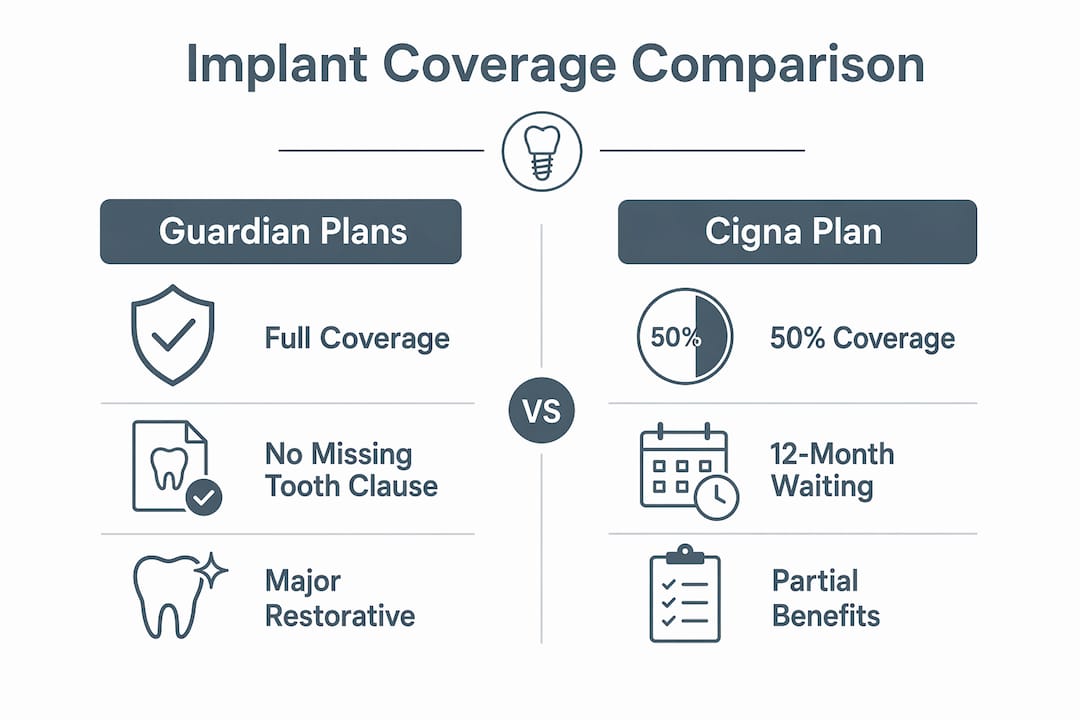
Cigna’s 1500 Plan covers implants at 50% in most markets, but the 12-month waiting period is firm and the missing tooth clause appears on most Cigna plans. That combination means patients with a pre-existing gap may be denied coverage entirely, and anyone needing an implant soon will wait a year before benefits kick in. The upside is Cigna’s network, which is one of the largest in the country, giving patients real flexibility in choosing a provider. If you can plan ahead and your tooth loss is recent, this plan delivers solid value.
Guardian Advantage Gold and Guardian Life
Guardian’s plans cover implants as major restorative procedures, which means the post, abutment, and crown are all potentially eligible rather than just the crown. In-network savings of 25–50% apply even on procedures not fully covered, which matters on a $4,000–$5,000 implant. Guardian Advantage Gold suits patients who want comprehensive coverage and can tolerate a waiting period. Guardian Life’s broader plan portfolio gives patients more options to match their budget and coverage needs.

MetLife and MetLife Dental PPO High
MetLife’s standard plans offer partial to full implant coverage depending on the specific plan, and pre-authorization is typically required before implant procedures begin. The MetLife Dental PPO High tier is the better pick for anyone planning multiple implants or a complex case. It carries higher premiums but delivers improved coverage limits and broader in-network access. The missing tooth clause is present on MetLife plans, so verify the plan documents before assuming a pre-existing gap is covered.
Humana Dental Plans and Humana Dental Value Plan
Humana’s strength is accessibility. The standard Humana Dental Plans offer mid-tier implant coverage that varies by state, making them a reasonable choice for patients who want an established insurer without paying top-tier premiums. The Humana Dental Value Plan is the entry-level option: premiums are lower, but implant coverage is limited and plan-dependent. For patients who need only basic implant benefits and are primarily focused on keeping monthly costs down, the Value Plan is worth a look, with the understanding that out-of-pocket costs will be higher per procedure.
Anthem Essential Choice PPO Silver
Anthem’s Essential Choice PPO Silver provides balanced PPO coverage with moderate premiums and a broad network. Implant coverage tends to be at the crown level rather than comprehensive, which limits savings on the surgical components. Patients who already have Anthem through an employer or who prioritize network breadth over implant-specific depth will find it a workable option.
Key differences across all eight plans:
- Coverage scope: Guardian plans and MetLife PPO High are most likely to cover all three implant components; Humana Value Plan and Anthem PPO Silver typically cover only the crown.
- Waiting periods: All eight plans impose waiting periods of up to 12 months for major restorative work. No featured plan waives the waiting period entirely.
- Missing tooth clause: Present on Cigna, MetLife, and Anthem plans in most markets; verify Guardian and Humana plan documents by state.
- Annual maximums: MetLife PPO High and Guardian plans tend toward higher maximums, which matters when a single implant can cost $3,000–$5,000 before insurance.
- Network size: Cigna and MetLife have the largest national networks; Guardian and Humana are strong regionally.
How does dental implant insurance coverage actually work?
Dental implants consist of three separate components, and insurers treat each one differently. The titanium post is the surgical screw placed into the jawbone, costing $1,500–$2,000. The abutment connects the post to the crown and runs $500–$800. The crown, the visible tooth restoration, costs $1,000–$1,800. Total cost per tooth typically falls in the $3,000–$5,000 range, and that is before any bone graft ($300–$3,000) or extraction ($150–$350) that may be required.
Insurers classify implants as either major restorative or cosmetic procedures. Plans that categorize them as cosmetic exclude them entirely. Plans that treat them as major restorative typically cover 50% after the deductible and waiting period, subject to the annual maximum. The critical question is whether “major restorative” in your plan means all three components or just the crown. Many plans cover only the crown at 50%, saving $500–$900, while comprehensive coverage of all three components saves $1,500–$2,500 per tooth.
The missing tooth clause is the most common reason implant claims get denied. If a tooth was already missing when you enrolled in the plan, the clause permanently excludes coverage for any implant replacing that tooth. This clause causes a significant share of implant claim denials and is present on most standard plans, including many Cigna and MetLife offerings.
Waiting periods of 6–12 months are standard before major restorative benefits begin. Plans that waive the waiting period, like Spirit Dental Gold and Platinum, typically cover implants at 50% immediately but charge higher premiums. Annual maximums cap total yearly benefits, often at $1,000–$2,000 on basic plans, which can be exhausted by a single implant procedure.
Key questions to ask any insurer before enrolling:
- Does the plan cover the implant post and abutment, or only the crown?
- Does a missing tooth clause apply, and does it cover teeth already missing?
- What is the waiting period for major restorative procedures?
- What is the annual maximum, and does it reset each calendar year?
- Which dentists in my area are in-network for implant procedures?
- Does the plan require pre-authorization before implant surgery?
- Is bone grafting covered if medically necessary?
PPO plans generally offer the most flexibility for implant patients because they allow out-of-network providers at a higher cost-share. HMO plans restrict patients to a specific network and often require referrals, which can limit implant specialist access. Indemnity plans reimburse a set fee schedule regardless of provider, which works well when your preferred oral surgeon is not in any network.
What do dental implants actually cost, and how much does insurance save you?
A single dental implant, including the post, abutment, and crown, typically costs $3,000–$5,000. Add a bone graft and the total can climb higher. Without insurance, patients pay every dollar out of pocket. With comprehensive implant coverage at 50%, the savings on a $4,000 implant reach $2,000, which recovers more than two years of premiums on most mid-tier plans in a single procedure.
The catch is annual maximums. A plan with a $1,500 annual maximum pays out $1,500 regardless of the 50% coverage rate, leaving the patient responsible for the rest. Patients planning multiple implants can spread treatment across policy years to maximize annual benefits, a strategy worth discussing with both your dentist and your insurer before scheduling.
Factors that influence total implant cost:
- Geographic location (urban markets run higher than rural)
- Provider type (oral surgeon vs. general dentist)
- Need for bone grafting or tooth extraction before placement
- Number of implants and whether implant-supported dentures are involved
- Choice of crown material (porcelain, zirconia, or metal)
- In-network vs. out-of-network provider status
Consider two patients, both needing a single implant at $4,500 total. The uninsured patient pays $4,500. The patient with a plan covering all three components at 50% with a $2,500 annual maximum pays $2,000 out of pocket after the deductible. The patient with a crown-only plan at 50% and a $1,500 maximum saves only $750 on the crown while paying full price for the post and abutment. The difference between “covers implants” and “covers implants comprehensively” is $1,250 on a single tooth.
Deductibles typically run $50–$150 per year on dental plans and apply before any major restorative benefit kicks in. On a $4,500 implant, a $100 deductible is a minor factor, but it does reduce the net benefit slightly. Patients should calculate net savings after the deductible, not before.
What are your alternatives if insurance falls short?
Insurance is not the only path to affordable implants. Several financial tools can reduce out-of-pocket costs meaningfully, either alongside a dental plan or as a standalone strategy.
Health Savings Accounts (HSAs) let patients set aside pre-tax dollars to pay for qualified medical and dental expenses, including implants. Flexible Spending Accounts (FSAs) work similarly through employer benefit programs. Both reduce the effective cost of implants by the patient’s marginal tax rate, which can be 22–24% for many working adults. Patients without implant coverage in their dental plan can still use an HSA or FSA to pay for the full procedure with pre-tax money.
Supplementary financial options worth considering:
- Dental discount plans: Not insurance, but membership programs offering 10–60% off dental procedures at participating providers. Plans like Careington or Aetna Dental Access charge a flat annual fee and have no waiting periods or annual maximums.
- In-house payment plans: Many oral surgeons and implant specialists offer 0% financing for 12–18 months through third-party lenders like CareCredit or Lending Club Health.
- Employer supplemental dental benefits: Some employers offer supplemental dental riders that increase annual maximums or add implant coverage on top of a base plan.
- Dental schools: Accredited dental school clinics perform implant procedures at significantly reduced rates under faculty supervision. The American Dental Association maintains a directory of accredited programs.
- Phased treatment: Spreading implant components across two policy years, placing the post in December and the crown in January, can effectively double the annual maximum available for a single implant.
Insurance becomes insufficient or impractical when the missing tooth clause disqualifies coverage, when the annual maximum is too low to make a meaningful dent, or when the waiting period makes coverage irrelevant for an urgent case. In those situations, HSAs, FSAs, and dental discount plans often deliver more immediate and predictable savings.
How should you evaluate dental insurance plans for implant coverage?
Evaluating plans for implant coverage requires looking past the marketing summary and into the actual policy document. The summary of benefits is a starting point, not the final word.
Evaluation criteria to apply to every plan you consider:
- Coverage scope: Confirm the plan covers the post, abutment, and crown, not just the crown.
- Missing tooth clause: Ask explicitly whether the clause applies and whether it covers teeth already missing at enrollment.
- Waiting period: Determine the exact waiting period for major restorative procedures and whether any waiver applies.
- Annual maximum: Calculate whether the maximum is high enough to pay meaningful benefits on a $3,000–$5,000 procedure.
- Network access: Verify that qualified implant specialists, oral surgeons, or periodontists in your area participate in the network.
- Pre-authorization requirements: Find out whether the insurer requires pre-authorization and what documentation is needed.
- Deductible: Confirm the annual deductible and whether it has already been met for the policy year.
Pro Tip: Request the full Summary of Benefits and Coverage document, not just the plan brochure. Search the document for the words “implant,” “osseointegration,” and “surgical post.” If none of those terms appear, the plan likely does not cover the surgical components.
Implantveneerguide’s content is developed in collaboration with dental professionals and grounded in peer-reviewed research, which means the guidance here reflects how implant coverage actually works in practice, not how insurers describe it in promotional materials. The dental implant consultation checklist on Implantveneerguide walks through the exact questions to raise with both your dentist and your insurer before committing to a plan.
Starting coverage before you need an implant is the single most effective strategy available. The 12-month waiting period on most plans is unavoidable once you need treatment. Enrolling now, even if an implant is 18 months away, means you enter the treatment phase with full benefits rather than waiting on the sidelines.
Key Takeaways
The best dental insurance plans for implants cover all three components, carry no missing tooth clause, and have annual maximums high enough to deliver real savings on a $3,000–$5,000 procedure.
| Point | Details |
|---|---|
| Coverage scope matters most | Plans covering the post, abutment, and crown save $1,500–$2,500 per tooth; crown-only plans typically save $500–$900 per tooth. |
| Missing tooth clause is a dealbreaker | This clause permanently excludes implants replacing teeth missing before enrollment; verify before purchasing. |
| Waiting periods require planning | Most plans impose a 12-month wait for major restorative work; enroll before you need treatment. |
| HSAs and FSAs fill the gap | Pre-tax accounts reduce effective implant costs by your marginal tax rate, even without insurance coverage. |
| Implantveneerguide | Implantveneerguide offers evidence-based guides and a cost estimator tool to help you plan implant costs with and without insurance. |
Why the right dental insurance choice affects more than your wallet
Most patients approach dental insurance for implants as a cost problem. It is also a timing problem, and that distinction changes how you should think about coverage.
Delaying an implant because coverage is unclear or premiums feel high rarely saves money. A missing tooth accelerates bone loss in the jaw, which can make future implant placement more complex and expensive, sometimes requiring bone grafting that would not have been necessary with earlier treatment. The dental bone graft procedure adds $300–$3,000 to the total cost and extends the treatment timeline by months. What looks like a short-term saving on premiums can become a long-term cost multiplier.
Comprehensive coverage also changes patient behavior in a measurable way. Patients who know their implant is substantially covered are more likely to proceed with treatment on the recommended timeline rather than postponing until the situation worsens. That is not a soft benefit. It is the difference between a straightforward implant and a more complex, more expensive reconstruction.
The psychological dimension is real too. Knowing that a $4,000–$5,000 procedure is 50% covered removes a significant source of financial anxiety from what is already a stressful medical decision. Patients make better decisions, ask better questions, and follow through on treatment when they are not simultaneously calculating whether they can afford the next step.
The conventional wisdom says to pick the cheapest plan that technically covers implants. That advice is wrong for most patients. A plan with a $1,000 annual maximum and a missing tooth clause may cost $30 less per month while delivering zero benefit when you actually need it. The better calculation is: what will this plan pay on my specific situation, and does that payment justify the premium? Run that math before you enroll, not after a claim is denied.
Implantveneerguide helps you plan before you commit
Choosing a dental plan for implants is easier when you know exactly what the procedure involves and what it should cost in your area. Implantveneerguide is a different kind of resource than an insurer’s website. There is no plan to sell you, no network to steer you toward, and no marketing language designed to make coverage sound better than it is.
The platform offers an implant candidacy checker built on evidence-based screening criteria, a cost estimator that breaks down procedure costs by component and location, and detailed guides on every stage of the implant process from candidacy through recovery. All content is developed with dental professionals and grounded in peer-reviewed research. If you are comparing insurance plans and want to understand what coverage you actually need before you commit, Implantveneerguide gives you the clinical context to make that call with confidence. Start with the financial planning guide to map your options across insurance, HSAs, and payment plans in one place.