How to Get Dental Implants Covered by Medical Insurance

Getting dental implants covered by medical insurance requires proving the procedure is medically necessary, not cosmetic. Most dental plans cap annual benefits at $1,000–$2,500 and exclude implants entirely, which is why routing a claim through medical insurance matters so much. The path to coverage depends on three things: qualifying medical conditions, correct procedural coding using CPT codes rather than dental CDT codes, and thorough documentation. Implantveneerguide has compiled this guide to walk you through every step, from establishing eligibility to appealing a denial.
How to get dental implants covered by medical insurance
Medical insurance covers dental implants when the procedure qualifies as reconstructive surgery tied to a medical event, not when it is elected for appearance. Trauma, oral cancer, and systemic disease are the three most common qualifying triggers. Understanding this distinction is the first filter every insurer applies.

What conditions qualify for medical coverage?
The following scenarios give you the strongest foundation for a medical insurance claim:
- Traumatic injury. A car accident or workplace injury that knocks out teeth creates a direct medical event. Insurers treat tooth replacement in this context as reconstructive care.
- Oral cancer reconstruction. Patients who lose bone or teeth during cancer surgery or radiation therapy qualify because the tooth loss is a direct consequence of medical treatment.
- Congenital defects. Conditions like ectodermal dysplasia, where teeth never develop, are classified as structural medical issues rather than cosmetic concerns.
- Systemic diseases. Sjögren’s syndrome, uncontrolled diabetes, and certain autoimmune conditions cause severe tooth loss as a documented medical side effect. Insurers recognize these links when supported by specialist records.
- Functional impairment. If missing teeth prevent normal chewing, cause significant bone loss, or affect speech, that functional deficit strengthens the medical necessity argument.
The key word insurers look for is functional. A claim framed around appearance will fail. A claim framed around documented functional loss tied to a medical cause has a real chance.
What does “medical necessity” actually mean to an insurer?
Medical necessity is the standard insurers use to decide whether a procedure is covered. For dental implants, it means the procedure must restore a function lost due to illness, injury, or a congenital condition. Cosmetic improvement alone does not meet this threshold. Your dental implant candidacy profile, including bone density, medical history, and the cause of tooth loss, directly shapes how an insurer evaluates your claim.
What documentation and coding do insurers require?
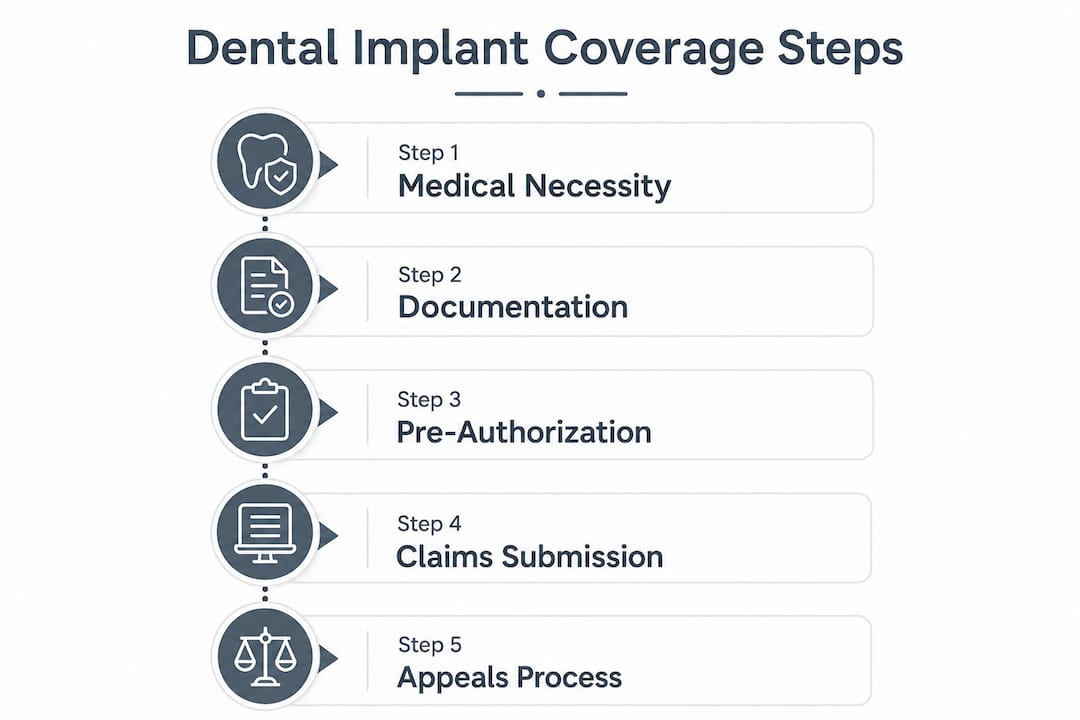
Documentation is where most claims succeed or fail. Comprehensive records including dental charts, 3D imaging, and a formal medical necessity letter are the minimum standard insurers expect. Missing any one of these creates grounds for an automatic denial.
Follow these steps to build a complete submission package:
- Gather your dental records. Request full periodontal charts, panoramic X-rays, and cone beam CT (CBCT) scans. CBCT imaging shows bone loss in three dimensions, which is far more persuasive than a flat X-ray alone.
- Obtain a medical necessity letter. This letter must come from your treating dentist or oral surgeon and include your personal information, your full medical and dental history, the specific diagnosis, the proposed treatment plan, and a clear explanation of why implants are the appropriate treatment rather than a bridge or denture.
- Add specialist letters. Letters from oncologists, rheumatologists, or other relevant specialists carry significantly more weight than a dentist’s letter alone. When multiple licensed physicians agree on necessity, insurers are far more likely to approve the claim.
- Use CPT codes, not CDT codes. This is the single most critical technical step. Dental CDT “D-codes” trigger automatic denial on a medical insurance claim. CPT code 21248 covers mandibular or maxillary reconstruction, and CPT code 41899 covers unlisted dentoalveolar procedures. Using the correct codes classifies the implant as reconstructive surgery, which is a covered category.
- Confirm your provider bills medical insurance. Not every dental office submits to medical insurers. Ask your provider directly whether they have experience with CPT code billing for implant procedures. The right provider makes this process significantly smoother.
Pro Tip: Ask your dentist’s billing coordinator to confirm the exact CPT codes before submission. One wrong code can delay your claim by months.
How do pre-authorization, claims submission, and appeals work?
Pre-authorization is the step most patients skip, and it is the one that costs them the most. Starting treatment before obtaining written pre-authorization from your medical insurer puts you at serious risk of paying the full cost out of pocket. Pre-authorization is not a guarantee of payment, but it is a formal insurer review of your proposed procedure codes and costs that gives you a written estimate of what they will cover.
The claims submission process works as follows:
- Submit your pre-authorization request with all supporting documentation before any procedure begins.
- After approval, proceed with treatment and confirm your provider submits the claim with the same CPT codes reviewed during pre-authorization.
- Keep copies of every document you submit, every letter you receive, and every phone call you make, including the date, time, and name of the representative.
- Track your claim status actively. Do not wait for the insurer to contact you.
When a claim is denied, the denial is not the end. Appeals that include additional clinical evidence and peer-to-peer reviews between your provider and the insurer’s medical reviewer succeed at a meaningful rate. A peer-to-peer review is a direct conversation between your dentist or physician and the insurer’s reviewing clinician. It gives your provider the chance to explain the medical rationale in clinical terms that a claims processor cannot fully evaluate.
Insurers frequently invoke the “least expensive alternative treatment” clause to deny implant claims, arguing that a denture or bridge would suffice. Challenge this with detailed clinical evidence showing why those alternatives are unsuitable for your specific anatomy or medical condition. Bone loss severity, systemic disease interactions, and prior failed restorations are all valid arguments.
Pro Tip: Request the specific denial reason in writing. Every appeal must directly address the stated reason, not just resubmit the same paperwork.
What are your options if medical insurance denies coverage?
A denial from medical insurance does not mean you pay the full cost alone. Several parallel strategies can reduce your out-of-pocket burden significantly.
- Use dental insurance for related procedures. Even if your dental plan excludes the implant itself, it may cover the crown, bone graft, or tooth extraction. Review your dental procedures coverage carefully to identify which components qualify.
- Apply HSA or FSA funds. Health savings accounts (HSA) and flexible spending accounts (FSA) allow you to pay for dental implants with pre-tax dollars. This effectively reduces your cost by your marginal tax rate.
- Stage treatment across plan years. If your dental plan has an annual maximum, scheduling the extraction and bone graft in one calendar year and the implant placement in the next lets you apply two years of benefits to one treatment.
- Ask about in-office financing. Many oral surgery practices offer payment plans, sometimes interest-free for 12–18 months. This does not reduce the total cost, but it makes it manageable.
The table below summarizes the main cost-management options when insurance coverage falls short:
| Strategy | Best for | Key limitation |
|---|---|---|
| Dental insurance partial coverage | Crowns, grafts, extractions | Annual cap of $1,000–$2,500 |
| HSA/FSA spending | Tax-free payment of full cost | Requires existing account balance |
| Staged treatment across years | Patients with dental plan maximums | Extends total treatment timeline |
| Provider financing plans | Immediate treatment needs | Interest may apply after promo period |
Implantveneerguide’s financial planning guide covers each of these options in detail, including how to combine them for maximum effect.
Key Takeaways
Medical insurance covers dental implants only when you prove medical necessity with correct CPT coding, complete clinical documentation, and a formal pre-authorization request before treatment begins.
| Point | Details |
|---|---|
| Medical necessity is the threshold | Coverage requires documented functional loss from trauma, cancer, or systemic disease. |
| CPT codes are non-negotiable | Using dental CDT codes on a medical claim causes automatic denial; use CPT 21248 or 41899. |
| Pre-authorization protects you | Always get written insurer approval before starting any implant procedure. |
| Appeals often succeed | Peer-to-peer reviews and additional specialist letters reverse many initial denials. |
| Fallback options exist | HSA/FSA funds, staged treatment, and partial dental coverage reduce costs when medical insurance denies. |
What I’ve learned about insurance claims that most guides won’t tell you
The single biggest mistake I see patients make is treating the insurance process as something their dentist will handle automatically. It is not. Your dentist’s billing team submits the paperwork, but you are the one who suffers the financial consequences of a denial. That means you need to be the most organized person in the room.
The framing of your claim matters as much as the facts inside it. Insurers read hundreds of claims a week. A letter that opens with a clear medical diagnosis, references a specific medical event, and uses clinical language tied to functional impairment reads completely differently than one that describes tooth loss in general terms. I have seen nearly identical clinical situations result in opposite outcomes based entirely on how the necessity letter was written.
The peer-to-peer review option is underused and undervalued. Most patients do not know it exists, and some providers do not proactively offer it after a denial. Ask for it directly. A five-minute conversation between your oral surgeon and the insurer’s reviewing physician can accomplish more than three rounds of written appeals.
Start the consultation checklist process early, before you even contact your insurer. The more organized your clinical picture is at the outset, the faster every subsequent step moves.
— Georgina
Implantveneerguide resources for your coverage planning
Navigating dental implant insurance coverage is easier when you have the right tools before your first insurer call.
Implantveneerguide’s candidacy checker gives you an evidence-based starting point, mapping your medical history and tooth loss cause against the criteria insurers actually use. From there, the cost estimator shows you realistic US price ranges so you can plan your HSA contributions or financing conversations with real numbers. Both tools are built on the same clinical standards that dental professionals use, with no sales pressure attached.
FAQ
Does medical insurance cover dental implants?
Medical insurance covers dental implants when the procedure is medically necessary due to trauma, cancer, or systemic disease. Purely cosmetic implants are not covered.
What CPT codes are used for dental implant claims?
CPT code 21248 covers mandibular or maxillary reconstruction, and CPT code 41899 covers unlisted dentoalveolar procedures. Using these codes instead of dental CDT codes classifies implants as reconstructive surgery on a medical claim.
What is a medical necessity letter for dental implants?
A medical necessity letter is a formal document from your treating provider that includes your diagnosis, medical history, treatment plan, and a clinical explanation of why implants are required over less expensive alternatives.
Can I appeal a dental implant insurance denial?
Yes. Persistent appeals with additional clinical evidence and peer-to-peer reviews between your provider and the insurer’s medical reviewer reverse many initial denials.
How can I reduce implant costs if insurance denies my claim?
Use HSA or FSA funds for tax-free payment, apply dental insurance to covered components like bone grafts or crowns, and consider staging treatment across two plan years to maximize annual benefits.