All on 4 Dental Implants Reviews: Real Patient Insights
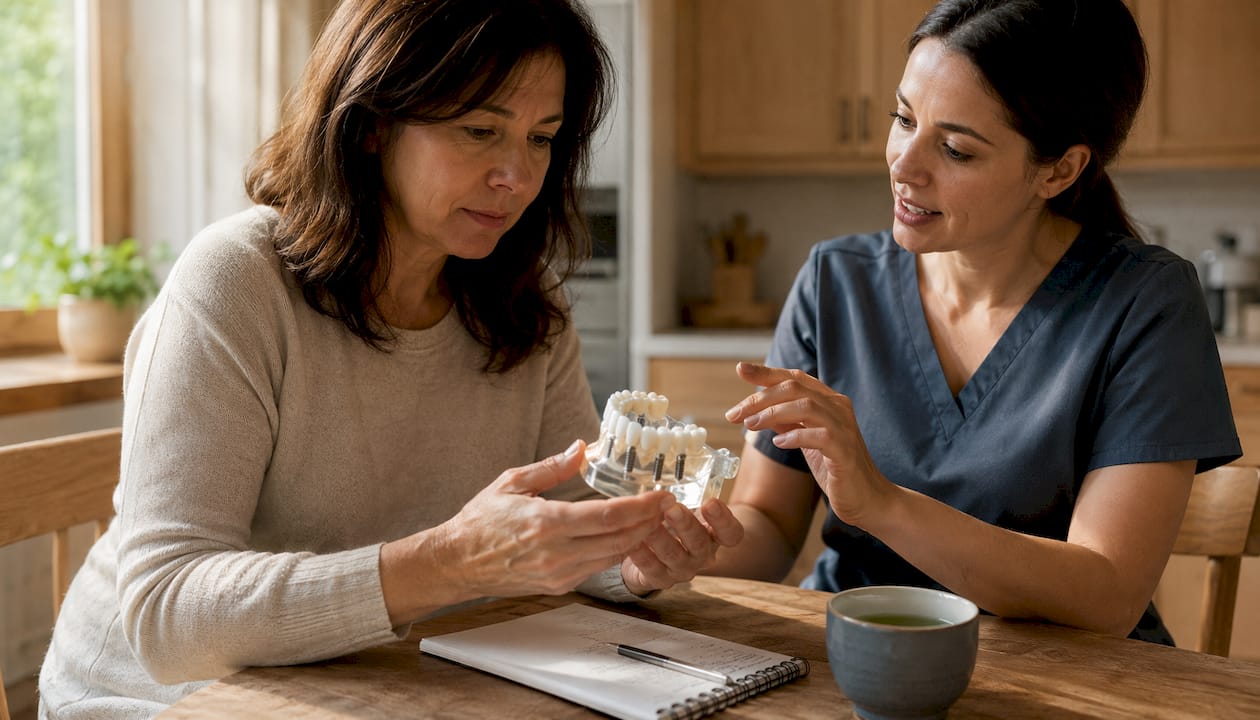
For most patients who need a full arch of teeth replaced, All-on-4 implants are worth serious consideration. Clinical data puts short-term implant survival at 99.8% at 24 months, and long-term survival at 95–98% at 10 years across multiple large-scale studies. Patient satisfaction tracks just as high: over 90% of patients say they would choose the procedure again, and most report restoring 80–90% of natural bite force. That combination of clinical durability and patient-reported outcome is hard to match with any removable alternative.
Before you go further, three conditions are immediate deal-breakers:
- Uncontrolled diabetes (HbA1c not optimized before surgery)
- Active heavy smoking with no cessation plan
- Unwillingness to accept a permanent, non-removable prosthesis
If none of those apply to you, the evidence and patient review themes covered below make a strong case. Implantveneerguide built this guide from peer-reviewed studies, systematic reviews, and real patient narratives so you can weigh both the clinical data and the lived experience side by side.
Table of Contents
- What do All on 4 dental implants reviews actually say about pros and cons?
- Common problems patients report in reviews and forums
- What is All-on-4 and how does it differ from dentures and individual implants?
- How much do All-on-4 dental implants cost in the U.S.?
- What does the clinical evidence say about survival rates and complications?
- What do long-term patient reviews actually say?
- Who is a good candidate, and what raises failure risk?
- What are your alternatives, and when should you choose them?
- What should you expect during recovery?
- What ongoing maintenance and repairs should you budget for?
- How should you read patient reviews and evaluate a provider?
- Key Takeaways
- The case for going in with clear eyes
- Useful sources and further reading
What do All on 4 dental implants reviews actually say about pros and cons?
What patients consistently praise
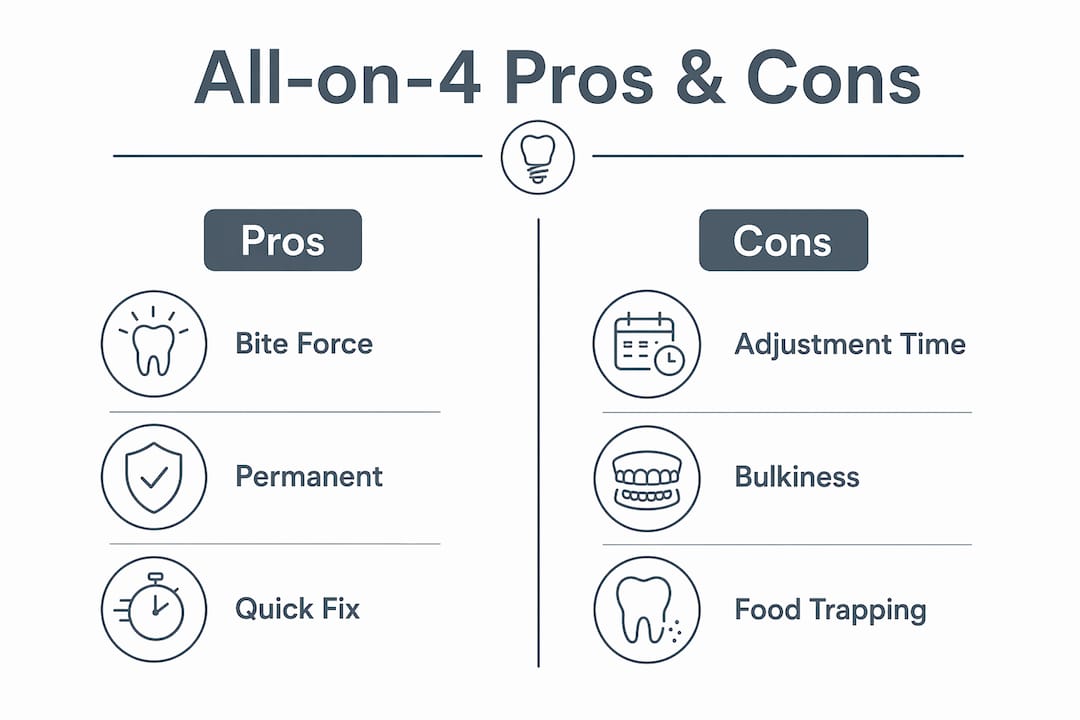
- Restored chewing ability. Patients describe eating steak, apples, and restaurant meals again after years of avoidance. The 80–90% bite force restoration reported in quality-of-life surveys matches what patients say in forums.
- Bone preservation. Implants prevent the jawbone resorption that causes the “sunken face” appearance common in long-term denture wearers.
- Fixed, permanent solution. No adhesive, no nightly removal, no soaking. Patients with prior denture experience consistently call this the single biggest quality-of-life shift.
- Improved speech and taste. A full palate-covering denture muffles taste and distorts speech. A fixed bridge eliminates both problems.
- Confidence. Patients report smiling more, speaking more clearly, and stopping the habit of covering their mouth when laughing.
What patients consistently complain about
- Initial bulkiness. The temporary prosthesis placed on surgery day feels thick and unnatural to most patients. This is the most common complaint in early reviews.
- Sensory differences. Biting into food feels different when force transmits through implants rather than natural tooth roots. Most patients adapt within a few months.
- Prosthesis repair needs. Acrylic bridges chip and fracture more often than zirconia, especially in the first year as bite forces settle.
- Cost and irreversibility. The procedure is effectively permanent. Patients who were not counseled on this upfront sometimes express regret, not about the outcome, but about the decision process.
| Dimension | Pros | Cons |
|---|---|---|
| Function | 80–90% bite force restored | Sensory adjustment period of weeks to months |
| Aesthetics | Natural appearance; bone structure preserved | Temporary prosthesis looks and feels bulkier |
| Permanence | Fixed; no removal needed | Irreversible; not suitable if you want reversibility |
| Cost impact | Single treatment vs. years of denture maintenance | Significant upfront cost per arch |
| Maintenance | Twice-yearly exams; water flosser daily | Acrylic repairs likely; zirconia repairs rare but costly |
| Lifespan | Acrylic ~10–15 years; zirconia 15–20+ years | Prosthesis replacement is a long-term budget item |
Common problems patients report in reviews and forums
The most frequent complaints in All-on-4 reviews are prosthetic, not surgical. Understanding which symptoms are normal adaptation versus red flags saves a lot of anxiety.
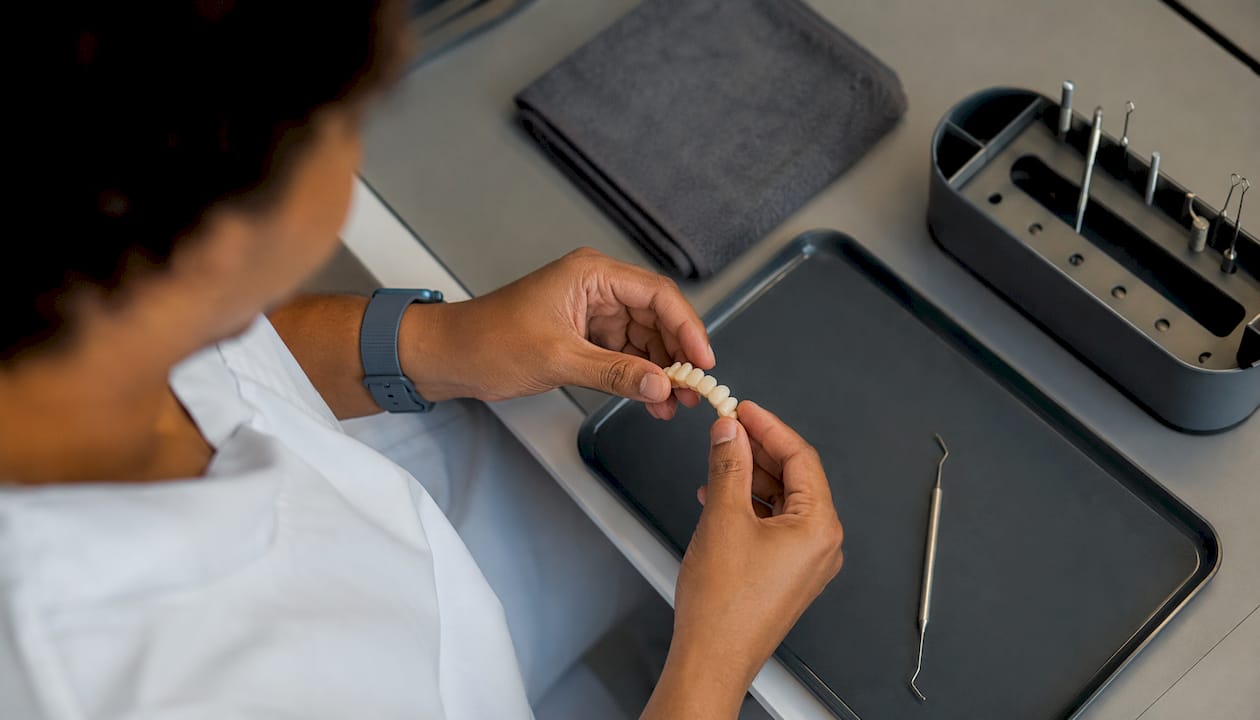
Temporary prosthesis bulkiness is almost universal in the first weeks. The same-day bridge is thicker than a final prosthesis because it needs to protect healing implants without precise bite calibration. Most patients describe it as feeling like “a mouthful of plastic.” It resolves when the final bridge is placed, typically at 3–6 months.
Speech changes appear early and usually resolve within 2–4 weeks. The tongue needs to relearn its position against a new surface. Reading aloud for 10–15 minutes daily accelerates adaptation.
Food trapping under the bridge is a real issue, particularly with the temporary prosthesis. A water flosser addresses most of it. Patients who skip this step report more gum irritation and more follow-up visits.
Prosthetic fractures and chips are the most common technical complication in systematic review data. Acrylic bridges are especially vulnerable. A single tooth segment chipping is not an implant failure; it is a prosthetic repair, usually completed in one appointment.
The healing gap surprises many patients. As post-surgical swelling subsides, gum tissue shrinks back to its natural contour, creating a visible gap between the gum line and the bridge. This is normal tissue remodeling, not a prosthetic failure. Patients who were not warned about it often post alarmed reviews in the first month.
Red flags that need immediate clinical attention:
- Persistent pain beyond 2 weeks post-op, or pain that returns after a pain-free period
- Implant mobility or a bridge that feels loose
- Swelling, discharge, or a bad taste that does not resolve within a week
- Numbness that does not improve after the first few days
Pro Tip: Keep a brief symptom log in the first 30 days. Noting when something changed (not just that it hurts) gives your surgeon far more useful information than “it’s been bothering me.”
For a deeper look at technical and prosthetic problems, Implantveneerguide covers the most common failure patterns and how experienced clinicians manage them.
What is All-on-4 and how does it differ from dentures and individual implants?
All-on-4 is a full-arch tooth replacement system where four implants support a fixed bridge that replaces an entire upper or lower row of teeth. The two posterior implants are typically angled at 30–45 degrees to maximize contact with available bone, which often eliminates the need for bone grafting that traditional implant placement requires.
How it differs from removable dentures:
- Dentures rest on gum tissue and rely on suction or adhesive. All-on-4 bridges are bolted to implants and do not move.
- Dentures accelerate jawbone resorption because they do not stimulate bone the way implant roots do. All-on-4 preserves bone density.
- Dentures restore roughly 20–25% of natural bite force. All-on-4 restores 80–90%.
How it differs from individual implants:
- Individual implants replace one tooth at a time, typically requiring one implant per tooth. A full arch of individual implants can involve 8–10 surgical placements.
- All-on-4 uses four implants to support a full arch, reducing surgical time, cost, and the need for extensive bone grafting.
- Individual implants are the better choice when only a few teeth are missing. All-on-4 is designed for full-arch or near-full-arch replacement.
A note on variants: The procedure is sometimes called All-on-X, where X may be 5 or 6 depending on bone quality, arch width, and the clinician’s judgment. More implants can improve load distribution, particularly for patients with bruxism or reduced bone density. The core concept is the same regardless of implant count.
**
How much do All-on-4 dental implants cost in the U.S.?
Per-arch pricing in 2026 breaks down by prosthesis material. Acrylic/PMMA hybrid bridges run $15,000–$25,000 per arch; zirconia bridges run $25,000–$38,000 per arch. Both arches together commonly land between $30,000 and $70,000+, depending on materials and surgical complexity.
| Item | Typical range |
|---|---|
| Implant placement (4 implants) | Included in most arch packages |
| Temporary prosthesis | Included in most arch packages |
| Final acrylic/PMMA bridge | Included in acrylic package |
The most common pricing trap is the “starting at” figure. Advertised bargain prices often cover only the temporary acrylic prosthesis, leaving the final bridge, extractions, imaging, and sedation as separate line items. A patient quoted “$12,000 per arch” may discover the all-in total is $22,000 once those items are added.
Use the cost estimator at Implantveneerguide to build a realistic regional estimate before your first consultation.
Insurance, FSA, and financing: Most dental insurance plans treat All-on-4 as elective and cover little or nothing. FSA and HSA funds can be applied to the surgical and diagnostic components. Most practices offer third-party financing through CareCredit or similar programs; 0% APR promotional periods are common but require minimum payment discipline to avoid deferred interest.
Pro Tip: Always request an itemized, all-inclusive treatment plan that separates the temporary bridge, the final bridge, imaging, sedation, and any anticipated add-ons. Compare that list line by line across at least two practices before committing.
What does the clinical evidence say about survival rates and complications?
The short-term data is strong. Implant survival reaches 99.8% at 24 months in large clinical series, with complete arch failures under 1%. Long-term data from multiple large-scale studies puts survival at 95–98% at 10 years.
Statistic: A systematic review of multiple cohorts found minimum implant survival of 97.6% at 36 months. Prosthetic fractures and component detachment were the most frequently reported complications, not implant loss.
| Outcome | Reported figure | Source type |
|---|---|---|
| Implant survival at 24 months | 99.8% | Large clinical series |
| Implant survival at 10 years | 95–98% | Multiple large-scale studies |
| Minimum survival at 36 months | 97.6% | Systematic review |
| Patients who would choose again | >90% | Quality-of-life surveys |
| Bite force restoration | 80–90% of natural | Patient-reported outcomes |
Prosthetic complications are the most common category of problem. Acrylic fractures, chipped teeth, and component detachment show up regularly in systematic review data. These are repairs, not failures, but they carry time and cost. Zirconia prostheses fracture far less often, which partly explains the price premium.
Biological complications center on peri-implantitis, an inflammatory condition affecting the tissue and bone around implants. It is the implant equivalent of periodontal disease and the primary long-term threat to implant survival. Frequency varies widely across studies depending on follow-up duration and diagnostic criteria.
Study limitations to know: Most published studies have follow-up periods of 5–10 years. Very long-term data (15–20 years) is limited because the procedure only became widespread in the early 2000s. The 95–98% survival figure is reliable for a decade; what happens beyond that is less well-documented.
What do long-term patient reviews actually say?
The pattern across multi-year patient accounts is consistent: high satisfaction, a difficult first few months, and a turning point when the final bridge is placed.
Recurring themes from patients at 1 year:
- Temporary prosthesis felt bulky and restricted diet, but the final bridge felt dramatically more natural
- Speech normalized within 2–4 weeks for most; a small number needed longer
- Eating out at restaurants again was the most-cited emotional milestone
- Patients who were warned about the healing gap handled it without alarm; those who were not warned posted panicked reviews
Recurring themes from patients at 3–5 years:
- Sustained satisfaction; most describe the procedure as one of the best decisions they made
- Acrylic bridge wearers reported at least one repair (chipped tooth, reline) within 3 years
- Zirconia bridge wearers reported fewer repairs but noted the higher upfront cost felt justified in retrospect
- A common regret: waiting too long due to fear or cost concerns
For anonymized multi-year patient scenarios, Implantveneerguide’s patient decision journeys illustrate typical 1-year and 5-year outcomes across different starting conditions.
Dental tourism reviews tell a different story. Cost savings can be significant, with per-arch prices at international clinics often running well below U.S. ranges. The tradeoff is continuity of care. Patients who develop a complication months after returning home face a difficult choice: manage it with a local dentist who did not place the implants, or travel back. Published clinic cost guides note this explicitly. If you are considering treatment abroad, Implantveneerguide’s dental tourism safety checklist is a practical starting point.

For a deeper look at what patients say on forums and social media, the Reddit review synthesis on Implantveneerguide separates genuine long-term accounts from short-term posts.
Who is a good candidate, and what raises failure risk?
Ideal candidate profile
- Missing most or all teeth in one or both arches, or teeth that are failing and will need extraction regardless
- Good general health that permits surgery under sedation
- Non-smoker, or genuinely committed to quitting before surgery
- Adequate bone volume, or willingness to accept minor grafting alternatives
- Stable systemic conditions (diabetes controlled, no active periodontal disease)
- Committed to twice-yearly maintenance and daily oral hygiene
Major risk factors
Smoking, uncontrolled diabetes, and heavy alcohol use are the three most consistently cited contributors to implant failure across clinical series. Active periodontal disease that has not been treated raises peri-implantitis risk significantly. Certain medications, including bisphosphonates and some immunosuppressants, affect bone metabolism and require a specific pre-op conversation with your surgeon.
Patients with bone loss should not assume they are automatically excluded. The angled posterior implants in the All-on-4 design specifically address moderate bone loss without grafting in many cases. For a detailed look at implant candidacy with bone loss, the guidance from Mersal Dental covers what is and is not feasible depending on the degree of resorption.
Pre-op optimization steps
- Get HbA1c below 7.0 (ideally below 6.5) before scheduling surgery if you have diabetes. Implantveneerguide’s guide on diabetes and implant healing explains the specific thresholds clinicians use.
- Begin a smoking cessation plan at least 8 weeks before surgery; many surgeons require confirmed cessation.
- Complete periodontal therapy for any active gum disease before implant placement.
- Bring a full medication list and medical history to your consultation.
Pro Tip: Ask your primary care physician to provide a written medical clearance note before your implant consultation. It speeds up the surgical planning process and signals to the implant team that you are a prepared, serious candidate.
What are your alternatives, and when should you choose them?
Fixed vs. removable vs. individual implants
| Option | Best for | Key tradeoff |
|---|---|---|
| Fixed All-on-4 | Full-arch loss; patients who want permanence | Irreversible; higher upfront cost |
| Removable implant-supported overdenture | Patients who want reversibility or lower cost | Less stable than fixed; requires nightly removal |
| Individual implants and crowns | Patients missing only a few teeth | Higher per-tooth cost for full-arch cases |
Patients who are hesitant about permanence should seriously consider a removable implant-supported overdenture. It uses 2–4 implants as anchors for a removable denture, costs significantly less, and can be upgraded to a fixed solution later. The function is better than a conventional denture but not as stable as a fixed bridge. For a full comparison of alternatives to dental implants, Implantveneerguide covers each option with candidacy criteria.
Zirconia vs. acrylic: which prosthesis material should you choose?
Acrylic/PMMA hybrid bridges cost less and are easier to repair chairside. A chipped tooth can usually be fixed in one appointment. The downside is that acrylic wears and stains over time, and repairs are commonly needed within a few years.
Zirconia bridges are harder, more translucent, and closer in appearance to natural enamel. They fracture far less often. When they do fracture, repair is more complex and sometimes requires a full replacement. The lifespan advantage (15–20+ years versus 10–15 for acrylic) makes zirconia the better long-term value for most patients who can absorb the higher upfront cost.
When to consider All-on-6
Adding two more implants (All-on-6) distributes bite load across a wider base. Clinicians typically recommend it for patients with bruxism, reduced bone density in the posterior jaw, or a wider arch that creates more leverage on the posterior implants. It is not a universal upgrade; for most patients with adequate bone, four implants perform equivalently.
What should you expect during recovery?
Healing happens in two distinct phases. Soft-tissue healing takes 7–14 days; osseointegration, where bone fuses to the implant surface, takes 3–6 months. The final bridge is placed after osseointegration is confirmed, commonly at the 3–6 month mark.
Week-by-week in the first month:
- Days 1–3: Swelling peaks. Pain is typically managed with prescribed analgesics and resolves for most patients within 72 hours. Soft diet only.
- Days 4–7: Swelling begins to subside. The healing gap becomes visible as gum tissue returns to its natural contour. This is normal.
- Weeks 2–4: Speech normalizes for most patients. Diet remains soft but expands to include more textures.
- Month 1–3: Osseointegration progresses. Patients continue on a modified diet, avoiding hard or crunchy foods that could stress the implants before full integration.
- Month 3–6: Final bridge fabricated and placed after bite measurements and imaging confirm stable integration.
Managing early symptoms:
- Swelling: ice packs in 20-minute cycles for the first 48 hours
- Altered taste: usually resolves within 2–4 weeks as swelling subsides
- Speech changes: read aloud daily; most patients normalize within 2 weeks
- Food trapping: use a water flosser at least once daily under the bridge
Pro Tip: Switch to a soft-bristle toothbrush and an antimicrobial rinse (chlorhexidine gluconate 0.12%, typically prescribed by your surgeon) for the first 2 weeks. These two steps reduce peri-implant inflammation during the most vulnerable healing window.
For a detailed phase-by-phase breakdown, Implantveneerguide’s recovery timeline guide covers milestones from surgery day through the 12-month mark.
What ongoing maintenance and repairs should you budget for?
Daily and routine care
- Brush twice daily with a soft-bristle toothbrush, paying attention to the gum line where the bridge meets tissue
- Use a water flosser daily to clear debris from under the bridge; this is non-negotiable for peri-implant health
- Twice-yearly professional cleanings with an implant-trained hygienist who uses non-metal instruments around the implant surfaces
- Annual or biannual X-rays to monitor bone levels around implants
Likely repairs by material
| Prosthesis type | Common repair | Typical lifespan | Repair frequency |
|---|---|---|---|
| Acrylic/PMMA hybrid | Chipped or fractured tooth segment | 10–15 years | At least once in 3–5 years for most patients |
| Zirconia | Fracture (less common); screw access repair | 15–20+ years | Infrequent; full replacement if major fracture |
Repair costs vary significantly by region and practice. A single acrylic tooth repair typically runs a few hundred dollars; a full prosthesis replacement is a larger investment comparable to the original prosthesis cost. Ask your provider at the outset which repairs are included in any warranty period and which are billed separately.
Peri-implantitis is the most serious long-term maintenance concern. Early signs include bleeding around the implant, gum recession, and bone loss visible on X-ray. Caught early, it is manageable. Left untreated, it can lead to implant loss. Implantveneerguide’s guide on peri-implantitis treatment covers the evidence-based intervention options, from mechanical debridement to surgical correction.
How should you read patient reviews and evaluate a provider?
Most negative All-on-4 reviews trace back to one of three sources: unmet expectations about the temporary prosthesis, sensory differences that were not explained pre-op, or a pricing surprise when the final bridge was billed separately. Knowing this changes how you read any review.
Checklist for evaluating patient testimonials
- Does the review specify whether the patient is describing the temporary or final prosthesis? Early complaints about bulkiness are almost always about the temporary.
- Does the review include a timeline? A 3-month review and a 3-year review are measuring completely different things.
- Were any complications reported, and if so, how did the clinic respond? A review that describes a complication and a good resolution is more informative than one that describes a perfect experience.
- Are before-and-after photos dated and clearly showing the final prosthesis, not the same-day temporary?
Questions to ask your provider
- How many full-arch cases have you placed, and what is your documented implant survival rate?
- Which implant brand and system do you use, and why?
- What exactly is included in the quoted price? Show me the itemized breakdown.
- What is your plan if one implant fails to integrate?
- What is your maintenance schedule and what repairs are covered under warranty?
- Can I see before-and-after photos of patients at 2+ years post-treatment?
Red flags in clinic claims and reviews
- A “starting at” price with no itemized breakdown
- Before-and-after photos that show only the temporary prosthesis
- No documented long-term cases or no willingness to share survival data
- Pressure to decide at the consultation appointment
- No mention of a follow-up protocol or maintenance schedule
Pro Tip: Use Implantveneerguide’s provider evaluation checklist before your consultation. It gives you a structured set of questions and scoring criteria so you can compare two or three practices on the same dimensions.
Key Takeaways
All-on-4 delivers reliable full-arch restoration for well-selected candidates, with 95–98% implant survival at 10 years and over 90% patient satisfaction, but realistic cost planning and candidacy screening determine whether the outcome matches the expectation.
| Point | Details |
|---|---|
| Clinical survival is strong | 99.8% at 24 months; 95–98% at 10 years across large-scale studies. |
| Patient satisfaction is high | Over 90% would choose the procedure again; 80–90% of natural bite force restored. |
| Cost requires line-item scrutiny | Per-arch acrylic runs $15,000–$25,000; zirconia $25,000–$38,000; “starting at” prices often exclude the final bridge. |
| Three deal-breakers disqualify candidates | Uncontrolled diabetes, active heavy smoking, and unwillingness to accept a permanent prosthesis. |
| Prosthetic repairs are expected | Acrylic bridges typically need at least one repair within 3–5 years; zirconia lasts 15–20+ years with fewer repairs. |
The case for going in with clear eyes
There is a version of the All-on-4 conversation that happens in a lot of dental offices, and it goes like this: the procedure is presented as a life-changing solution, the survival statistics are cited, the before-and-after photos are shown, and the patient leaves feeling either excited or overwhelmed. What often gets compressed or skipped is the middle part: the temporary prosthesis phase, the healing gap, the sensory adjustment, the repair cadence for acrylic, and the fact that “starting at $15,000” and “all-in $28,000” are not the same number.
The clinical evidence genuinely is strong. A procedure with 95–98% survival at a decade and over 90% patient satisfaction is not a marketing claim. But the patients who end up most satisfied are the ones who went in knowing what the first six months would actually feel like, who understood the difference between a temporary and a final prosthesis, and who got an itemized quote rather than a headline figure.
The patients who post the most alarmed reviews are almost never describing surgical failures. They are describing the healing gap nobody warned them about, or a chipped acrylic tooth they did not know was a routine repair, or a final bridge cost that appeared as a surprise line item. Those outcomes are not inevitable. They are the result of a consultation that moved too fast.
If you are seriously considering this procedure, the most useful next step is a 3D CBCT scan and a line-item quote from at least two practices. Implantveneerguide’s candidacy checker is a practical starting point to self-screen before that appointment.
Useful sources and further reading
- All-on-4 implant survival: clinical series data — PubMed, primary clinical series reporting 99.8% survival at 24 months and long-term survival of 95–98% at 10 years
- Patient satisfaction and functional outcomes — PubMed, quality-of-life survey data on bite force restoration and willingness to repeat the procedure
- The All-on-4 treatment concept: systematic review — PMC, multi-cohort systematic review covering prosthetic complication rates and minimum survival at 36 months
- All-on-4 dental implant cost guide — per-arch price ranges for acrylic and zirconia prostheses and breakdown of what “starting at” prices typically exclude
- All-on-4 risks and candidacy overview — Implantveneerguide’s clinical risk and candidacy resource
- Peri-implantitis treatment: what actually works — Implantveneerguide’s evidence-based guide to managing the primary long-term biological complication