Can Dental Implants Qualify as a Medical Necessity?
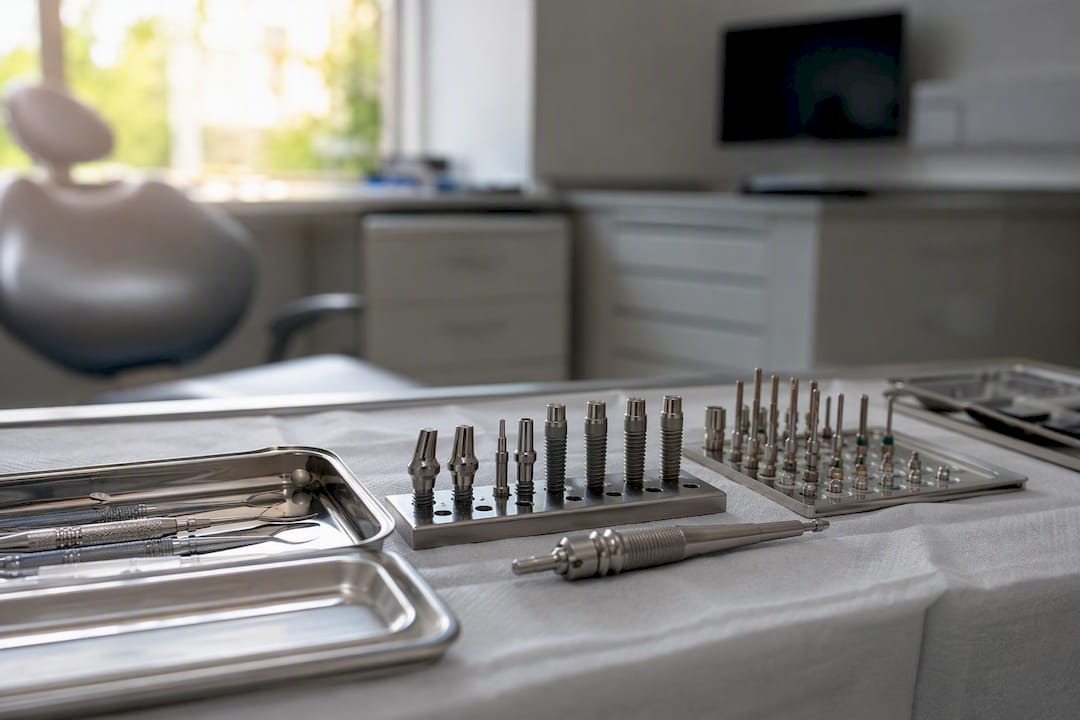
Yes. In the U.S., dental implants can be covered as a medical necessity when they correct a documented functional deficit or result from a qualifying medical cause, such as trauma, cancer treatment, or a systemic condition that impairs nutrition. Medicare, however, excludes routine dental services in most circumstances. Employer medical plans, dental plans, and Medicaid are where these claims usually get decided.
Before you do anything else:
- Ask your dentist for a written treatment plan and current radiographs.
- Request a predetermination or prior authorization in writing, not just a phone call.
- Pull your subscriber contract and read the dental and medical exclusions sections yourself.
Pro Tip: Insurers reviewing borderline cases often cite specific clinical thresholds, like fewer than several posterior occlusal contact points per side, rather than general statements about chewing difficulty. Match your documentation to that language.
Table of Contents
- Medical Necessity Dental Implants: What Insurers Actually Look For
- Which Insurers Cover Implants, and Where Coverage Gets Confusing
- Building the Documentation Package for Predetermination
- Medical Scenarios That Typically Support a Necessity Claim
- Where Claims Get Denied: Exclusions and Fine Print
- Paying the Gap: Financing When Coverage Falls Short
- How Implantveneerguide Helps You Prepare a Stronger Case
- How Medical Necessity Changes Implant Coding and Billing
- What the Clinical Evidence Says About Implant Necessity
- Your Rights When an Insurer Denies a Medical Necessity Claim
- Where to Go From Here
- Why This Process Rewards Patience Over Persuasion
- Frequently Asked Questions
- Sources
Medical Necessity Dental Implants: What Insurers Actually Look For
Insurers don’t approve implants because a patient wants better teeth. They approve them when the record shows a measurable “functional deficit,” meaning your mouth can no longer do its basic job of chewing, and covered alternatives (bridges, dentures) can’t fix it. The Excellus BCBS medical policy is a good example of how this gets written into plan language: fewer than four posterior occlusal contact points per side, or a denture that’s become unstable and painful despite adjustments, are treated as objective red flags rather than subjective complaints.
The documentation insurers typically request includes:
- An occlusal chart showing where teeth (or the lack of them) actually meet.
- Panoramic radiographs or a CT scan showing bone volume and existing tooth positions.
- A current evaluation of any existing denture or bridge, including why it’s failing.
- A written treatment plan from the treating dentist, tying the proposed implants to a specific functional or medical problem.
No two payers apply this the same way. A UHG clinical policy on implant placement, for instance, lays out separate thresholds for full-arch cases, often citing multiple implants per edentulous arch, versus single-tooth replacements. State Medicaid programs set their own bar entirely. The plan document governs, not what worked for your neighbor’s insurer.
Which Insurers Cover Implants, and Where Coverage Gets Confusing
Coverage for dental implants doesn’t sit neatly under one kind of insurance. It depends on why you lost the tooth and which policy you’re reading.
- Medical insurance sometimes covers implants when they treat or prevent a medical problem. Guardian’s overview of implant coverage notes that tooth loss from trauma, cancer treatment, or conditions like GERD or diabetes complications can trigger coverage, but only with clinical documentation linking the implant to that diagnosis.
- Dental insurance usually classifies implants as a standard dental benefit, often with an annual maximum, or excludes them outright. Check both your medical and dental plan documents; they rarely align.
- Medicaid varies drastically by state. New York, for example, revised its clinical criteria and prior-authorization requirements to expand implant coverage under medical necessity standards, something not every state has matched.
- Medicare excludes routine dental services in most Original Medicare coverage. Exceptions are narrow and generally tied to a covered medical procedure, like jaw reconstruction after cancer surgery, not standalone tooth replacement.
If you’re on a Medicare Advantage plan, some carriers add limited dental riders. Read that rider’s implant language specifically; it’s often thinner than it sounds in marketing materials.
Building the Documentation Package for Predetermination
A weak implant claim usually fails not because the case lacked merit, but because the paperwork didn’t connect the dots for a reviewer who’s never met you. The goal is to make the medical link obvious on paper.
Start with this checklist:
- A treatment plan from your prosthodontist or oral surgeon specifying the number and location of implants.
- Current radiographs or a CT scan, no older than what your specific insurer requires (often six to twelve months).
- An occlusal analysis documenting contact points, or lack of them.
- Medical records connecting the tooth loss to an underlying diagnosis, cancer treatment, trauma, or a systemic condition affecting healing or nutrition.
- Operative or pathology reports if the tooth loss followed surgery, radiation, or an accident.
A letter of medical necessity ties this together in narrative form. It should state plainly why the patient can’t function without the implant, why cheaper alternatives (a removable denture, a bridge) have already failed or would fail, and how the implant addresses the diagnosis on record, not just the missing tooth.
Once submitted, most predetermination reviews take two to four weeks, though Excellus BCBS’s provider guidance recommends submitting interarch distance and proposed restoration design upfront to avoid a second request cycle. If denied, ask for the full written denial reason, then file an internal appeal with any missing clinical detail before considering external review.
Implantveneerguide’s guide to getting implants covered by medical insurance walks through this appeal sequence in more detail if your first submission gets rejected.
Medical Scenarios That Typically Support a Necessity Claim
Certain patient histories map cleanly onto insurer logic, because each one shows the implant fixing a functional or systemic problem, not a cosmetic one.
- Traumatic facial injury. A car accident or sports injury that destroys teeth and surrounding bone leaves an obvious functional gap insurers recognize quickly.
- Cancer treatment. Radiation or chemotherapy to the head and neck often causes tooth loss or bone damage that a fixed prosthesis can’t safely replace without an implant foundation.
- Denture failure. When a lower denture has become so unstable that a patient can’t maintain adequate nutrition, that’s a documented systemic risk, not a comfort complaint.
- Progressive bone loss. Cases where remaining bone is deteriorating and delay would make future implant placement impossible carry real urgency in a reviewer’s eyes.
Purely elective cases, wanting straighter-looking replacement teeth when a functional bridge already works, rarely clear the bar. Insurers reserve medical necessity language for cases where the alternative is decline, not dissatisfaction.
Where Claims Get Denied: Exclusions and Fine Print
Most denials trace back to policy language patients never read closely. Third-molar (wisdom tooth) implants are almost universally excluded. So are cases framed as improving appearance on an arch that already functions adequately. Some policies also exclude implants meant to “extend” a functional arch rather than repair a genuine gap.
Watch for these limits before you submit anything:
- Caps on the number or location of implants covered, often written for denture-anchoring cases specifically, not full mouth reconstruction.
- Ancillary services (bone grafts, sinus lifts) excluded unless bundled into the same authorization.
- Mandatory healing periods after grafting before implant placement will be approved, sometimes four to six months.
Get every predetermination answer in writing, and request the complete denial letter if you’re refused. Verbal assurances from a call center rarely hold up during an appeal.
Paying the Gap: Financing When Coverage Falls Short
Partial coverage, or none, is common enough that it’s worth planning for before treatment starts. A Health Savings Account or Flexible Spending Account can usually cover implant costs when a dentist documents the procedure as treating a diagnosed condition, so keep your treatment plan and diagnosis codes on file for reimbursement.
Beyond tax-advantaged accounts:
- Many oral surgery and prosthodontic offices offer in-house payment plans or partner with third-party medical financing.
- Staging treatment (a removable overdenture now, a fixed full-arch restoration later) can spread cost over time without abandoning the medical rationale for treatment.
- Dental schools and nonprofit clinics sometimes offer reduced-cost implant placement through supervised student programs, worth checking if cost is the main barrier rather than urgency.
Pro Tip: Ask your prosthodontist for CPT and CDT codes upfront. Having the exact billing codes ready speeds up both HSA/FSA reimbursement and any appeal you end up filing. Implantveneerguide’s cost estimator for U.S. implant pricing can help you scope realistic ranges before you commit to a plan.
How Implantveneerguide Helps You Prepare a Stronger Case
Good documentation starts before you ever call your insurer. Implantveneerguide’s Dental Implant Candidacy Checker screens for the same clinical factors insurers ask about: functional deficits, available bone volume, and health conditions like uncontrolled diabetes that can complicate healing, as outlined in Mayo Clinic’s clinical guidance.
The site’s implant consultation checklist maps directly onto what claims reviewers request: current radiographs, occlusal contact findings, and an explicit treatment plan rather than a vague recommendation. Every guide is built from peer-reviewed clinical sources and existing insurer policy language, not marketing copy, which is the point of the platform.
- Screen your own case for functional-deficit indicators before your consultation.
- Cross-check candidacy factors like bone density and systemic health against Mayo Clinic’s clinical criteria.
- Use the consultation checklist to walk into your appointment with the right questions already prepared.
How Medical Necessity Changes Implant Coding and Billing
Whether an insurer treats a case as medically necessary directly shapes which codes your provider submits and how the claim gets processed. Dental implants are billed under Current Dental Terminology (CDT) codes, like D6010 for endosteal implant placement, when submitted to a dental plan. When the same procedure is tied to a medical diagnosis, trauma repair, tumor reconstruction, or a systemic condition, providers often submit under CPT codes instead, routing the claim through medical insurance rather than dental.
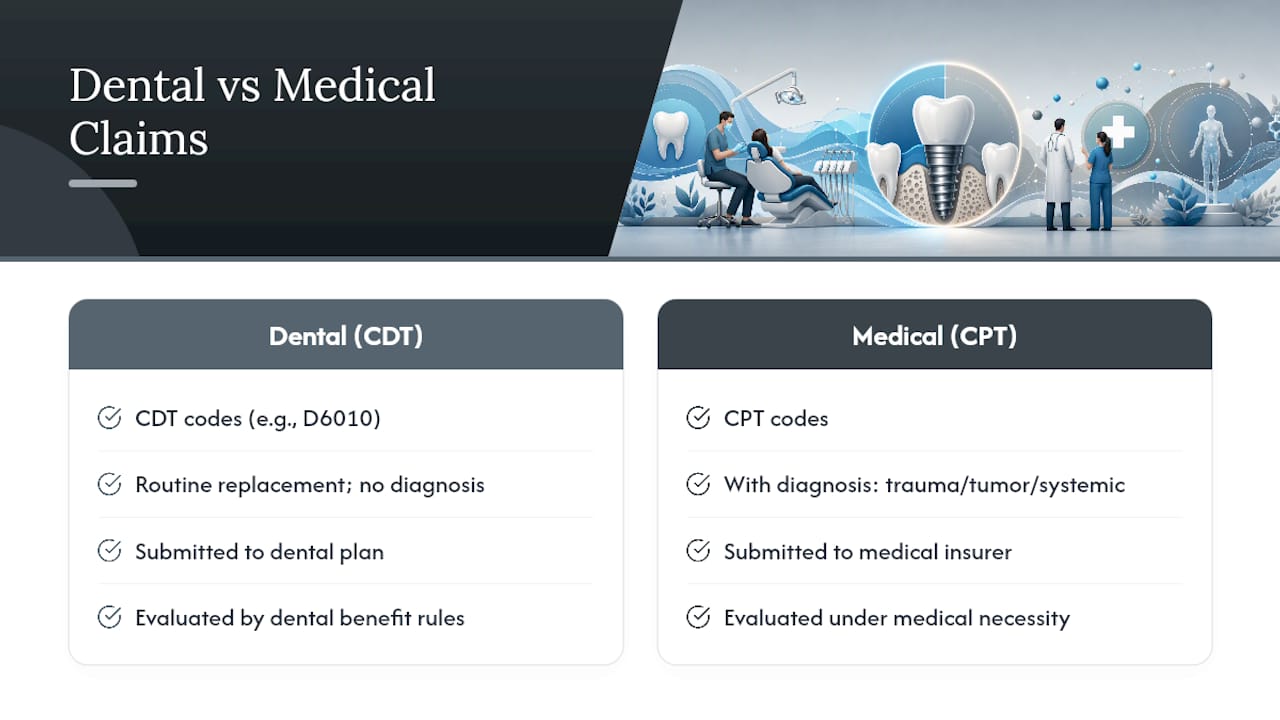
This distinction matters because a claim coded purely as dental (cosmetic-leaning language, no diagnosis code attached) gets evaluated against a dental plan’s often-thin implant benefit, sometimes capped at a few thousand dollars lifetime. The same procedure, coded with an ICD-10 diagnosis code that documents the underlying medical cause, gets evaluated under medical necessity criteria instead, where coverage can be more generous but documentation demands are stricter.
Providers who bill for medical necessity typically attach diagnosis codes explaining why the tooth was lost or why function is impaired, not just a procedure code describing what was done. A claim for implant placement following mandibular reconstruction after cancer surgery, for instance, gets billed differently than the same implant placed for an otherwise healthy patient replacing a tooth lost to decay. Ask your billing office directly which coding pathway they intend to use, and whether they’ll submit to medical insurance, dental insurance, or both in sequence. Dual submission, dental first, medical as a secondary claim, is common practice when a case has real medical grounding but the dental benefit alone won’t cover the full cost.
What the Clinical Evidence Says About Implant Necessity
The case for implants as medically necessary, rather than elective, rests on decades of clinical outcomes data, not just insurer convenience. Industry summaries report implant success rates commonly between 90% and 95%, a figure clinicians point to when arguing implants are a durable, evidence-backed solution rather than a premium upgrade over dentures.
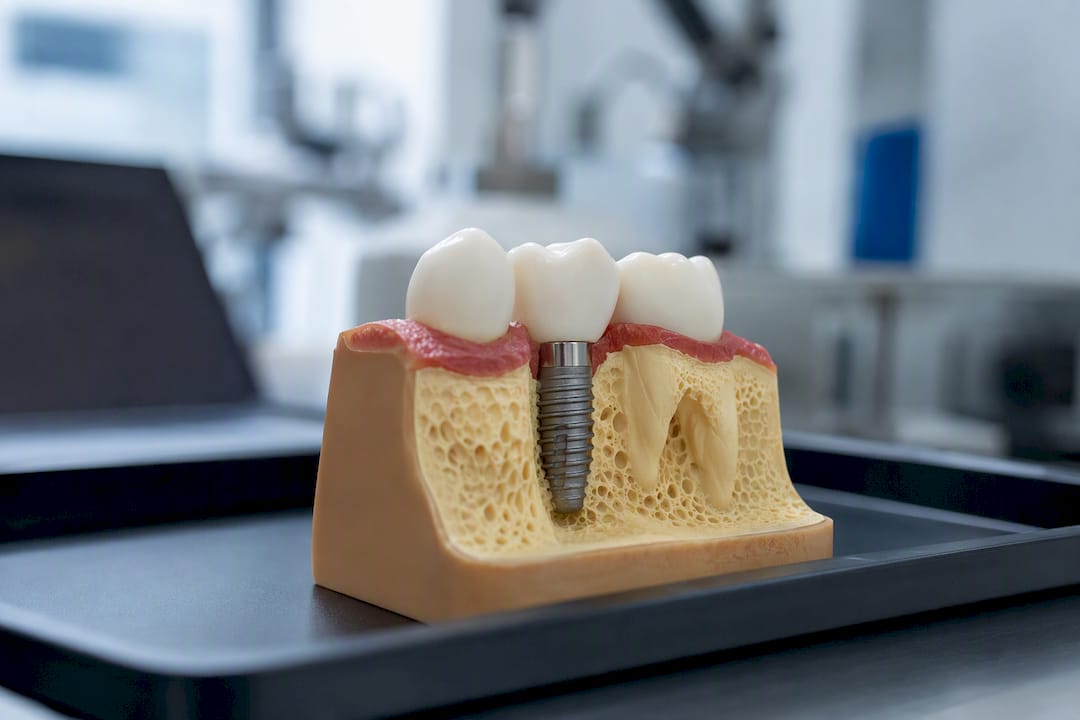
The clinical rationale insurers increasingly accept centers on bone preservation. When a tooth is lost, the jawbone beneath it begins to resorb without a root stimulating it. An implant, because it integrates directly into bone the way a natural root does, is one of the few restorative options that actually slows that process rather than sitting passively on top of the gum line the way a denture does. That distinction, preventing progressive bone loss versus simply covering a gap, is what pushes clinical framing away from cosmetics and toward function.
The FDA’s classification of dental implants as regulated medical devices reinforces this framing at a federal level: implants are evaluated and cleared based on safety and functional performance standards, not cosmetic criteria, and you can learn how to whiten teeth after dental work safely to maintain their appearance. Mayo Clinic’s own clinical guidance on the procedure similarly frames candidacy around bone health, healing capacity, and systemic conditions, the same functional lens insurers apply when deciding a claim. Practical coverage success tends to hinge less on a dentist’s general statement that “implants would be better” and more on documentation that ties a specific oral finding to a specific systemic or functional consequence, like a documented inability to chew certain foods leading to measurable nutritional risk.
Your Rights When an Insurer Denies a Medical Necessity Claim
A denial isn’t the end of the process, and it isn’t necessarily correct. Every U.S. health plan governed by ERISA (most employer-sponsored plans) is legally required to provide a written denial reason and a defined internal appeal process, typically with at least 180 days to file. Read the denial letter closely; insurers sometimes deny for a fixable documentation gap rather than a genuine coverage exclusion, and resubmitting with the missing radiograph or occlusal record can overturn the decision without a formal appeal at all.
If the internal appeal fails, many states require insurers to offer an external review conducted by an independent reviewer with no financial stake in the outcome. This review is binding on the insurer in most states, meaning if the external reviewer sides with you, the plan generally has to pay. State insurance departments (not just the plan itself) can also field complaints when a denial appears to conflict with the plan’s own written medical policy, which is worth pursuing if your case matches the insurer’s own published functional-deficit criteria and still got denied.
Medicaid denials follow separate state-specific appeal procedures, often through a state fair hearing process rather than the ERISA framework. Timelines and evidentiary standards vary by state, so check your state Medicaid dental manual directly rather than assuming federal appeal rules apply. For complex or repeated denials, some patients consult a healthcare advocate or attorney who specializes in insurance appeals, particularly when the dollar amount at stake covers full-arch reconstruction rather than a single implant.
Where to Go From Here
Yes, dental implants can qualify as a medical necessity in the U.S., but coverage depends entirely on documentation quality and which specific plan language governs your case.
| Point | Details |
|---|---|
| Functional deficit documentation | Collect occlusal charts, radiographs, and a written treatment plan before requesting predetermination. |
| Payer type matters | Medical insurance, dental insurance, and Medicaid apply different criteria; Medicare largely excludes routine dental care. |
| Letter of medical necessity | Explicitly link tooth loss or dysfunction to a diagnosed medical condition, not just cosmetic preference. |
| Denials are appealable | Request the full denial letter and pursue internal appeal, then external review if your plan qualifies. |
| Financial backup plans exist | HSA/FSA funds, office financing, and staged treatment can offset costs when coverage falls short. |
If you’re still assembling your case, Implantveneerguide’s Dental Implant Candidacy Checker is a practical starting point, and the procedures overview covers how implants compare to other restorative options if your claim doesn’t go through.
Why This Process Rewards Patience Over Persuasion
The biggest misconception patients carry into this process is that a compelling personal story wins a medical necessity claim. It doesn’t. Insurers respond to documentation that matches their own published clinical thresholds, not to how urgently a patient describes their situation. That’s a hard adjustment for people who’ve genuinely suffered with failing dentures for years and expect their frustration to count as evidence.
The conventional advice, “ask your dentist to write a strong letter,” undersells what actually moves a claim forward. A strong letter paired with a weak radiograph or missing occlusal chart still gets denied. What works is treating this like an insurance claim first and a health story second: get the objective clinical measurements the payer’s own policy asks for, then let the letter connect those measurements to your diagnosis.
If you take one thing from this guide, prioritize the paperwork before the persuasion. Match your case to your specific insurer’s published criteria, not to what worked for someone else’s plan. That’s the difference between a fast approval and a frustrating year of appeals.
Frequently Asked Questions
What qualifies as medical necessity for dental implants? Insurers generally require a documented functional deficit, such as fewer than four posterior occlusal contact points per side, an unstable or painful denture, or tooth loss tied to trauma, cancer treatment, or a systemic condition affecting nutrition or healing.
Does Medicare cover dental implants? Original Medicare excludes routine dental services in most circumstances, including implants placed for standard tooth loss. Coverage exceptions are narrow and usually tied to a separately covered medical procedure, not standalone implant placement.
How do I write a letter of medical necessity for dental implants? The letter should clearly connect your tooth loss or oral dysfunction to a diagnosed medical condition, explain why standard alternatives like a bridge or denture have failed or would fail, and reference the specific clinical documentation, radiographs, occlusal analysis, and treatment plan, submitted alongside it.
Can I appeal a denied dental implant claim? Yes. Most employer plans require a written denial reason and offer an internal appeal, often followed by an independent external review in many states. Medicaid denials follow separate state fair hearing procedures instead of the standard employer-plan appeal process.
Will insurance cover implants for cosmetic reasons? Generally no. Purely elective cases where an existing bridge or denture already functions adequately rarely meet medical necessity thresholds, since insurers reserve that classification for documented functional or systemic risk, not appearance.
This article is general information, not a substitute for advice from a qualified doctor. Consult a qualified healthcare professional about your own circumstances before acting on anything here.
Sources
- Dental Implants — Excellus BCBS medical policy
- Dental implant surgery — Mayo Clinic
- Dental implants: what you should know — FDA