Does Dental Insurance Cover Veneers? What US Plans Pay For

Short answer: no, most dental insurance in the United States does not cover veneers, because insurers classify them as cosmetic. The exception is narrow, but real: if a tooth needs a veneer to repair trauma, severe enamel loss, or another functional problem, some plans will pay part of the cost once you prove medical necessity.
That single distinction, cosmetic versus medically necessary, decides almost every veneers insurance coverage claim in the country. Before you book anything, pull your plan’s schedule of benefits and its limitations and exclusions section, then call your insurer and ask for a predetermination in writing. That one document tells you what the insurer will actually pay before you’re on the hook for it.
- Cosmetic veneers: excluded by nearly every dental plan, no exceptions worth counting on.
- Medically necessary veneers (trauma, enamel erosion, structural fracture): sometimes covered, partially, with documentation.
- Your move right now: request a predetermination using the correct CDT code before treatment starts.
Key Takeaways
Veneers insurance coverage in the US almost always excludes cosmetic cases and only sometimes pays toward medically necessary ones with strong documentation and the right CDT code.
| Point | Details |
|---|---|
| Cosmetic exclusion is standard | Nearly every US dental plan excludes veneers unless the case is medically necessary. |
| Medical necessity requires proof | Trauma, severe enamel erosion, or structural loss need imaging and a written clinical narrative. |
| CDT code choice matters | D2960, D2961, and D2962 can each get different coverage treatment from the same insurer. |
| Predetermination avoids surprises | A written pre-estimate shows exact dollar amounts before treatment, not just a vague “covered” answer. |
| Annual maximums cap payouts | A $1,000 to $2,500 yearly limit can be exhausted by one porcelain veneer, even after approval. |
Table of Contents
- Why Insurers Treat Veneers as Cosmetic
- When Veneers Might Actually Get Covered
- How Insurers Actually Evaluate a Veneer Claim
- What Veneers Actually Cost, With or Without Insurance
- Building a Claim That Has a Real Shot
- Paying for Veneers When Insurance Says No
- Your Checklist Before You Schedule Anything
- Pre-Existing Condition Clauses and Older Damage
- Individual Plans vs. Group Dental Insurance
- State Rules That Can Change Your Coverage
- Medicare, Medicaid, and Veneers
- What the Research Actually Supports
- Frequently Asked Questions
- Sources
Why Insurers Treat Veneers as Cosmetic
Dental plans exclude veneers using language like “procedures that are cosmetic in nature, including but not limited to veneer facings.” Delta Dental’s own coverage page states this plainly, and it’s echoed almost word for word across Humana’s veneer guidance. Insurers don’t hide this. They put it in the policy on purpose.
Part of the reason traces back to federal health policy. Under the Affordable Care Act, dental coverage for adults was never designated an essential health benefit the way pediatric dental was. That gives insurers wide latitude to exclude elective procedures for adult members, and veneers land squarely in that category unless a dentist can show functional necessity.
A few plan clauses compound the problem:
- Missing-tooth clauses deny coverage tied to conditions that existed before the policy started.
- Frequency limitations cap how often a restorative procedure on the same tooth gets paid for, sometimes once every five to seven years.
- Cosmetic exclusion riders apply even when a dentist frames the work as restorative, unless documentation says otherwise.
Roughly one in three US adults reports skipping dental care due to cost, according to consumer surveys, and veneers sit at the expensive end of that spectrum precisely because insurance rarely helps.
When Veneers Might Actually Get Covered
Insurers don’t cover veneers for a straighter smile. They sometimes cover them when a tooth’s structure or function is genuinely compromised. UnitedHealthcare’s own clinical policy on labial veneers lists specific clinical indications insurers look for before approving anything.
- Traumatic fracture. A chipped or cracked front tooth from an accident, a sports injury, or a fall has a documented cause and a clear before-and-after clinical picture.
- Severe enamel erosion. Acid erosion, certain medications, or genetic enamel defects (amelogenesis imperfecta, for example) can thin enamel to the point where a veneer restores function, not just appearance.
- Structural loss affecting bite or speech. When a tooth’s shape has changed enough to interfere with chewing or clear speech, that’s a functional argument insurers can weigh.
What strengthens any of these claims is the paper trail behind them: dated X-rays or intraoral photos, a written clinical narrative from the dentist explaining why a veneer (not a filling or crown) is the appropriate fix, and a record of any prior treatment on that tooth. Insurers want to see that this isn’t an elective upgrade dressed up as a repair.
Even strong clinical evidence sometimes loses to plan language. A missing-tooth clause, a strict cosmetic exclusion, or a frequency limit can override medical necessity entirely, and there’s often no appeal path around a hard exclusion written into the contract itself.
Pro Tip: Ask your dentist to photograph the damaged tooth immediately after an injury, not weeks later. Insurers weigh contemporaneous documentation far more heavily than a narrative written after the fact.
How Insurers Actually Evaluate a Veneer Claim
Three procedure codes govern how veneers get billed, and the code chosen can single-handedly decide the outcome. CDT code D2960 covers direct resin veneers built chairside, D2961 covers indirect resin veneers made in a lab, and D2962 covers porcelain laminate veneers. Some plans will pay toward D2960 while flatly excluding D2962, since porcelain reads as the more cosmetic, premium option even when the clinical justification is identical.

Predetermination is the tool that turns guesswork into a real answer. Submitting a predetermination request, sometimes called a pre-estimate, gets you a written response from the insurer stating what it will pay and how that amount applies toward your deductible and annual maximum, all before treatment starts.
Two structural limits shape what you’ll actually receive:
- Alternative-benefit rules (“least expensive alternative treatment”) mean an insurer can approve the claim but pay only what a cheaper procedure, like a composite filling, would have cost. You cover the difference for porcelain.
- Annual maximums, commonly between $1,000 and $2,500 per year, can be wiped out by a single porcelain veneer, leaving nothing for other care that year.
Many plans also impose a waiting period of six to twelve months before major restorative work is covered at all. If you enrolled recently specifically to get veneer coverage, check that waiting period first. It often makes the whole conversation moot.
What Veneers Actually Cost, With or Without Insurance
Material choice drives price more than almost anything else. Composite resin veneers typically run $500 to $2,895 per tooth, while porcelain veneers run higher, often $1,000 to $4,000 per tooth. Porcelain also tends to last longer and resists staining better, according to Cleveland Clinic’s overview of veneer materials, which is part of why insurers push back harder on covering it.
Here’s how the math tends to play out when a claim is approved under a medical-necessity exception:
- Insurer applies alternative-benefit rules. If your porcelain veneer costs $2,200 but the insurer treats it like a $900 composite repair, you’re reimbursed based on the $900 baseline.
- Coinsurance kicks in on that baseline. A plan paying 50% of major restorative work covers roughly $450 of that $900, not $2,200.
- You pay the remainder. In this example, that’s roughly $1,750 out of pocket for one tooth, and that’s before the annual maximum caps anything else you need done that year.
Two porcelain veneers can burn through a $2,000 annual maximum by themselves, which is why the cost estimator tool is worth running before you commit to a treatment plan rather than after.
Building a Claim That Has a Real Shot
Getting a veneer claim approved is less about luck and more about paperwork discipline. Here’s the sequence that gives you the best odds:
- Get a written clinical narrative from your dentist that states the diagnosis, the cause (trauma, erosion, fracture), and why a veneer specifically is the appropriate treatment rather than a filling or crown.
- Confirm the CDT code before submission. Ask your dentist’s office which code (D2960, D2961, or D2962) they intend to bill, and whether your plan treats that code differently than the alternatives.
- Submit the predetermination request and wait for the written response rather than starting treatment on a verbal assurance from a call center representative.
- If denied, file an appeal that responds to the specific denial reason, not a general restatement of your case. New radiographs, a second opinion from another dentist, and a direct reference to the plan’s own clinical policy language all strengthen an appeal meaningfully.
- Ask about medical billing if trauma caused the damage. If an accident broke the tooth, ask whether the practice has experience cross-coding to medical insurance, since medical plans sometimes cover trauma-related dental work that dental plans won’t touch, and often at a higher payout.
Pro Tip: Request the insurer’s internal review notes along with any denial letter. Reviewers sometimes cite a specific missing document, and knowing exactly what they wanted saves you a second denial cycle.
Paying for Veneers When Insurance Says No
Most people end up paying for at least part of their veneers out of pocket, even with a successful claim. A few options soften that blow.
- HSA and FSA funds can be used for veneers that treat or prevent disease, but not for purely cosmetic work. IRS Publication 502 draws that line clearly, so keep the clinical narrative on file in case you’re asked to substantiate the expense later.
- In-office payment plans let you spread cost over several months, often interest-free for a limited window.
- Third-party dental financing extends payments longer but usually carries interest once any promotional period ends.
- Dental discount plans aren’t insurance. They’re a membership that gets you a negotiated discount, often 10% to 60% off, with no annual maximum or waiting period to worry about.
- Composite veneers, bonding, or crowns cost less upfront than porcelain veneers, though composite stains faster and needs more frequent replacement, and a crown removes more natural tooth structure. The veneer versus crown decision aid walks through that trade-off in more detail.
Your Checklist Before You Schedule Anything
Four things determine whether your treatment timeline and your wallet stay aligned:
- Pull your plan’s schedule of benefits and its limitations and exclusions section, and call to confirm exactly how your insurer handles D2960, D2961, and D2962.
- Request a predetermination in writing, and ask directly whether a waiting period, missing-tooth clause, or frequency limit applies to your case.
- Expect predeterminations to take two to four weeks and appeals to run four to eight weeks, so build that time into your treatment schedule rather than assuming a fast answer.
- If the first answer is a denial, treat it as round one, not the final word.
Why Trust Implant Veneer Guide
Implantveneerguide builds its guides in collaboration with dental professionals and grounds every claim in peer-reviewed research and primary insurer documentation, not marketing copy.
- Evidence-based content reviewed against clinical policy language, not sales material.
- Free tools, including a candidacy checker and a cost estimator, built to help you plan before you commit.
- No provider referrals or paid placements influencing the guidance you read here.
Pre-Existing Condition Clauses and Older Damage
A pre-existing condition clause lets an insurer deny coverage for a problem that existed before your policy took effect, and it’s one of the most common reasons a seemingly solid medical-necessity claim still gets rejected. If the fracture, decay, or enamel loss on the tooth predates your enrollment date, even by a few weeks, the insurer can point to that clause and walk away from the claim entirely.
This catches people off guard because the timeline often isn’t obvious from a single visit. A tooth that’s been slowly eroding for years doesn’t have one clean injury date the way a sports accident does, and insurers know that ambiguity works in their favor. Reviewers will look at your dental records going back to your enrollment date, sometimes further, to establish when a problem started.
The practical defense is documentation that predates the treatment request. If you have X-rays or exam notes from before you needed the veneer that show the tooth was healthy, or at least show a clear point when the damage began, that record can rebut a pre-existing condition denial. Without it, the burden of proof falls entirely on your word against the insurer’s assumption.
This is one more reason to request a predetermination early rather than waiting until a tooth is failing. A predetermination submitted while a tooth is still stable, followed later by documented trauma or a diagnosed progressive condition, creates a timeline that’s much harder for an insurer to dispute.
Individual Plans vs. Group Dental Insurance
Group dental plans, the kind offered through an employer, tend to have broader networks, higher annual maximums, and shorter or waived waiting periods compared to individual plans purchased directly through an insurer or a marketplace. Employers negotiate group rates that spread risk across many employees, which generally gives insurers more room to soften some restrictions.
Individual plans purchased on the open market often come with longer waiting periods for major restorative work, sometimes twelve months rather than the six months common on group plans, and lower annual maximums. Insurers writing individual policies have less predictable risk pools, since anyone can enroll regardless of their current dental health, so they compensate with tighter limits and more conservative underwriting.
Neither plan type covers cosmetic veneers as a rule. The difference shows up almost entirely in how medically necessary claims get processed. A group plan is more likely to have a shorter waiting period standing between you and coverage, and a marginally higher chance that a claims reviewer has flexibility on borderline cases. An individual plan, particularly a lower-premium option, may carry a stricter frequency limitation or a lower annual maximum that caps what you can recover even after approval.
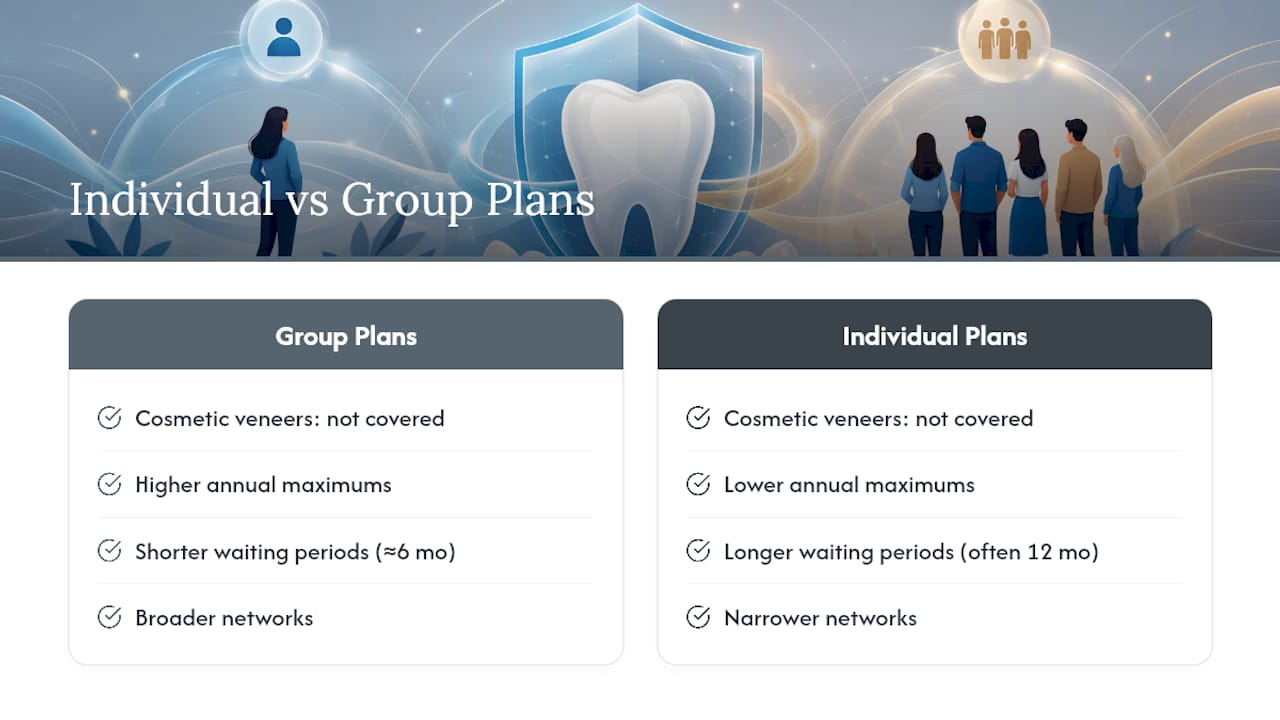
If you’re choosing between employer coverage and an individual plan and veneers are a live possibility, ask both insurers directly about their waiting period for major restorative work and their current annual maximum before you enroll in either one.
State Rules That Can Change Your Coverage
Dental insurance regulation happens mostly at the state level, and that creates real variation in what protections you have if a claim gets denied. Every state has an insurance department that oversees dental plan filings, but the specific mandates vary. Some states require insurers to offer an external review process for denied claims, which gives you a path beyond the insurer’s own internal appeal if your medical-necessity case gets rejected twice.
A smaller number of states have passed laws restricting how alternative-benefit clauses can be applied, limiting how aggressively an insurer can downgrade a claim to the cheapest comparable procedure. Others regulate waiting periods on group plans more tightly than federal law requires. None of these mandates require insurers to cover cosmetic veneers, that exclusion holds nationwide, but they can affect how a medically necessary claim gets reviewed and what recourse you have after a denial.
Because these rules shift by state and change periodically, the most reliable step is calling your state’s department of insurance directly and asking whether your state mandates external review for dental claim denials. That single phone call tells you whether you have a real appeal path beyond your insurer’s own internal process, which matters most if your first predetermination or claim comes back denied.
Medicare, Medicaid, and Veneers
Original Medicare does not cover routine dental care, and that includes veneers under essentially any circumstance, cosmetic or otherwise. Some Medicare Advantage plans bundle in limited dental benefits, but those benefits almost universally focus on preventive care, extractions, and basic restorative work rather than veneers, which remain excluded even under enhanced Advantage dental riders.
Medicaid dental coverage for adults varies enormously by state, since each state sets its own adult dental benefit within federal Medicaid guidelines. A handful of states offer no adult dental benefit at all beyond emergency extractions. Others cover more restorative work but still typically exclude veneers as cosmetic, applying the same reasoning private insurers use. Pediatric Medicaid dental benefits are more consistent nationwide, since children’s dental coverage is a required benefit, but that doesn’t extend to elective cosmetic work for a child’s permanent teeth either.
If trauma caused the damage and you’re enrolled in Medicaid, the more realistic path is often through medical billing rather than the dental benefit, particularly if the injury also involved facial structures beyond a single tooth. That crosses into medical coverage territory where Medicaid’s rules differ from its dental benefit entirely, and it’s worth raising directly with your care coordinator rather than assuming the dental benefit is your only option.
What the Research Actually Supports
The conventional advice on veneers insurance coverage stops at “veneers are cosmetic, don’t bother.” That’s technically true and practically useless. What the evidence actually supports is more specific: the CDT code your dentist selects, the timing of your documentation relative to your enrollment date, and whether you request a predetermination before treatment rather than after, these three things decide more outcomes than the underlying medical facts do.
Most people lose these claims not because their case lacked merit, but because they submitted the wrong code, skipped the predetermination step, or appealed with the same paperwork that got denied the first time. A second opinion, a specific reference to the insurer’s own clinical policy, and new imaging change outcomes far more often than a strongly worded letter does.
If you’re weighing whether a veneer or a crown makes more clinical sense for a damaged tooth, work through that decision with your dentist before you pick a procedure code, since that choice shapes your entire coverage argument from the start.
Frequently Asked Questions
Does dental insurance cover veneers for cosmetic reasons? No. Cosmetic veneers are excluded by nearly every US dental plan, regardless of insurer or plan tier.
Are veneers covered by insurance if a tooth is fractured? Sometimes, if you can document the trauma with imaging and a clinical narrative, and your plan doesn’t have a hard cosmetic exclusion or missing-tooth clause blocking the claim.
What CDT code is used for porcelain veneers? D2962 covers porcelain laminate veneers. D2960 covers direct resin veneers and D2961 covers indirect resin veneers, and insurers sometimes treat these three codes differently.
How much does a predetermination cost, and how long does it take? Predeterminations are typically free to request and usually take two to four weeks for a written response.
Can I use my HSA or FSA for veneers? Only if the veneer treats or prevents disease under IRS guidelines. Purely cosmetic veneers don’t qualify for HSA or FSA reimbursement.
Does Medicare cover veneers? No. Original Medicare excludes routine dental care entirely, and Medicare Advantage dental riders that include limited benefits still exclude veneers.
This article is general information, not a substitute for advice from a qualified doctor. Consult a qualified healthcare professional about your own circumstances before acting on anything here.
Sources
- Veneers: Cost and Insurance Coverage — Delta Dental