Dental Insurance Coverage for Implants: 2026 Guide

Does dental insurance cover implants?
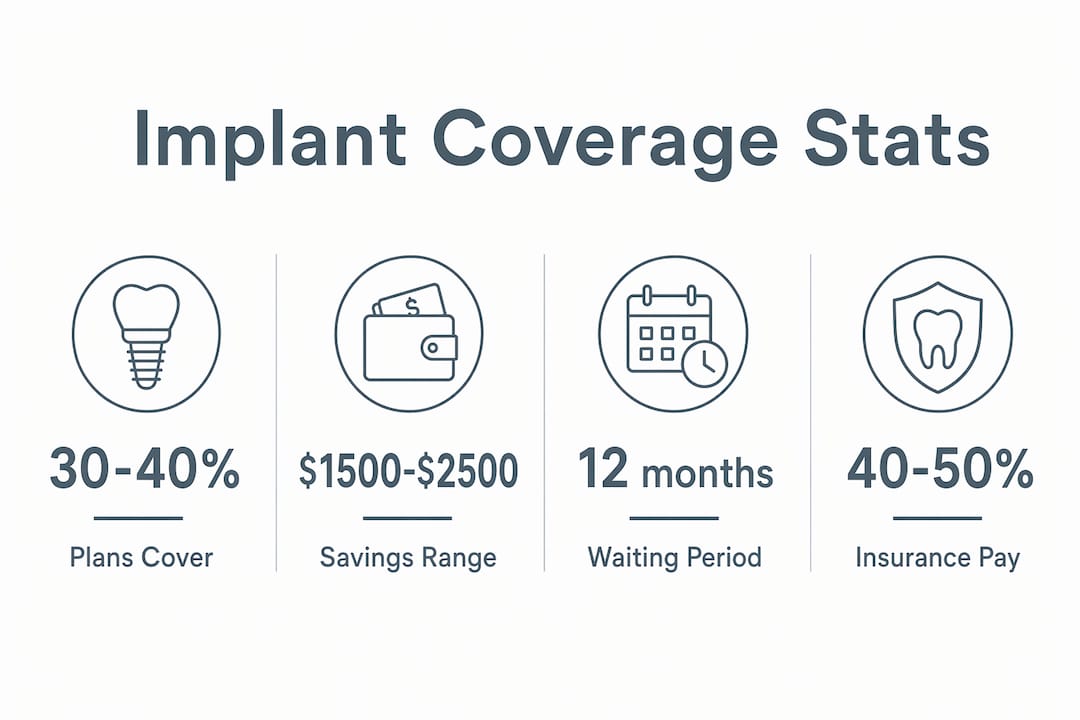
Most dental insurance plans do not fully cover implants, but partial coverage is available if you know where to look. About 30–40% of U.S. dental insurance plans include some form of implant coverage, ranging from full surgical coverage to crown-only benefits. Here is what that typically looks like in practice:
- Coverage rate: Plans that do cover implants generally reimburse 40–50% of costs after you meet your deductible.
- What gets covered: Some plans cover all three components (titanium post, abutment, and crown); others pay only for the visible crown.
- Annual maximums: Most dental plans cap total annual benefits at $1,000–$2,000, which is well below the full implant cost for even a single tooth.
- Missing tooth clause: If your tooth was lost before your policy’s effective date, many plans will deny the claim outright.
- Waiting periods: Most implant-covered plans require a 12-month waiting period before major restorative benefits kick in.
- Cosmetic classification: Dental insurance is not federally mandated, and many plans classify implants as cosmetic rather than medically necessary, which means they exclude them entirely.
The bottom line: coverage exists, but it is rarely generous. Understanding the specifics before you enroll can save you thousands.
Table of Contents
- How different plan types handle implant coverage
- What does an implant actually cost, and what will insurance pay?
- How to choose dental insurance that actually covers implants
- Ways to make dental implants more affordable
- Common questions about dental implant insurance coverage
- What Implantveneerguide has learned about implant coverage gaps
- How to file and get approval for implant coverage claims
- Key Takeaways
- The part most guides skip about implant insurance
How different plan types handle implant coverage
Not all dental plans are built the same, and the plan structure you choose has a direct effect on how much implant coverage you actually get.

PPO plans
Preferred Provider Organization (PPO) plans are the most common choice for patients seeking implant coverage. They let you see any licensed dentist, though staying in-network lowers your costs. PPO plans typically offer the broadest implant benefits among standard plan types, often covering a percentage of the post, abutment, and crown after your deductible. The tradeoff is higher monthly premiums compared to HMO plans.
- Usually cover major restorative work at 40–50% after deductible
- Larger provider networks give you more flexibility in choosing an oral surgeon
- Annual maximums still apply, so splitting procedures across calendar years is a common strategy
HMO plans
Health Maintenance Organization (HMO) dental plans require you to use in-network providers and often assign you a primary dentist. Implant coverage under HMO plans tends to be more limited. Some HMO plans offer implants as a covered service through their network at a fixed fee schedule, but others exclude them entirely.
- Lower premiums, but restricted provider choice
- Fixed-fee schedules can reduce costs if implants are included
- Verify explicitly whether the plan covers the surgical post or only the crown
Indemnity plans
Indemnity (fee-for-service) plans reimburse a set percentage of the “usual, customary, and reasonable” (UCR) fee for any licensed dentist you choose. These plans often carry higher premiums but can provide better coverage flexibility for complex procedures like implants.
- No network restrictions; you choose your provider
- Reimbursement is based on UCR rates, which may be lower than your dentist’s actual fee
- Some indemnity plans cover implants more generously than PPO plans, but you need to read the fine print
Pro Tip: Before enrolling in any plan, call the insurer directly and ask: “Does this plan cover the implant post, the abutment, and the crown as separate covered benefits?” A plan that only covers the crown leaves you paying for the two most expensive surgical components out of pocket.
What does an implant actually cost, and what will insurance pay?
Dental implant costs break down across several components, and insurance coverage varies for each one. The table below reflects typical U.S. price ranges and common coverage scenarios.
| Component | Typical Cost Range | Commonly Covered? | Notes |
|---|---|---|---|
| Titanium implant post (surgical) | $1,000–$2,000 | Sometimes | Often excluded or covered at 40–50% |
| Abutment | — | Sometimes | Frequently bundled with post coverage |
| Porcelain crown | $1,000–$2,000 | More often | Most plans that cover implants start here |
| Bone graft | — | Rarely | May be covered if medically necessary |
| Tooth extraction | — | Usually | Covered under basic or preventive benefits |
| Full single implant (total) | — | Partial only | Annual maximums cap total payout |
Comprehensive plans that cover all three components save patients $1,500–$2,500 per tooth compared to crown-only coverage. That gap is significant when you are budgeting for multiple implants or a full-arch restoration.
Annual maximum limits are the most common financial obstacle. A plan with a $1,500 annual maximum will pay out no more than $1,500 total for all dental care in a given year, regardless of what your implant actually costs. If your plan reimburses 50% of a $4,000 implant, the theoretical benefit is $2,000, but the annual cap cuts that to $1,500. You pay the rest.
Bone grafts and extractions add to the total cost, and coverage for these procedures varies widely. Bone grafts are more likely to be covered when a dentist documents them as medically necessary due to bone loss from injury or disease. Without that documentation, expect to pay out of pocket.
How to choose dental insurance that actually covers implants
Choosing the right plan requires more than comparing monthly premiums. Most people pick a plan based on price and discover the coverage gaps only when they submit a claim.
Check coverage of all three implant components. Ask specifically whether the plan covers the implant post, the abutment, and the crown as separate line items. Many plans advertise “implant coverage” but only reimburse the crown, leaving the surgical components uncovered. The cost difference between full and crown-only coverage runs $1,500–$2,500 per tooth.
Verify the missing tooth clause. The missing tooth clause disqualifies coverage for any tooth that was already missing when your policy took effect. If you lost a tooth last year and enroll in a new plan today, that tooth is excluded. Always confirm this before enrolling, especially if you are replacing a tooth you lost recently.
Check the waiting period. A 12-month waiting period is standard for major restorative procedures. If you need an implant soon, a plan with a waiting period will not help you this year. Some plans waive waiting periods if you transfer from comparable prior coverage, so ask about that option.
Compare annual maximums against your expected costs. A $1,000 annual maximum is nearly useless for implant coverage. Look for plans with maximums of $2,000 or higher, or plans that offer a separate implant benefit outside the standard annual cap.
Consider the provider network. If you already have a trusted oral surgeon or periodontist, confirm they are in-network before you commit. Out-of-network costs can eliminate any savings the plan provides.
- Review the Summary of Benefits and Coverage (SBC) document, not just the marketing materials.
- Look for plans that specify “major restorative” coverage including implants, not just “restorative” coverage.
- Ask whether the plan uses a fee schedule or UCR reimbursement, since fee schedules can limit payouts below your dentist’s actual charges.
Ways to make dental implants more affordable
Even with partial coverage, implants are expensive. These strategies help close the gap between what insurance pays and what you owe.
Use an HSA or FSA. Health Savings Accounts (HSAs) and Flexible Spending Accounts (FSAs) let you pay for implants with pre-tax dollars, which effectively reduces your cost by your marginal tax rate. An HSA requires enrollment in a high-deductible health plan, but funds roll over year to year. FSA funds typically expire at year end, so plan your procedure timing accordingly.
Split the procedure across two calendar years. Implant treatment naturally occurs in stages: the post placement is one appointment, and the crown is placed months later after osseointegration. Timing these stages across two calendar years lets you apply two separate annual maximums to a single implant, potentially doubling your insurance payout. This is one of the most practical strategies available and costs you nothing to execute.
Stay in-network. In-network providers have negotiated rates with your insurer, which lowers the base cost before your coverage percentage is applied. An out-of-network dentist charging $5,000 for an implant costs you more than an in-network dentist charging $3,500, even if your coverage percentage is identical.
Ask about payment plans. Many dental practices offer in-house financing or work with third-party financing programs. Spreading payments over 12–24 months can make a $4,000 implant manageable without requiring you to delay treatment.
Check your candidacy for implants without insurance. If your current plan offers no implant coverage, it may be worth calculating whether a new plan’s premiums plus the waiting period actually save you money compared to paying out of pocket with a negotiated cash rate.
For a full breakdown of how to use HSAs, FSAs, and financing alongside your dental plan, the financial planning guide at Implantveneerguide covers each option in detail.
Common questions about dental implant insurance coverage
Is implant coverage standard in most dental plans? No. Only about 30–40% of U.S. dental plans include any implant coverage. It is an optional benefit, not a baseline requirement, and many basic or budget plans exclude it entirely.
How much will insurance typically pay toward an implant? Plans that do cover implants generally reimburse 40–50% of the allowed cost after your deductible, subject to your annual maximum. Given that annual maximums often sit at $1,000–$2,000, the actual dollar benefit can be modest relative to total implant costs.
What is the missing tooth clause, and does it affect me? The missing tooth clause excludes coverage for teeth that were already missing before your policy’s start date. If you lost a tooth before enrolling, that specific tooth will not be covered, even if the plan otherwise includes implants.
Are implants considered cosmetic or medically necessary? It depends on the plan and the clinical situation. Many plans default to classifying implants as cosmetic, which means they are excluded. However, medically necessary implants resulting from injury, bone loss, or documented functional impairment are more likely to receive coverage approval. Your dentist’s documentation plays a major role in how the claim is classified.
What waiting periods apply to implant coverage? Most plans impose a 12-month waiting period before major restorative benefits, including implants, become available. Enrolling early and planning your procedure timeline accordingly is the most straightforward way to avoid this delay.
Does Medicare cover dental implants? Traditional Medicare (Parts A and B) does not cover routine dental care, including implants. Some Medicare Advantage (Part C) plans include dental benefits, and a small number cover implants to some degree, but coverage is limited and varies by plan. Reviewing the specific Medicare Advantage plan’s dental benefit summary is the only reliable way to confirm what is included.
What Implantveneerguide has learned about implant coverage gaps
The single most common misunderstanding patients bring to implant consultations is the assumption that “dental insurance covers implants” means the plan will pay for the whole thing. It rarely does, and the gap between expectation and reality is where most financial surprises happen.
Here is what the details actually show:
- Crown-only vs. full coverage: A plan that covers only the crown leaves the titanium post and abutment, which together represent the majority of the procedure cost, entirely on you. Full implant coverage, covering post, abutment, and crown, saves $1,500–$2,500 per tooth compared to crown-only plans.
- The missing tooth clause is the most overlooked exclusion. Patients frequently enroll in a new plan after losing a tooth, assuming the implant will be covered. The missing tooth clause disqualifies that tooth from day one. Checking this clause before you enroll, not after, is the only way to avoid a denied claim.
- Waiting periods punish late enrollees. If you wait until you need an implant to get dental insurance, the 12-month waiting period means you will pay out of pocket anyway. The patients who benefit most from implant coverage are those who enrolled in a plan before the tooth was lost or before the need became urgent.
- Medically necessary classification changes everything. Implants placed due to injury, bone loss, or documented functional need are more likely to be approved. Working with your dentist to document the clinical necessity, rather than framing the procedure as elective, can shift a denial into an approval.
Coverage penetration stat: Only 30–40% of U.S. dental plans include any implant benefit. That means the majority of patients are navigating implant costs without meaningful insurance support, which makes understanding your plan’s exact terms more valuable than the plan itself.
Comparing the dentures vs. implants cost and coverage picture is also worth doing before you commit to implants, since dentures are covered more consistently across plan types and carry lower upfront costs.
How to file and get approval for implant coverage claims
Getting coverage approved requires more than submitting a bill after the procedure. The approval process starts before treatment begins.
Request a pre-authorization (predetermination). Before any implant work starts, ask your dentist to submit a predetermination request to your insurer. This is not a guarantee of payment, but it tells you in advance what the plan will and will not cover, and at what reimbursement level. Skipping this step is the fastest way to receive a surprise denial after the fact.
Gather supporting documentation. Your insurer will want clinical records that justify the procedure. This includes X-rays showing bone loss or the missing tooth, a written treatment plan from your dentist or oral surgeon, and any documentation supporting medical necessity. If the implant is replacing a tooth lost due to injury or disease, that context should be explicit in the records.
Understand your plan’s coding requirements. Dental procedures are billed using CDT (Current Dental Terminology) codes. The implant post, abutment, and crown each have separate codes. If your dentist submits the wrong code, the claim may be denied or underpaid. Confirm with your dental office that they are familiar with your specific plan’s coding preferences.
Appeal denied claims. A first denial is not final. If your claim is denied, request the denial reason in writing and ask your dentist to submit a letter of medical necessity along with supporting clinical records. Many denials are overturned on appeal, particularly when the procedure is documented as medically necessary rather than elective.
Track your annual maximum usage. If your plan has a $1,500 annual maximum and you have already used $800 on other dental work, only $700 remains for your implant claim. Timing your implant stages to align with your plan’s benefit year can preserve more of your maximum for the surgical components.
Use Implantveneerguide’s cost estimator tool to model your expected out-of-pocket costs after insurance, so you go into the process with a realistic number rather than a best-case estimate.
Key Takeaways
Most patients with dental insurance still pay the majority of implant costs out of pocket, making plan selection and financial planning the two highest-leverage decisions in the process.
| Point | Details |
|---|---|
| Coverage is limited | Only 30–40% of U.S. dental plans include any implant benefit. |
| Reimbursement rate | Plans that cover implants typically pay 40–50% after deductibles, subject to annual maximums. |
| Full vs. crown-only coverage | Full implant coverage saves $1,500–$2,500 per tooth compared to crown-only plans. |
| Missing tooth clause | Teeth lost before your policy’s start date are excluded from implant coverage. |
| Timing and HSAs help | Splitting procedure stages across two calendar years and using HSA or FSA funds can reduce net costs. |
The part most guides skip about implant insurance
Most articles on dental insurance coverage for implants spend a lot of time listing plan types and not enough time on the decision that actually matters: whether the plan you are considering will cover the specific tooth you need replaced, given when you lost it and when you enroll.
The missing tooth clause and the 12-month waiting period are not fine print. They are the two most common reasons patients end up with a plan that technically covers implants but pays nothing for their actual procedure. A plan that covers implants in the abstract is worthless if your tooth was lost six months ago and the plan has a waiting period.
What I find most patients underestimate is the value of enrolling in a plan before you need it. Dental insurance for implants works best as a long-term strategy, not a reactive purchase. If you are reading this because you already need an implant, your best moves are the HSA/FSA route, the calendar-year split on procedure stages, and a close look at whether the plan’s premiums plus the waiting period actually pencil out versus a negotiated cash price. The implant candidacy checker at Implantveneerguide can help you map your clinical situation to realistic coverage expectations before you commit to a plan.
The patients who come out ahead financially are the ones who read the Summary of Benefits before enrolling, not after the crown is placed.
Recommended
- Dental Implant Cost in 2026: Your Complete Price Guide — Dental Education Guide
- Dental Implants Without Insurance: 2026 Cost Guide — Dental Education Guide
- Alternatives to Dental Implants: Your 2026 Options Guide — Dental Education Guide
- Dental Insurance and Financing for Implants and Veneers (U.S. Guide)