Medical Tourism for Dental Implants: 2026 Complete Guide

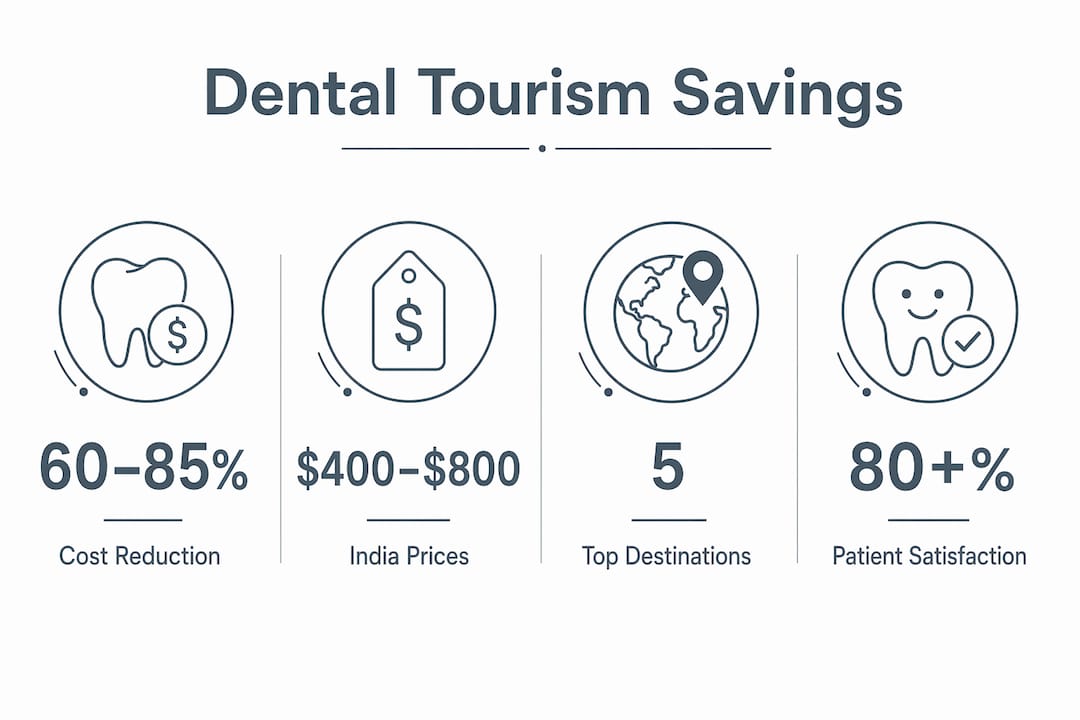
Traveling abroad for dental implants can cut your costs by 60–85% compared to U.S. prices, where a single implant with a crown typically runs $3,000–$5,500. In Mexico, that same procedure costs $700–$1,500. In India, as little as $400–$800. The savings are real, and for patients needing multiple implants or full-arch restorations, the math becomes hard to ignore.
But cost is only part of the picture. Dental implant surgery is a multi-stage, surgical procedure, and the country you choose matters far less than the specific clinic you walk into. Quality standards, implant brands, follow-up protocols, and your ability to get care back home if something goes wrong all deserve as much attention as the price quote.
Here is what you need to know before booking anything:
- Cost savings of 60–85% are achievable, but only at clinics using named-brand implants (Straumann, Nobel Biocare, Zimmer Biomet) with proper diagnostics
- Top destinations for Americans include Mexico, Turkey, Hungary, India, and Costa Rica, each with distinct trade-offs
- Accreditation from bodies like the Joint Commission International (JCI) signals a clinic meets international safety standards
- Follow-up care is the most underestimated risk: many U.S. dentists refuse to service implants placed abroad due to liability or incompatible parts
- Travel timing matters: wait at least 7–10 days after a single implant before flying
- Hidden costs including bone grafts, corrective care, and return trips can erode savings significantly
Top destinations for dental implants in 2026
Mexico, Turkey, Hungary, India, and Costa Rica are among commonly chosen destinations for Americans seeking dental implants abroad. Each has different profiles regarding cost, regulatory environment, and practical logistics.
Mexico is the default choice for most Americans, and for good reason. Border cities like Los Algodones and Tijuana are literally a short drive from Arizona and California. Cancún adds a resort option for patients who want a longer stay. The concentration of clinics in Los Algodones means you can compare providers easily, though quality ranges from excellent to questionable within a few blocks.
Turkey offers savings of 60–85% compared to U.S. prices, and Istanbul’s top clinics genuinely use premium implant brands. The all-inclusive package model (implant, crown, hotel, airport transfer) is well-developed here. The trade-off is a long transatlantic flight and the reality that rushed timelines are common at high-volume clinics.

Hungary is Europe’s dental tourism capital, with Budapest dentists who trained in Germany and Austria and operate under EU regulatory standards. For Americans, the distance is a real drawback. For patients already planning a European trip, it makes strong sense.
India offers the lowest prices globally, with implants ranging $400–$800, and major cities like Delhi, Mumbai, and Bengaluru have modern clinics with CBCT scanners and CAD/CAM technology. The flight time from the U.S. is a genuine barrier, and quality varies more here than in any other destination on this list.
Costa Rica punches above its weight for North Americans. San José clinics are modern, English is widely spoken, and the flight from most U.S. cities is under five hours. Costs sit slightly higher than Mexico but lower than Hungary, and the country has a long history of medical tourism infrastructure.
How to choose the right dental tourism destination for implants
The destination itself is secondary. What actually determines your outcome is the clinic you select within that destination. That said, several criteria should shape your shortlist before you ever contact a specific provider.
- Accreditation and certification. JCI accreditation is the gold standard for international healthcare facilities. A clinic with JCI status has passed independent audits of its safety protocols, sterilization standards, and patient care procedures. Not every excellent clinic holds JCI status, but it is a reliable starting filter. You can also check registration with the national dental regulatory body (COFEPRIS in Mexico, the Türk Dişhekimleri Birliği in Turkey).
- Implant brand transparency. Ask the clinic directly which implant system they use. Straumann, Nobel Biocare, Zimmer Biomet, and Dentsply Sirona all have established clinical track records and global parts availability. A clinic that hedges on this question or quotes a price that is suspiciously below market floors is likely using unbranded components.
- Surgeon qualifications and international patient experience. Ask for the treating dentist’s credentials, specialty training, and how many international implant cases they handle annually. Clinics experienced with dental tourists tend to have structured pre-arrival consultation processes and travel-aligned treatment timelines.
- Post-operative care and warranty terms. Get the warranty in writing before you commit. A solid warranty covers both the implant parts and the labor to fix or replace them. Vague verbal assurances mean nothing if you are back home and something fails.
- Communication quality. If getting a clear, itemized written treatment plan before you travel is slow or difficult, that is a preview of what post-surgery communication will look like. English proficiency and responsiveness are practical quality signals.
- Local follow-up coordination. Ask whether the clinic will share your treatment records, implant brand documentation, and post-op protocols with a dentist back home. The best international clinics actively support this.
Pro Tip: Before booking, send your dental X-rays or panoramic scan to at least three clinics and compare the written treatment plans you receive. Legitimate clinics will review your imaging and provide an itemized quote before you commit to anything.
Risks and challenges of dental tourism for dental implants
The primary risk is not the surgery itself. It is what happens after you fly home.
Failed or poorly executed work abroad often requires costly corrective procedures domestically, and many U.S. dentists will decline to take over a case placed abroad due to liability concerns or incompatible implant systems. Think of it like taking a car to a mechanic who does not carry parts for that model. Even a skilled local dentist cannot adjust or repair an implant if the components are not available in the U.S. market.
- Infection and implant failure. Sterilization standards and surgical protocols vary across clinics and countries. Complications like peri-implantitis (infection around the implant) are harder to manage when your treating dentist is thousands of miles away.
- Incompatible implant systems. Different countries often use proprietary implant systems. If your U.S. dentist cannot source the abutment or crown components for your specific implant brand, you may need to return to the original clinic overseas for any adjustments.
- Hidden costs. Bone grafts, sinus lifts, and corrective surgeries are frequently not included in initial quotes. A patient who budgets for one implant at $900 can end up paying $2,000+ once diagnostics reveal the need for bone augmentation.
- Misleading low quotes. Prices below approximately $500 for a single implant in Turkey, or $400 in India, often signal unbranded implant components, limited diagnostics, or less experienced surgical staff.
- Travel-related complications. Flying too soon after surgery increases swelling due to cabin pressure changes and raises infection risk. Long flights also limit movement, which can affect healing.
Pro Tip: Request the clinic’s documented complication rate and ask specifically how they handle implant failures for international patients. A clinic that cannot answer this clearly, or deflects the question, is telling you something important. Also verify that any warranty covers both parts and labor in writing, not just a verbal promise.
You can review a full dental implant risk breakdown to understand what complications look like and how they are typically managed.
Travel and recovery logistics after dental implant surgery abroad
Timing your return flight is one of the most practically important decisions in dental tourism planning, and it is one most patients underestimate.
Waiting at least 7–10 days before flying after a single implant procedure allows initial swelling to subside and reduces infection risk. For full-arch restorations or complex cases involving bone grafts, most providers recommend delaying air travel for two to three weeks, or longer if any complications arise. Always confirm the specific timeline with your treating dentist before booking your return flight.
- Build recovery time into your itinerary. Do not book a flight home the evening of your procedure. Plan at least two to three days of on-site recovery before any travel.
- Arrange accommodation near the clinic. You may need follow-up appointments within the first week, and having transportation sorted in advance reduces stress during recovery.
- Bring your treatment documentation home. Collect your implant brand documentation, surgical notes, post-op instructions, and the clinic’s contact information before you leave. Your U.S. dentist will need these.
- Identify a local dentist before you travel. Not all U.S. dentists will take on patients who had implants placed abroad. Confirm in advance that a dentist near you is willing to provide monitoring and handle any issues between your trips.
- Plan for a second trip. Most implant procedures require two visits separated by three to six months for osseointegration (the process of bone fusing with the implant). Budget for both trips when calculating total cost.
- Consider travel insurance carefully. Standard travel insurance rarely covers dental treatment complications. Specialist medical travel insurers may offer coverage; check the policy terms before purchasing.
For a detailed breakdown of what to expect at each stage, Implantveneerguide’s travel and recovery guide covers the full timeline from pre-departure to final crown placement.
Pros and cons of traveling abroad for dental implants
The financial case for dental tourism is genuinely strong for the right patient. The risks are also real, and they tend to cluster around follow-up care rather than the surgery itself.
Pros:
- Cost savings of 60–85% versus U.S. prices, with the largest gains on full-arch restorations and multiple implants
- Access to experienced specialists who perform high volumes of implant cases, particularly in Turkey, Hungary, and Mexico’s major dental hubs.
- Shorter wait times compared to some U.S. providers, with many clinics offering pre-arrival consultation and structured treatment timelines
- Opportunity to combine treatment with travel, particularly in destinations like Costa Rica and Thailand
Cons:
- Follow-up care gaps. The most consistent complaint from dental tourists is difficulty getting care back home if something goes wrong. Local dentists may refuse to service foreign implants.
- Warranty enforcement is difficult. A written warranty from a clinic in another country is hard to enforce if you are back in the U.S. and the clinic does not respond.
- Hidden costs can erode savings. Multiple trips, unexpected bone grafts, and corrective procedures can push total costs well above the initial quote.
- Travel stress during recovery. Long flights, time zone changes, and distance from your home support network all complicate healing.
- Quality is inconsistent. Even within a single city, clinic quality varies dramatically. The country’s reputation does not guarantee the specific clinic you choose meets that standard.
For patients needing a single implant, the math is tighter once you factor in flights and accommodation. For full-arch cases or multiple implants, the savings can still be substantial even after all travel costs. You can explore whether traveling for full-mouth implants makes financial and clinical sense for your specific situation.
How to evaluate dental tourism clinics with confidence
The single most reliable predictor of a good outcome abroad is clinic quality, not country. JCI accreditation and a documented track record with international patients matter more than whether a destination is trending on social media.
Here is a practical framework for evaluating any clinic before you commit:
- Verify accreditation independently. Check the JCI website directly rather than relying on a clinic’s self-reported status. Also confirm registration with the national dental regulatory body.
- Request an itemized written treatment plan. Any legitimate clinic will review your X-rays or panoramic scan and send a written plan with costs broken down by procedure before you book. A total figure with no line items is a red flag.
- Confirm the implant brand in writing. Ask for the specific implant system, model, and manufacturer. Cross-reference it against established brands with global parts availability.
- Ask about complication protocols. How does the clinic handle implant failure for international patients? What is the process for a patient who returns home and develops an infection? Clear, specific answers indicate experience with this scenario.
- Check before-and-after portfolios. For complex cases, ask to see documented outcomes from similar procedures, not just cosmetic photos.
- Get a second opinion from a U.S. dentist. Before traveling, have a local dentist review the treatment plan you receive from abroad. Over-treatment recommendations are documented in dental tourism complaint patterns, and an independent review is the most effective check.
- Secure warranties covering parts and labor. A warranty that covers only the implant fixture but not the crown or the labor to replace it is worth little. Get the full scope in writing.
Pro Tip: Prioritize clinics that proactively share patient outcome data and have structured protocols for managing international patients after they return home. A clinic that has handled complications for overseas patients before will have a clear process. One that has not will improvise.
Use Implantveneerguide’s provider evaluation guide to work through a structured checklist before contacting any clinic abroad.
Key Takeaways
Medical tourism for dental implants delivers real savings, but only when you choose the clinic as carefully as the destination.
| Point | Details |
|---|---|
| Cost savings are substantial | U.S. implant costs drop considerably abroad, resulting in significant savings. |
| Clinic quality beats country reputation | JCI accreditation and verified patient outcomes predict results better than destination popularity. |
| Follow-up care is the top risk | Many U.S. dentists refuse to service implants placed abroad due to liability or incompatible parts. |
| Wait 7–10 days before flying | Flying too soon after a single implant raises swelling and infection risk; full-arch cases need longer recovery before travel. |
| Hidden costs can erode savings | Bone grafts, corrective care, and multiple trips can increase actual costs beyond initial quotes. |
Ready to assess your options?
Before contacting any clinic abroad, confirm that you are actually a good candidate for dental implants. Bone density, gum health, and systemic conditions all affect whether implants will succeed, regardless of where the procedure is performed.
Implantveneerguide’s implant candidacy checker walks you through an evidence-based screening in minutes, so you go into any consultation knowing exactly what questions to ask and what your baseline looks like.