Dental Insurance vs Discount Plan: Which Saves You More?

For most healthy adults who only need two cleanings a year, a dental discount plan or paying cash is usually cheaper. Dental insurance makes more sense when you expect major restorative work, when an employer covers most of the premium, or when you need orthodontics for a child. That’s the short version. The longer version depends on three things: how much dental work you actually expect, whether you can wait through a 6–12 month waiting period, and whether your preferred dentist participates in the plan you’re considering.
Here’s what the numbers look like at a glance. Individual dental insurance premiums typically run $20–$60 per month, putting annual costs at $240–$720 before you’ve paid a single copay. Dental discount plan memberships usually cost $80–$200 per year total. The gap is significant when your care needs are modest.
Three factors that should drive your decision:
- Expected volume of care. If you’re planning implants, a crown, or a root canal, insurance’s cost-sharing can offset its higher premiums. If you’re mostly preventive, the math often favors a discount plan or cash.
- Timing. Discount plans activate within days and have no waiting periods. Insurance often makes you wait 6–12 months before covering major work.
- Provider access. Both options require your dentist to participate. Always verify before you buy.
Table of Contents
- How does dental insurance actually work?
- How do dental discount plans work?
- Pros, cons, and red flags for each option
- Which option fits your situation?
- How to compare specific plans before you buy
- Real cost scenarios: when each option saves you money
- Other ways to lower dental costs
- Key Takeaways
- The part most comparison guides skip
- Implantveneerguide helps you plan the costs that coverage won’t fully solve
- Useful sources
How does dental insurance actually work?
Dental insurance is a cost-sharing arrangement: you pay a monthly premium, and the insurer covers a percentage of your treatment costs up to an annual cap. The American Dental Association distinguishes between true insurance plans and discount or referral arrangements, and the mechanics matter when you’re budgeting.
The numbers you need to know
Typical individual plan parameters, according to HealthInsurance.org:
- Monthly premiums: $20–$60 for individuals
- Annual deductible: $50–$150
- Annual maximum benefit: $1,000–$2,000
- Waiting periods: 6–12 months for major work, sometimes 3–6 months for basic
That annual maximum is the number most people underestimate. Once you hit $1,500 in benefits paid, the insurer stops. You cover everything after that at full price, even though you’re still paying monthly premiums.
How networks affect your cost
In-network dentists have contracted rates with the insurer, so the percentage splits apply to a negotiated fee, not the dentist’s full list price. Go out of network and you may owe the difference between what the dentist charges and what the insurer considers “reasonable.” That gap can be substantial.
Pro Tip: Before enrolling, look up your current dentist in the plan’s provider directory. If they’re out of network, run the numbers on switching dentists versus paying out-of-network costs.
A filling that costs $200 in-network might cost $280 out-of-network, with the insurer still calculating its 80% share on the lower contracted rate.
How do dental discount plans work?
A dental discount plan, sometimes called a dental savings plan, is not insurance. The plan pays nothing. You pay a membership fee, get a card, show it at a participating dentist, and pay a pre-negotiated reduced rate directly. That’s the whole model, and its simplicity is both its strength and its limitation.
Membership fees typically run $80–$200 per year, and discounts on procedures generally range from 15% to 60% depending on the procedure and the specific plan. Preventive care discounts tend to be on the lower end; some specialty work can hit the higher end, though that varies by plan and ZIP code.
What you get (and don’t get)
- No deductibles, no annual maximums, no claims to file
- No waiting periods — most plans activate within 24–48 hours
- Discounts apply to whatever procedures you need, including some cosmetic work that insurance typically excludes
- You must use a participating dentist to get the negotiated rate
- The plan network is often smaller than a major insurer’s
The no-claims aspect is genuinely convenient. You show your card, pay the discounted fee, and leave. There’s no explanation of benefits to decode, no reimbursement to wait for, no pre-authorization headaches for a crown.
The catch is network size. Discount-plan networks are often smaller than major insurance networks, and coverage varies significantly by ZIP code. In a rural area, you might find only one or two participating dentists within a reasonable drive.
Pro Tip: Before buying any discount plan, call the specific dentist you want to use and ask what the negotiated fee is for the exact procedure you need. The advertised “up to 60% off” headline rarely applies uniformly across all procedures.
Pros, cons, and red flags for each option
Dental insurance
Pros:
- Shares the cost of expensive procedures (crowns, root canals, bridges)
- Preventive care often covered at 100% from day one
- Large provider networks in most metro areas
- Employer-sponsored plans often subsidize premiums significantly
- Predictable monthly cost for budgeting
Cons:
- Annual maximums ($1,000–$2,000) can be exhausted quickly on major work
- Waiting periods of 6–12 months for major procedures
- Premiums can exceed the value received if you only use preventive care
- Out-of-network costs can be unexpectedly high
- Pre-authorization requirements add friction for complex work
Dental discount plans
Pros:
- Low annual cost ($80–$200)
- No waiting periods; activates within days
- No annual maximums or benefit caps
- No claims to file; straightforward at the point of service
- Useful supplement when insurance annual maximum is exhausted
Cons:
- Plan pays nothing; you still pay the full discounted fee out of pocket
- Smaller provider networks; rural access can be limited
- Discount rates often range from 15% to 60% by procedure and plan
- No protection against catastrophic dental costs
- Some plans charge enrollment fees on top of membership fees
Red flags to watch for before you buy
Watch out for these warning signs: a provider directory with fewer than 10 dentists in your area, advertised savings with no published fee schedule, enrollment fees that double the stated membership cost, and cancellation penalties that lock you in for a full year.
According to SmartAsset’s analysis, insurance is not automatically cheaper. If you pay premiums all year and only use preventive care, your total annual spend on insurance can easily exceed what you’d pay with a discount plan or cash.
Pro Tip: Always ask for the plan’s actual fee schedule for your ZIP code, not just the advertised discount percentage. A plan that claims “up to 50% off” might only discount cleanings by 15% in your area.
Which option fits your situation?
The rule of thumb: if you expect to spend less than $500 on dental care in a year, a discount plan or cash usually wins. If you’re expecting major restorative work or your employer subsidizes your premium, insurance typically makes more sense. The break-even math is worth running for your specific situation.
Common profiles and recommended choices
-
Healthy young adult, preventive care only. Two cleanings and an annual X-ray run roughly $250–$350 cash. A discount plan membership ($80–$200) plus discounted preventive rates often beats paying $480+ in annual premiums for coverage you barely use. Cash or discount plan wins here.
-
Family with children needing orthodontics. Orthodontic coverage under insurance varies widely, and many plans exclude it or cap it at $1,000–$1,500 lifetime. A discount plan that includes orthodontic discounts may actually be more useful. Compare the specific orthodontic benefit carefully before choosing.
-
Adult expecting a crown or root canal soon. A root canal plus crown can run $2,000–$3,500 cash. Insurance at 50% coverage (after deductible) could save $800–$1,500, but only if you’ve cleared the waiting period. If you need the work now, a discount plan is the only option that activates immediately.
-
Patient planning dental implants or veneers. Most insurance plans either exclude implants entirely or cap coverage well below actual costs. A discount plan may offer 15–30% off implant fees, which on a $3,000–$5,000 procedure is meaningful. For detailed implant cost planning, the dental implants without insurance cost guide at Implantveneerguide breaks down what patients actually pay out of pocket.
Quick decision checklist
- What dental procedures do you realistically expect this year, and what do they cost at cash price?
- Can you wait 6–12 months for major work, or do you need care now?
- Does your preferred dentist participate in the plan you’re considering?
How to compare specific plans before you buy
Run a simple total-cost comparison: add up your annual fees plus expected out-of-pocket costs under each option, then compare that to paying cash with or without a discount. Concrete break-even math is the only reliable way to know which option saves you money.
Documents and details to gather
- Sample Explanation of Benefits (EOB) from the insurer showing what they actually paid on a comparable claim
- Provider network directory filtered by your ZIP code
- Fee schedule or discount table for the specific procedures you expect
- Waiting period rules for each procedure category
- Deductible amount and annual maximum
- Procedure-specific coverage percentages (not just the headline tier percentage)
Red flags that should end the conversation
- No published provider list, or a list that requires you to call to verify
- Discount rates listed as ranges with no procedure-specific breakdown
- Cancellation penalties exceeding one month’s fee
- Enrollment fees not disclosed upfront
- No physical address or state licensing information for the plan administrator
How to run a break-even calculation
- List the procedures you expect this year and find their average cash prices in your area.
- Add the annual plan cost (premium total or membership fee).
- Apply the plan’s benefit (insurance coverage percentage after deductible, or discount plan’s negotiated rate).
- Compare the total you’d pay under each option against the cash price with no plan.
That four-step math takes about 15 minutes and can save you hundreds of dollars in the wrong plan.
Pro Tip: Dental schools affiliated with accredited universities offer procedures at 40–70% below typical market rates, performed by supervised students. For non-urgent work, this can beat both insurance and discount plans on cost.
Real cost scenarios: when each option saves you money
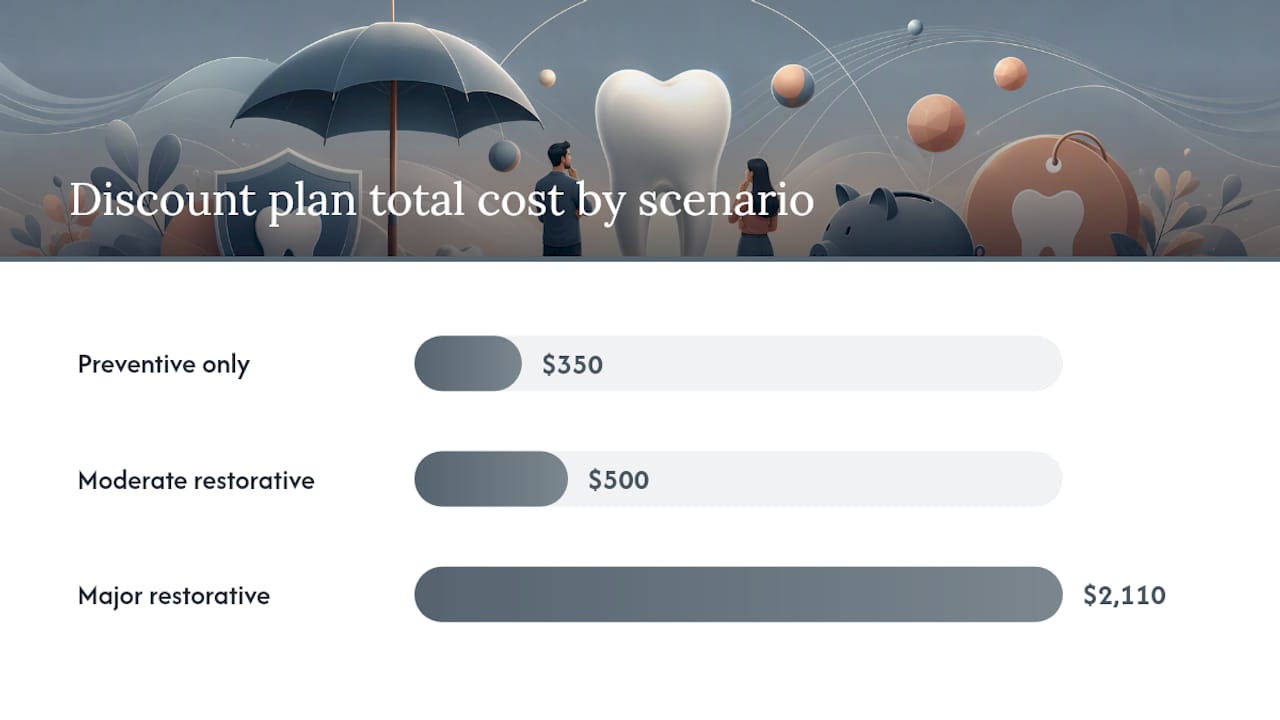
The crossover point where insurance becomes advantageous is roughly when your expected annual dental spend exceeds $800–$1,000 in cash costs, accounting for the premium you’ve already paid. Below that threshold, a discount plan or cash usually comes out ahead. Here’s how the math plays out across three realistic scenarios, using cost assumptions grounded in published example calculations and side-by-side comparisons.
| Scenario | Typical cash cost | Insurance: premium + out-of-pocket | Discount plan: membership + discounted cost | Net difference |
|---|---|---|---|---|
| Preventive only (2 cleanings, exam, X-rays) | ~$300 | ~$600 (premiums) + — = ~$600 | ~$150 (membership) + ~$200 (discounted) = ~$350 | Discount plan saves ~$250 vs insurance |
| Moderate restorative (preventive + 1 filling) | ~$500 | ~$600 (premiums) + ~$40 (20% of $200 filling) = ~$640 | ~$150 + ~$350 (discounted) = ~$500 | Roughly break-even; slight discount plan edge |
| Major restorative (crown + root canal + preventive) | — | ~$600 (premiums) + ~50% of major procedure after deductible = subtotal | ~$150 + ~$1,960 (30% discount on major) = ~$2,110 | Insurance saves money if employer subsidizes premium; savings vary |
A few things the table makes clear. First, the preventive-only scenario is where insurance most consistently loses. You’re paying $600 in premiums for care that would cost $300 cash. Second, the major restorative scenario is where insurance’s cost-sharing finally earns its keep, but only if you’ve cleared the waiting period. Third, the moderate scenario is genuinely close, and small differences in your dentist’s actual fees or your plan’s specific discount rates can tip it either way.
For patients planning implants or veneers specifically, the math shifts further. Implant costs typically run $3,000–$5,000 per tooth, and most insurance plans cap major work at $1,500 annually. A dental implant cost estimator can help you model the real numbers for your situation before you commit to any plan.
Other ways to lower dental costs
Insurance and discount plans aren’t the only routes to affordable dental care. Several alternatives can be cheaper depending on your situation, income, and the urgency of your needs.
- Marketplace dental plans. HealthCare.gov lists standalone dental plans and dental plans bundled with health coverage. Standalone dental plans on the Marketplace are generally only available when you also purchase a Marketplace health plan, so check eligibility before assuming you can buy dental coverage alone.
- Medicare. Original Medicare (Parts A and B) does not cover routine dental care. Medicare Advantage plans sometimes include dental benefits, but coverage varies widely. Medicare.gov is the authoritative place to check what a specific Advantage plan covers.
- Payment plans and financing. For implants or veneers, many practices offer in-house financing or work with third-party lenders. The financing options for dental implants guide at Implantveneerguide covers the main options and their real costs.
Pro Tip: If you need immediate major work and have no insurance, combine a dental discount plan (for the immediate negotiated rate) with a dental school consultation for any non-urgent follow-up work. The two together can cut your total cost significantly.
Key Takeaways
Dental insurance is worth the premium when you expect major restorative work or when an employer subsidizes the cost; for preventive-only care, a discount plan or cash almost always costs less.
| Point | Details |
|---|---|
| Run the break-even math | Add annual plan fees plus expected out-of-pocket costs and compare to cash price before choosing any plan. |
| Verify dentist participation | Both insurance and discount plans require your dentist to be in-network; confirm before enrolling. |
| Watch waiting periods | Insurance imposes 6–12 month waits for major work; discount plans activate within days, making them better for immediate needs. |
| Prefer insurance with employer subsidy | When an employer covers most of the premium, insurance’s cost-sharing on major work is hard to beat. |
| Use Implantveneerguide for implant/veneer cost planning | The cost estimator and decision guides help patients model real out-of-pocket costs before committing to a plan. |
The part most comparison guides skip
One thing I notice consistently when patients come to Implantveneerguide with questions about coverage for implants or veneers: they’ve already made the insurance-vs-discount-plan decision based on the monthly premium alone, without ever running the full-year math. That single oversight costs people real money.
The deeper issue is that most dental coverage comparisons treat insurance as the default “serious” option and discount plans as a budget fallback. That framing is backwards for a specific and common patient profile: someone who needs one or two major procedures now, has no employer subsidy, and can’t wait six months for coverage to kick in. For that person, a discount plan plus a dental school consultation for follow-up work is often the most financially sound path, not a compromise.
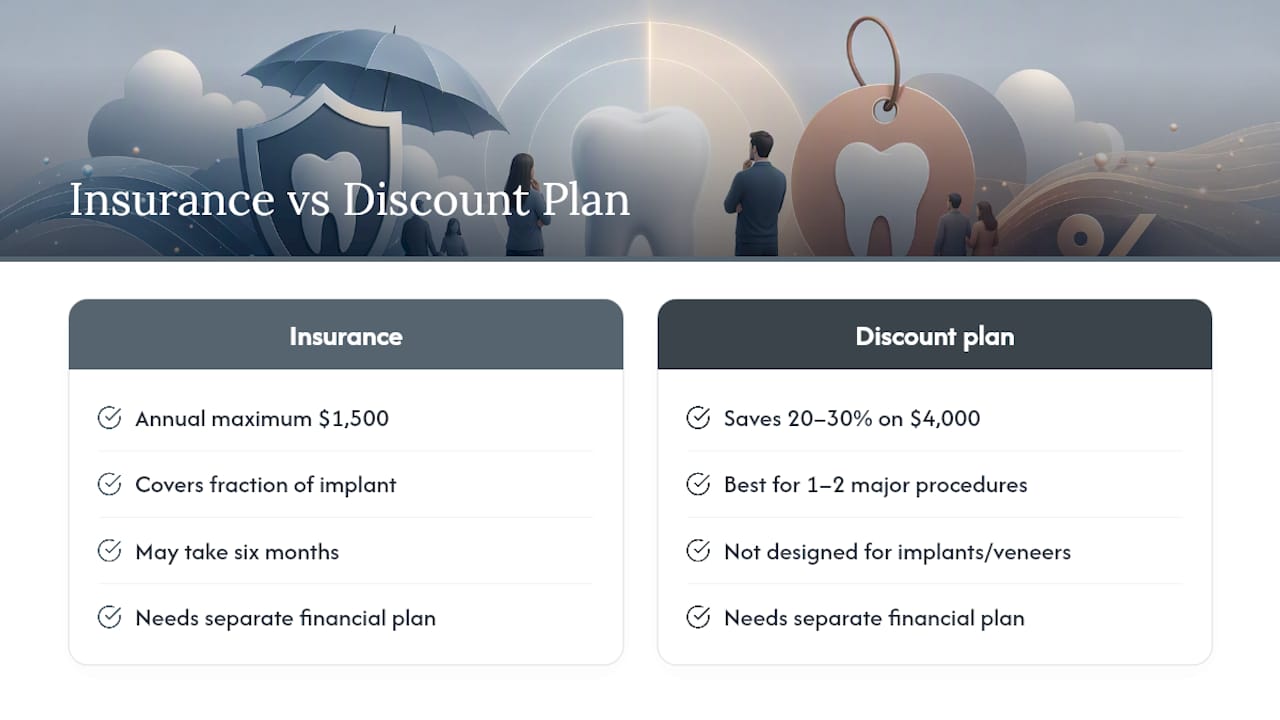
The other thing worth saying plainly: neither insurance nor a discount plan was designed with implants or veneers in mind. Insurance annual maximums of $1,500 cover a fraction of a single implant. Discount plan savings of 20–30% on a $4,000 procedure are meaningful but still leave a large out-of-pocket balance. Patients planning major cosmetic or restorative work need a separate financial plan, not just a coverage card. The financial planning guide for implants and veneers at Implantveneerguide addresses exactly that gap, with cost ranges, financing options, and decision frameworks built around what patients actually face.
Implantveneerguide helps you plan the costs that coverage won’t fully solve
If you’re weighing dental coverage specifically because you’re considering implants or veneers, the coverage comparison is only part of the picture. Both insurance and discount plans leave a significant gap when procedures run $3,000–$15,000 or more, and knowing that gap in advance is what separates a manageable treatment plan from a financial surprise.
Implantveneerguide’s interactive tools give you a concrete starting point. The dental implant and veneer cost estimator lets you model realistic out-of-pocket costs based on U.S. price ranges, so you can see exactly what insurance or a discount plan would and wouldn’t cover before you commit. The candidacy checker helps you assess whether implants are a realistic option for your situation, which affects how aggressively you need to plan for major coverage gaps. Start with the cost estimator to put real numbers behind the comparison you just read.
This article provides general information about dental coverage options and is not a substitute for advice from a licensed insurance professional or your state’s insurance regulator. Plan terms, fees, and eligibility rules vary; verify current details directly with the plan provider or at HealthCare.gov.
Useful sources
These are the primary sources used in this article. Each covers a specific aspect of the insurance-vs-discount-plan comparison.
- What’s the difference between dental insurance and dental discount plans?
- Dental Savings Plans vs. Insurance: Comparison | eMedicare
- Dental Savings Plan vs. Insurance: Pros and Cons — SmartAsset
- Dental Discount Plan vs Insurance: 2026 Comparison
- Types of Dental Plans
- Dental Insurance vs. Discount Plans: What’s the Real Difference for Adults?
- healthcare.gov
Always verify provider lists and plan documents directly with the plan administrator before enrolling. Discount rates and network coverage change, and what’s listed online may not reflect current availability in your ZIP code.