Full Mouth Dental Implants Cost: What Patients Should Expect

Full mouth dental implants in the U.S. typically cost between $30,000 and $70,000 or more for both arches, with a single arch ranging from $15,000–$36,000 for fixed solutions like All-on-4 or All-on-6. Implant-supported overdentures are more affordable, starting around $8,000–$20,000 per arch, while individual implants for a full arch can reach $30,000–$90,000+. Three things drive most of the spread: the treatment type you choose, whether you need bone grafting or extractions, and the prosthetic material (acrylic versus zirconia).
Before you evaluate any quote, here is what the numbers typically look like:
- Low end (single arch): $8,000–$15,000 (implant overdenture, minimal prep work)
- Average (single arch): $18,000–$25,000 (All-on-4, standard materials, minor grafting)
- High end (single arch): $30,000–$45,000+ (All-on-6, zirconia, complex grafting)
- Low end (full mouth, both arches): $30,000–$35,000
- Average (full mouth): $40,000–$55,000
- High end (full mouth): $70,000–$90,000+
These ranges come from national pricing data across U.S. clinics. The wide spread is not random — it reflects real differences in what quotes include. HSA and FSA accounts, CareCredit-style financing, and phased treatment across calendar years can all reduce what you pay out of pocket in any given year.
Table of Contents
- What does “full mouth dental implants” actually mean?
- What factors push the price up or down?
- How much do full mouth dental implants cost, broken down by line item?
- How do people actually pay for full-arch implants?
- Who is a candidate, and how long does treatment take?
- What are the long-term costs and risks you should plan for?
- Are full mouth implants worth the cost compared to dentures?
- How to compare quotes and avoid common traps
- Key Takeaways
- The case for slowing down before you sign
- Plan your full-arch treatment with Implantveneerguide
- Useful sources
What does “full mouth dental implants” actually mean?
The phrase covers several distinct clinical approaches, and the one your dentist recommends will shape your entire cost picture.
All-on-4 places four implant posts per arch to anchor a fixed prosthetic bridge. It is the most widely advertised full-arch solution because it works with less bone volume than other options and costs less per tooth than placing individual implants. Typical range per arch varies depending on clinical circumstances.
All-on-6 uses six implants per arch, which distributes bite force more evenly and suits patients with stronger bone or higher bite demands. The extra hardware and lab work increase the cost per arch significantly. Both All-on-4 and All-on-6 deliver a fixed, non-removable result.
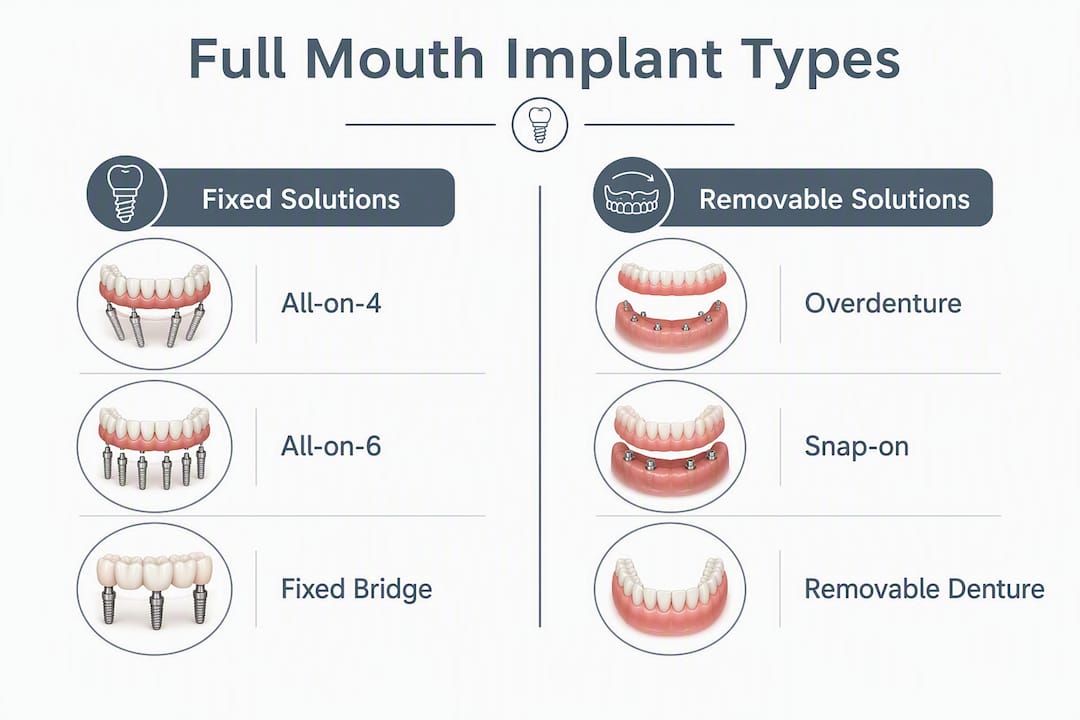
Implant-supported overdenture (snap-on denture) attaches a removable prosthesis to two to four implants using locator attachments or a bar. It is the most affordable implant-based option, generally costing less per arch, and suits patients who prefer easier cleaning or have budget constraints. The tradeoff: it still comes out for cleaning, and the attachments wear and need periodic replacement.
Implant-supported fixed bridge replaces each missing tooth with an implant-anchored crown rather than a shared arch prosthesis. This approach can be more costly per arch and requires more implants and complex lab work, but it most closely mimics natural dentition.
Individual implants for a full arch represent the most anatomically complete option: one implant per tooth. Costs can be substantially higher for a single arch depending on implant count, materials, and surgical complexity.
The fixed-versus-removable distinction matters beyond cost. Fixed solutions (All-on-4, All-on-6, fixed bridge) function more like natural teeth, require no nightly removal, and tend to preserve bone better. Removable overdentures cost less upfront but require more maintenance and may need relining as the jaw changes shape over time.
What factors push the price up or down?
Quote variability is the single biggest source of confusion in this market. Two practices can quote $20,000 apart for what sounds like the same procedure — and both quotes can be accurate, because they include different things.
Clinical drivers
- Number of implants: More posts mean more surgical time, more hardware, and higher lab fees. Going from All-on-4 to All-on-6 per arch generally increases cost due to additional implants and related work.
- Extractions: Removing remaining teeth adds significant cost per tooth and is often excluded from advertised prices.
- Bone grafting: A notable portion of full-arch cases require augmentation, which adds variable additional costs per graft site; sinus lifts may add further expense.
- Zygomatic implants: For patients with severe upper jaw bone loss, zygomatic implants anchor into the cheekbone. They are significantly more expensive and require a specialist.
- Staged vs. same-day surgery: Immediate-load protocols (“same-day teeth”) cost more upfront but compress the timeline. Staged treatment spreads cost but adds visits.
Prosthetic drivers
- Acrylic hybrid prosthesis: Less expensive, lighter, easier to repair. Typical lifespan 5–10 years before replacement.
- Zirconia prosthesis: More durable, more natural-looking, harder to repair if fractured. Adds $3,000–$10,000 per arch over acrylic but can last 15–20+ years with proper care.
- Provisional prosthesis: Most full-arch cases require a temporary prosthesis during osseointegration. This is a separate lab fee that many ads omit.
- Lab fees and custom shading: In-house labs versus outsourced labs affect both cost and turnaround time.
Technology and practice drivers
- CBCT 3D imaging: Required for precise implant planning; typically $250–$600 and often excluded from base quotes.
- Guided surgery: Computer-guided placement improves precision but adds to surgical cost.
- Surgical team: An oral surgeon or prosthodontist typically charges more than a general dentist, and for complex cases, the expertise gap is worth the premium.
- Sedation/anesthesia: IV sedation adds a notable additional cost per treatment session. General anesthesia in a surgical center costs more.
Non-clinical drivers
- Geographic region: Practices in major metro areas (New York, Los Angeles, San Francisco) charge 20–40% more than rural or mid-sized markets.
- Warranty and maintenance programs: Some practices bundle a 5-year warranty on the prosthesis; others charge per repair.
- Follow-up visits: Post-surgical check-ins, screw retorques, and adjustments may or may not be included.
Pro Tip: Ask every practice for a written list of exclusions before comparing quotes. Advertised prices almost never include grafting, imaging, extractions, or the provisional prosthesis — and those four items alone can add $5,000–$14,000 to the total.
How much do full mouth dental implants cost, broken down by line item?
The table below shows typical U.S. ranges for each major solution type. Per-arch prices exclude bone grafting, extractions, and imaging unless noted.

| Solution type | Typical range (per arch) | What’s usually included | Timeline |
|---|---|---|---|
| All-on-4 | $15,000–$30,000 | Implants, abutments, final prosthesis | 4–9 months |
| All-on-6 | $20,000–$36,000 | Implants, abutments, final prosthesis | 4–9 months |
| Implant overdenture | $8,000–$20,000 | Implants, attachments, removable prosthesis | 3–6 months |
| Implant-supported fixed bridge | $30,000–$45,000 | Implants, crowns, lab work | 6–12 months |
| Individual implants (full arch) | $30,000–$90,000+ | Per-tooth implants, crowns | 12–18+ months |
Sample itemized quote: single arch (All-on-4, standard case)
- Consultation and treatment planning: $200–$500
- CBCT 3D imaging: $300–$600
- Extractions (4 teeth): $600–$1,600
- Bone grafting (1–2 sites): $1,000–$6,000
- Implant posts (4): $4,000–$8,000
- Abutments: $1,200–$2,400
- Provisional prosthesis: $1,500–$3,000
- Final prosthesis (acrylic hybrid): $3,000–$6,000
- Lab fees: $1,500–$3,500
- IV sedation: $500–$1,500
- Follow-up visits: $0–$800
Single arch total (realistic): $15,000–$34,000
Sample itemized quote: both arches (All-on-4, standard case)
Double most line items above, with some economies of scale on sedation and imaging. Realistic full-mouth total: $30,000–$65,000, consistent with the broader national range of $30,000–$70,000+.
Material choice alone shifts the final number significantly. Upgrading both arches from acrylic to zirconia can add $6,000–$20,000 to the total, but zirconia’s longer lifespan often makes it the better value over a 15-year window.
Common exclusions in advertised prices: future prosthetic replacements, warranty service beyond the initial period, emergency repairs, sedation, and any preparatory work (grafting, extractions, imaging).
How do people actually pay for full-arch implants?
Dental insurance
Most dental plans cover a portion of implant costs after deductible, but coverage limits and classifications vary and can cover only a small fraction of total cost. On a $40,000 case, that maximum covers a small fraction. A few premium employer plans carry higher maximums or separate implant riders, so it is worth reading your plan’s summary of benefits carefully.
Medical insurance can apply when tooth loss results from a documented medical condition (cancer, trauma, congenital defect). Getting that coverage requires pre-authorization and detailed clinical documentation, but it can be meaningful when it applies.
HSA and FSA
HSA and FSA funds reduce effective cost by your marginal tax rate, typically 25%–37% depending on your bracket and state. On a $40,000 treatment, that translates to $10,000–$14,800 in real savings if you can fund enough of the procedure through pre-tax dollars. HSA accounts have no use-it-or-lose-it deadline (unlike most FSAs), making them particularly useful for multi-year treatment plans.
Financing options
- In-office 0% plans (12–24 months): The lowest-cost option if you can pay within the promo window. A $30,000 case over 24 months works out to $1,250/month with no interest.
- CareCredit-style deferred-interest programs: : if you carry any balance past the promotional period, retroactive interest applies to the original full amount, not just the remaining balance. On a $30,000 balance, that can mean thousands in unexpected charges.
- Personal loans and dental-specific lenders: Unsecured personal loans typically carry APRs of 7%–36% depending on credit. A $30,000 loan at 12% over 60 months runs roughly $667/month and costs about $10,000 in total interest.
- HELOC: Home equity lines often carry lower rates (currently 7%–9% in most markets) and longer terms, reducing monthly payments but extending the debt.
Pro Tip: With any deferred-interest plan, set a calendar reminder 60 days before the promo ends and pay the balance in full. If you cannot guarantee that, a fixed-rate personal loan is safer even at a higher APR.
For a deeper look at financing strategies for dental implants, including side-by-side monthly payment comparisons, Implantveneerguide’s financing guide covers the full range of options.
Dental tourism is another route some patients consider. Costs in Mexico, Hungary, and other destinations can run 50%–70% lower than U.S. prices, but
are real risks. Implantveneerguide’s medical tourism guide walks through how to calculate the true cost including travel and contingency care.
Who is a candidate, and how long does treatment take?
Candidacy basics
Most adults with missing teeth are potential candidates, but several factors affect whether you qualify for full-arch implants and whether you need preparatory work first.
- Active periodontal disease must be treated and resolved before implant placement.
- Smoking significantly increases implant failure risk; most clinicians require cessation or at minimum a reduction plan.
- Uncontrolled diabetes impairs healing; well-managed diabetes is generally acceptable.
- Bone volume: Insufficient bone requires grafting before or at the time of implant placement. Patients with significant bone loss may still be candidates with augmentation, zygomatic implants, or alternative protocols.
- General health: Certain medications (bisphosphonates, immunosuppressants) and conditions (active cancer treatment, bleeding disorders) require specialist evaluation.
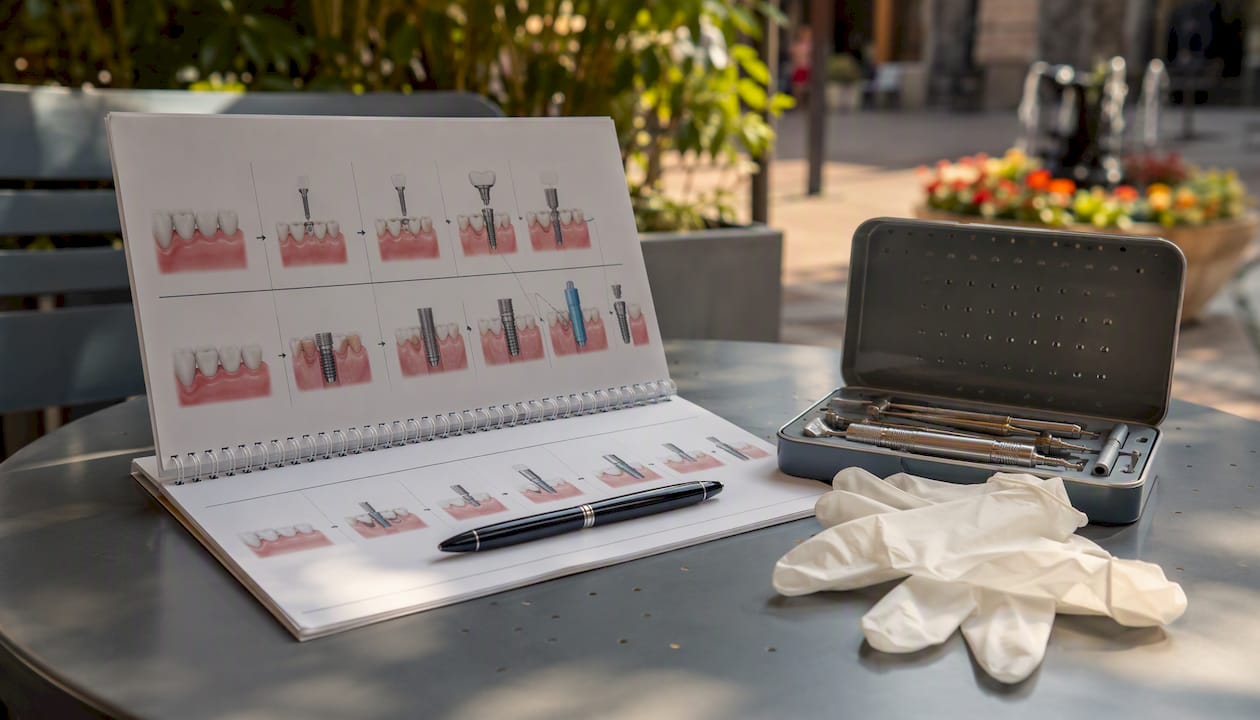
Treatment timeline
- Consultation and 3D imaging (1–2 visits, 2–4 weeks): CBCT scan, treatment planning, and cost estimate.
- Preparatory work (1–3 months if needed): Extractions, bone grafting, and healing time before implant placement.
- Implant placement surgery (1 day): Posts placed under sedation; provisional prosthesis fitted same day in immediate-load cases.
- Osseointegration (3–6 months): Implants fuse with the jawbone. This is the longest phase and cannot be safely shortened.
- Provisional prosthesis phase (1–3 months): Final adjustments to bite, aesthetics, and fit before the permanent prosthesis is fabricated.
- Final prosthesis delivery (1–2 visits): Permanent restoration seated and adjusted.
Total calendar time: 4–9 months for straightforward cases; 12–18 months when significant grafting is required.
Immediate-load protocols (“same-day teeth”) compress steps 3–5 by placing a provisional prosthesis on the day of surgery. They are appropriate for patients with adequate bone density and favorable anatomy. When bone volume is marginal, staged treatment is safer and produces better long-term outcomes. Use Implantveneerguide’s treatment timeline planner to map your specific phases before your first consultation.
What are the long-term costs and risks you should plan for?
Complications that add cost
- Peri-implantitis: Bacterial infection around the implant, analogous to gum disease. Treatment ranges from non-surgical cleaning to bone grafting around the implant. Prevention through regular maintenance is far cheaper than treatment.
- Implant failure: Rare but real, occurring in roughly 5%–10% of cases over 10 years. Replacement requires a new implant post and often additional grafting.
- Prosthesis fracture: Acrylic prostheses can crack, especially in patients with bruxism. Repairs run $500–$2,000; full replacement $3,000–$8,000 per arch.
- Screw loosening: Abutment or prosthetic screws require periodic retorquing, typically included in maintenance plans but billed separately otherwise.
Routine maintenance costs
- Professional cleanings: Implant-specific hygiene visits, typically 2–4 times per year, run $100–$300 per visit.
- Prosthetic relines (overdentures): Every 2–5 years, $300–$800.
- Acrylic prosthesis replacement: Every 5–10 years, $3,000–$8,000 per arch.
- Zirconia prosthesis: More durable, with a realistic lifespan of 15–20+ years, but replacement costs $6,000–$15,000 per arch when needed.
The lowest quote is not always the best value. A $15,000 per-arch quote that excludes a maintenance plan, uses a lower-grade acrylic prosthesis, and carries no warranty can cost more over 10 years than a $22,000 quote that includes a 5-year warranty, zirconia-grade materials, and annual maintenance visits. Get the full picture before you decide.
Ask for the warranty terms in writing. Specifically: what is covered (prosthesis fracture, implant failure, screw replacement), for how long, and what voids the warranty (missed maintenance visits, tobacco use, trauma). Document the lab partner’s name and the material grade of your prosthesis in your treatment contract.
Are full mouth implants worth the cost compared to dentures?
For most patients who are good candidates, the answer over a 15–20 year window is yes, but the math depends on your starting point.
Pros of full-arch implants:
- Fixed, non-removable teeth that function like natural dentition
- Bone preservation (implants stimulate the jaw; dentures do not)
- No adhesives, no nightly removal, no dietary restrictions
- Higher patient-reported quality of life and confidence
Cons:
- High upfront cost ($30,000–$70,000+)
- Surgical risk and recovery time
- Complex repair if something fails
- Not suitable for everyone without preparatory work
A conventional full denture costs $1,500–$5,000 per arch upfront but requires relining every 2–5 years ($300–$800), replacement every 7–10 years ($1,500–$5,000), and does not prevent bone resorption. Over 20 years, the cumulative cost of dentures plus the bone loss they allow can approach or exceed the cost of implants, especially when you factor in the quality-of-life difference.
The clearest cases for implants: patients under 65 with good general health, adequate bone or willingness to graft, and a long planning horizon. Patients who want fixed teeth, eat a varied diet, or have struggled with conventional dentures typically report the highest satisfaction. For a personalized cost-of-ownership comparison, Implantveneerguide’s cost estimator lets you model your specific arch, grafting needs, and material choice against a 10-year maintenance projection.
How to compare quotes and avoid common traps
Getting three quotes is standard advice. Getting three comparable quotes takes a checklist.
What every quote must itemize
- Consultation and treatment planning fee
- CBCT 3D imaging
- Extractions (per tooth)
- Bone grafting (per site, with graft type specified)
- Implant posts (brand, number, and implant system)
- Abutments
- Provisional prosthesis
- Final prosthesis (material grade specified: acrylic hybrid, zirconia, or other)
- Lab fees (in-house vs. outsourced; lab name if possible)
- Sedation/anesthesia
- Follow-up visits and adjustments
- Warranty terms and what voids them
Questions to ask at every consultation
- Who places the implants: the dentist you are meeting, an oral surgeon, or a periodontist?
- Who fabricates the prosthesis, and can you see the lab’s work?
- What is the failure protocol if an implant does not integrate?
- What follow-up is included in the quoted price, and for how long?
- Can you see before-and-after cases for patients with similar bone volume and arch needs?
To evaluate your provider beyond the quote, Implantveneerguide’s provider checklist covers credentials, lab partnerships, and red flags to watch for.
Pro Tip: Splitting treatment across two calendar years, one arch per year, lets you apply your dental insurance maximum twice. On a plan with a $2,000 annual maximum, that is $4,000 in coverage instead of $2,000 on a single-year treatment. Many practices will accommodate this scheduling specifically for insurance purposes.
On material specs: “zirconia” is a marketing term that covers a range of grades. Ask for the specific zirconia type (monolithic vs. layered, and the brand/grade) and whether the lab provides a material certificate. “Zirconia-like” or “zirconia-reinforced” acrylic is not the same product and will not last as long.
Key Takeaways
Full mouth dental implants cost $30,000–$70,000+ for both arches in the U.S., and the difference between a low and high quote almost always comes down to what is included, not what is performed.
| Point | Details |
|---|---|
| U.S. price range | Both arches run $30,000–$70,000+; a single arch ranges from $8,000 (overdenture) to $45,000+ (fixed bridge), with fixed full-arch options like All-on-4 or All-on-6 typically starting at $15,000 per arch. |
| Top three cost drivers | Treatment type (All-on-4 vs. overdenture), grafting needs ($500–$3,000 per site), and prosthetic material (acrylic vs. zirconia). |
| Financing best practice | HSA/FSA saves 25%–37% in effective cost; avoid deferred-interest plans unless you can pay in full before the promo period ends. |
| Compare quotes properly | Require itemized quotes covering 12 line items; ask who places implants, who fabricates the prosthesis, and what the warranty covers. |
| Implantveneerguide tools | Use the cost estimator and candidacy quiz to model your case before your first consultation. |
The case for slowing down before you sign
Most patients who regret their implant experience share one thing: they moved fast. They saw an ad for $399/month, booked a consultation the same week, and signed a treatment plan before they understood what was and was not in the quote.
The price range for full-arch implants is genuinely wide, and that width is not a sign that the market is broken. It reflects real clinical differences: the surgeon’s training, the lab’s quality, the materials used, and whether the practice will still be managing your case in year five when a screw needs retorquing. A $15,000 per-arch quote and a $28,000 per-arch quote can both be honest. The question is what each one actually delivers over a decade.
What I find most useful in Implantveneerguide’s approach is the emphasis on documentation before commitment: get the itemized quote, confirm the lab partner, verify the material grade, and read the warranty terms before you schedule surgery. The evidence library and candidacy tools exist precisely to give patients the vocabulary to ask those questions without feeling like they are challenging their dentist. You are not challenging anyone. You are making a $40,000–$70,000 decision, and you deserve a written answer to every line item.
Plan your full-arch treatment with Implantveneerguide
Implantveneerguide gives you the tools to walk into any consultation prepared. The Dental Implant & Veneer Cost Estimator generates a U.S. price range based on your arch, grafting needs, and prosthetic material preference, so you have a realistic benchmark before any practice quotes you a number. The candidacy quiz screens your oral health baseline, bone volume indicators, and medical history against standard clinical criteria, giving you a clear sense of whether you are likely to need preparatory work and how that affects your timeline and budget.
Both tools are free, evidence-based, and built without any affiliation to specific clinics or implant brands. Take the candidacy quiz first, then run the estimator, and bring both outputs to your consultation as a starting point for the itemized quote conversation.
Useful sources
The figures and clinical guidance in this article draw from the following resources. Consult a licensed prosthodontist or oral surgeon for a personalized estimate.
- American Academy of Implant Dentistry — What Are Dental Implants? — Clinical overview of implant types and candidacy criteria from the leading U.S. implant specialty organization.
- Calcusense Dental Implant Cost Calculator — Aggregated U.S. price ranges for All-on-4, All-on-6, and overdenture solutions.
- DentistDecoded — FSA/HSA Dental Expenses — Explanation of tax-advantaged accounts and effective savings rates for implant care.
- NerdWallet — Best Dental Loans — Comparative APR ranges and term examples for personal and dental-specific loans.
- Mersaldental — Dental Implant Cost in the U.S.: 2025–2026 Guide — Price variability context and clinical reasons for cost differences across U.S. markets.
- Implantveneerguide — Financing Options for Dental Implants — In-depth comparison of in-office plans, CareCredit-style offers, and personal loan scenarios.
- Implantveneerguide — Medical Tourism for Dental Implants — Risk/benefit framework for seeking treatment abroad, including true-cost calculations.
A note on these figures: Dental implant pricing changes as materials, lab technology, and practice costs evolve. Every number in this article reflects ranges reported across U.S. clinics and published guides; your actual quote will depend on your specific anatomy, location, and treatment plan. Always request an itemized written estimate and verify it with a licensed dental professional before committing to treatment.